Sunday, June 30, 2024

David Housewright

A past President of the Private Eye Writers of America, David Housewright won a prestigious Edgar Award from the Mystery Writers of America and three Minnesota Book Awards for his Rushmore McKenzie and Holland Taylor private eye novels as well as other tales of murder and mayhem in the Midwest.

His new novel is Man in the Water: A McKenzie Novel.

Recently I asked Housewright about what he was reading. His reply:
I tend not to read other writers’ books while I’m working on my own. Fortunately, I finished my next book about six weeks ago and sent it off to my publisher. I’ve been binging ever since. Two books stand out.

The first is Small Mercies by Dennis Lehane. I’ve always maintained that the best crime novels are always about more than the crime and whodunit; are always about more than who killed Mr. Body in the library with a candlestick (It was Miss Scarlet, by the way. It’s always Miss Scarlet). This book deals with race hatred, family, the criminality of power, personal salvation and so much more. It is thought-provoking as well as dark and suspenseful. A terrific book!

The second is Once in a Blue Moon Lodge by Lorna Landvik. Landvik might have the most authentic Minnesota voice of all the very many great writers from my home state. It is most decidedly not a crime novel, in case you’re wondering, and deals with love – love between parents and their children, between husbands and wives, between lovers, between people who are unrelated but considered family. It is also thought-provoking as well as warm and funny.

I recommend that read them back-to-back like I did.
Learn more about the book and author at David Housewright's website and Facebook page.

My Book, The Movie: The Last Kind Word.

The Page 69 Test: The Last Kind Word.

The Page 69 Test: Stealing the Countess.

The Page 69 Test: What the Dead Leave Behind.

The Page 69 Test: First, Kill the Lawyers.

The Page 69 Test: In a Hard Wind.

Q&A with David Housewright.

--Marshal Zeringue

Saturday, June 22, 2024

Yoon Ha Lee

A Korean-American sf/f writer who received a B.A. in math from Cornell University and an M.A. in math education from Stanford University, Yoon Ha Lee finds it a source of continual delight that math can be mined for story ideas. Lee’s novel Ninefox Gambit won the Locus Award for best first novel, and was a finalist for the Hugo, Nebula, and Clarke awards; its sequels, Raven Stratagem and Revenant Gun, were also Hugo finalists. His middle grade space opera Dragon Pearl won the Mythopoeic Award for Children’s Literature and the Locus Award for best YA novel, and was a New York Times bestseller. Lee’s short fiction has appeared in publications such as Tor.com, Clarkesworld Magazine, and Audubon Magazine, as well as several year’s best anthologies.

Lee’s hobbies include composing music, art, and destroying the reader. He lives in Louisiana with his husband and an extremely lazy catten.

Lee's new novel is Moonstorm.

Recently I asked the author about what he was reading. His reply:
The last book I read was an ARC of James S. A. Corey’s The Mercy of Gods. I knew I was going to like this, as I enjoyed The Expanse, but I did not expect to be snarling carnivorously at everyone who came in between me and my reading experience! Besides, my catten is better at carnivorous snarling anyway. (Kidding. She is a giant round marshmallow.)

I’m betraying my age, but The Mercy of Gods is like the best parts of William Sleator’s supremely creepy psychology experiment children’s horror novel House of Stairs if you mashed it up with the far-flung alien empires in C. J. Cherryh books like Hunter of Worlds and The Faded Sun, and added heavy doses of microbiology, ineffable mystery, and body horror. We start with a planet settled by humans, but to which humans are not native; the humans themselves have no idea how they got there. On the eve of a triumph in microbiology research, that world becomes the latest conquest by aliens who rate other species as (a) useful (b) extinct.

This book absolutely grabbed me because the authors take the opening gambit of telling us, from the viewpoint of an alien, that the humans win in their rebellion. We already know the outcome. So the question then becomes not “Will the humans win?” but “How will they win, and will the price be worth it?” I see possible glimpses of the former, and am terrified already of the latter.

Beyond that, I am ride or die already for the two lead characters: Dafyd, who looks like a useless nepotism hire bench monkey except he’s a genius at interpersonal/soft skills except when it comes to his own love life; and Jessyn, a scientist whose struggles with anxiety and depression in some ways make her the best prepared to deal with hostile aliens.

In any case, I have already penciled “MOAR CARNIVOROUS SNARLING” into my planner for whenever the next book drops!
Visit Yoon Ha Lee's website.

The Page 69 Test: Revenant Gun.

My Book, The Movie: Ninefox Gambit.

Q&A with Yoon Ha Lee.

The Page 69 Test: Fox Snare.

My Book, The Movie: Moonstorm.

The Page 69 Test: Moonstorm.

--Marshal Zeringue

Wednesday, June 19, 2024

D.W. Buffa

D.W. Buffa's newest novel to be released (July 2024) is Evangeline, a courtroom drama about the murder trial of captain who is one of the few to survive the sinking of his ship.

Buffa is also the author of ten legal thrillers involving the defense attorney Joseph Antonelli. He has also published a series that attempts to trace the movement of western thought from ancient Athens, in Helen; the end of the Roman Empire, in Julian's Laughter; the Renaissance, in The Autobiography of Niccolo Machiavelli; and America in the twentieth century, in Neumann's Last Concert.

Here is Buffa's take on Hermann Hesse's Demian:
Thomas Mann and Hermann Hesse both won the Nobel Prize for Literature. Both were born in Germany, and both became citizens of other countries. There was something else these two remarkable writers had in common: their greatest works would not have been possible had Friedrich Nietzsche never lived.

In the introduction to Hesse’s novel, Demian, Thomas Mann wrote:

The electrifying influence exercised on a whole generation just after the First World War by Demian…is unforgettable.” Unforgettable because, “With uncanny accuracy this poetic work struck the nerve of the times and called forth a grateful rapture from a whole youthful generation who believed that an interpretation of their innermost life had risen from their own midst - whereas it was a man already forty-two years old who gave them what they sought.”

Hesse had written Demian over a few months in l917, the third year of the war. It was published just after the war, in l919, the same year he wrote an essay entitled “Zarathustra’s Return” in which he acknowledged “his enormous debt to and reverence for” Nietzsche. The debt could not have been greater. In Steppenwolf, Hesse’s most famous novel, Harry Haller turns his back on what the l9th Century has produced - the bourgeois, Nietzsche’s “last man,” - with as much disgust as Flaubert expressed in Madame Bovary. Through the French Revolution and the forces of industrialization, the world had been turned upside down. Money, comfort, work - everything looked down upon by the aristocracy - was now looked up to as man’s greatest achievements. The noble sense of a scale of rank and values had been replaced by the demand for equality and the right of everyone to their own, uninstructed, opinion. The sense of reverence for the customary, the established way - the morning prayer, as Nietzsche had put it - had been replaced by the morning paper - the daily report of whatever was new. Everyone had become an actor, showing others what they thought others wanted to see, and then, believing what others thought about them, thought that was who they were.

The bourgeois, according to Steppenwolf, which is the name Harry Haller has given himself, is incapable of giving himself entirely either to God or to the flesh. The “absolute is his abhorrence.” He will never follow one path or the other; he always seeks the safety of a middle ground. “He may be ready to serve God, but not by giving up the fleshpots.” The bourgeois is the very definition of mediocre: “a creature of weak impulses, anxious, fearful of giving himself away and easy to rule. Therefore, he has established majority for power, law for force, and the polling booth for responsibility.”

The choice of the name Steppenwolf is not accidental. Haller has both a “tamed or sublimated nature” and the raw nature of a wolf, a savage creature for whom cruelty has no meaning. But, as Nietzsche taught, the self is not divided between these two natures, a rational and an irrational part as the ancients understood it, but a “hundred or a thousand selves.” In a not completely veiled allusion to what happened to Nietzsche, the madness that put him in an asylum, Steppenwolf writes that if someone of “unusual powers and unusually delicate perceptions sees that the ‘self is made up of a bundle of selves’” the majority “puts them under lock and key, calls science to aid, establishes schizophrenia and protects humanity from the necessity of hearing the cry of truth from the lips of these unfortunate persons.”

Steppenwolf is not a novel in the usual sense. It does not attempt to trace the development of the various characters of a story through their relationships; it is a report of what Steppenwolf has written down, his reflections on the disordered times in which he has the misfortune to live. Reading Steppenwolf is like reading what an intelligent student might write about what he had learned from a teacher who had himself studied under the one of the most remarkable minds of the last two hundred years; it is like reading what someone with an unusual gift for literature might write about what he had learned from reading Friedrich Nietzsche.

Harry Haller - Steppenwolf - suffers from the loneliness of his knowledge, his understanding of the fatal deficiencies of what Europe has become: a “cemetery where Jesus Christ and Socrates, Mozart and Haydn, Dante and Goethe were but the indecipherable names on mouldering stones…,” a civilization where the bourgeois are prevented by the very machinery that controls their time measured existence from “recognizing the stupidity and shallowness, the hopeless tragedy and waste of the lives they lead.” This includes especially the scholar who “believes in the value of more knowledge and its acquisition, because he believes in progress and evolution.” Haller, the Steppenwolf, can see the future: the next war “will be a good deal more terrible than the last.”

Like Steppenwolf, Demian is a very short novel, barely a hundred fifty pages, but every page holds your attention. This, in part, is because you know in advance, as it were, the effect it had, that “electrifying influence” Thomas Mann writes about in his introduction. Everyone knows that Nietzsche, though he despised both German anti-semitism and German nationalism, had something to do with fascism as it took form in Europe. But for every person who read Nietzsche, hundreds, and more likely, thousands, read Hermann Hesse. Demian had an effect that no other novel had on young Europeans since Goethe’s The Sorrows of Young Werther, nearly a hundred years earlier. Werther led more than one young man to commit suicide out of his own feelings of love lost despair; Demian helped lead an entire generation to the Third Reich and the suicide of Europe.

The story of Demian is told by his young friend, Sinclair, who was drawn to him when Demian, new to the school Sinclair attends, gives him his own interpretation of the Biblical story of Cain and Abel. When Cain kills his brother, he is “awarded a special decoration for his cowardice, a mark that protects him and puts the fear of God into all the others, that’s quite odd, isn’t it?” What really happened, Demian explains, is that “a strong man killed a weaker one and all the weak became afraid of him. Cowards, afraid to fight, they say that God has put a mark on him and that this is the reason - not their cowardice - that they don’t do anything about it.”

The distinction between the strong and the weak, and the way the weak conceal their weakness and weaken the strong, are the central elements of the story, the explanation of everything that is wrong in Europe and the prescription of what needs to be done to make things right again. Everywhere, Demian insists, you see the “reign of the herd instinct, nowhere freedom and love.” It is what the 19th Century has done. “For a hundred years or more Europe has done nothing but study and build factories! They know exactly how many ounces of powder it takes to kill a man but they don’t know how to pray to God, they don’t even know how to be happy for a single contented hour.”

The herd instinct can be overcome, or, rather, there are some, always a few, who are different from the herd. “Those who are too lazy and comfortable to think for themselves and be their own judges obey the laws. Others sense their own laws within them; things are forbidden to them that every honorable man would do any day in the year and other things are allowed to them that are generally despised.” It is the struggle, the life and death struggle, that the individual has with himself. At one point, Demian insists that the only reality is the one that is contained within ourselves, and this is the reason why each man has one vocation - to find the way to himself, to discover his own destiny and “live it out wholly and resolutely within himself.”

Finding the way to our true self is not easy. “Every god and devil that ever existed…are within us, exist as latent possibilities, as wishes, as alternatives.” How to choose, how to know what is better, what is worse; how to decide this, or anything, if you are, like Sinclair, an unusual boy of eighteen who frequently considered himself a genius, and just as frequently, crazy? When he enrolls in the university, he lives in an old house near the town hall. On his table are a few volumes of Nietzsche, volumes with which he becomes intimately familiar: “I lived with him, sensed the loneliness of his soul, perceived the fate that had propelled him on inexorably; I suffered with him, and rejoiced that there had been one man who had followed his destiny so relentlessly.”

Believing in what Nietzsche had written, he believes Demian is right that, “The world, as it is now, wants to perish - and it will.” And when it does, the will of humanity, what Nature wants for man, what is written in the individual, as “it stood written in Nietzsche,” will “come to the fore again.” There is only one task for Demian and Sinclair and others like them: to represent an “island in the world,” to wear again the sign of Cain, to be “considered ‘odd’ by the world; yes, even crazy, and dangerous.” Humanity, for those who bind themselves and their opinion closer to the herd, is something complete that must be maintained, but for those who wear the sign humanity is a distant goal. And then, repeating Nietzsche’s prophecy that the Twentieth Century would be more warlike than any other time in human history, Demian says of the war he sees coming: “People will love it. Even now they can hardly wait for the killing to begin - their lives are that dull!” This is only the beginning. The new world has begun, and it will be “terrible for those clinging to the old.”

And, like nearly every prophecy Nietzsche made, the prophecy came true. The war came, and it was even more terrible than he, or Hermann Hesse, could have imagined. Leo Strauss, who lived through it, once remarked that those were fortunate who preferred the novels of Jane Austen to those of Thomas Mann. He could have said the same thing about the novels of Hermann Hesse.
Visit D.W. Buffa's website.

Third reading: The Great Gatsby

Third reading: Brave New World.

Third reading: Lord Jim.

Third reading: Death in the Afternoon.

Third Reading: Parade's End.

Third Reading: The Idiot.

Third Reading: The Decline and Fall of the Roman Empire.

Third Reading: The Scarlet Letter.

Third Reading: Justine.

Third Reading: Patriotic Gore.

Third reading: Anna Karenina.

Third reading: The Charterhouse of Parma.

Third Reading: Emile.

Third Reading: War and Peace.

Third Reading: The Sorrows of Young Werther.

Third Reading: Bread and Wine.

Third Reading: “The Crisis of the Mind” and A Man Without Qualities.

Third reading: Eugene Onegin.

Third Reading: The Collected Works of Thomas Babington Macaulay.

Third Reading: The Europeans.

Third Reading: The House of Mirth and The Writing of Fiction.

Third Reading: Doctor Faustus.

Third Reading: the reading list of John F. Kennedy.

Third Reading: Jorge Luis Borges.

Third Reading: History of the Peloponnesian War.

Third Reading: Mansfield Park.

Third Reading: To Each His Own.

Third Reading: A Passage To India.

Third Reading: Seven Pillars of Wisdom.

Third Reading: The Letters of T.E. Lawrence.

Third Reading: All The King’s Men.

Third Reading: The Roman History of Ammianus Marcellinus.

Third Reading: Naguib Mahfouz’s novels of ancient Egypt.

Third Reading: Main Street.

Third Reading: Theodore H. White's The Making of the President series, part I.

Third Reading: Theodore H. White's The Making of the President series, part II.

Third Reading: Thus Spoke Zarathustra.

Third Reading: Fiction's Failure.

--Marshal Zeringue

Wednesday, June 12, 2024

Kimberly S. Belle

Kimberly Belle's new novel, The Paris Widow, “continues the author’s winning streak” according to Publishers Weekly. Her previous novels include The Marriage Lie, a Goodreads Choice Awards semifinalist for Best Mystery & Thriller, and the co-authored #1 Audible Original, Young Rich Widows. Belle’s novels have been optioned for film and television and selected by LibraryReads and Amazon & Apple Books Editors as Best Books of the Month, and the International Thriller Writers as nominee for best book of the year. She divides her time between Atlanta and Amsterdam.

Recently I asked Belle about what she was reading. Her reply:
Gothictown, a 2025 release by Emily Carpenter, a story about a family who moves to Juliana, Georgia to start over after the pandemic and gets way (way!!) more than they bargained for. I’m a huge Carpenter fan, so when she offered me an early read, I happily accepted and am gobbling the story up. It’s creepy in the best possible way.

I’m also just starting Ruth Ware’s One Perfect Couple. Ruth is one of those authors I don’t care what the book is about; I just know I want to read it. She’s also an upcoming guest of the Killer Author Club, a bi-weekly author interview series I host along with fellow authors Heather Gudenkauf and Kaira Rouda (for schedule, see killerauthorclub.com). I’ll definitely be fangirling!
Visit Kimberly Belle's website.

The Page 69 Test: Dear Wife.

Q&A with Kimberly Belle.

The Page 69 Test: My Darling Husband.

The Page 69 Test: The Paris Widow.

--Marshal Zeringue

Thursday, May 30, 2024

Eva Gates

Eva Gates, also known as Vicki Delany, is one of Canada’s most prolific and varied crime writers and a national bestseller in the U.S. She has written more than forty-five books: clever cozies to Gothic thrillers to gritty police procedurals, to historical fiction and novellas for adult literacy. She is currently writing four cozy mystery series: the Catskill Summer Resort mysteries for Penguin Random House, the Tea by the Sea mysteries for Kensington, the Sherlock Holmes Bookshop series for Crooked Lane Books, and the Lighthouse Library series (as Eva Gates) for Crooked Lane.

Delany is a past president of the Crime Writers of Canada and co-founder and organizer of the Women Killing It Crime Writing Festival. Her work has been nominated for the Derringer, the Bony Blithe, the Ontario Library Association Golden Oak, and the Arthur Ellis Awards. Delany is the recipient of the 2019 Derrick Murdoch Award for contributions to Canadian crime writing. She lives in Prince Edward County, Ontario.

The latest Eva Gates Lighthouse Library mystery is The Stranger in the Library.

Recently I asked Delany about what she was reading. Her reply:
Summer is my best reading time. Nothing I love more than sitting in the sun by the pool with a good book. But, before the Great Canadian Summer gets into full swing, here’s what I’ve been reading lately.

The Hunter by Tana French. Easily one of the best books I’ve read in a long time. French is Irish and the book (follow up to The Seeker) is set in a small, rural patch of Irish countryside where the people are not exactly accepting of strangers, and definitely into following everyone else’s business. The plot is interesting, the atmosphere perfect, the characters well drawn and fascinating, but the best part, to me, is French’s skillful use of the Irish accent and idioms that cleverly give the English speaking reader a taste of the dialect without making it something you have to parse through to understand. When local words are used, they’re well placed in context so you understand without having to look them up. Highly, highly recommended.

The Lantern’s Dance by Laurie R. King. I’ve been reading this series about Mary Russell and her mentor/husband Sherlock Holmes since the publication of The Beekeeper’s Apprentice thirty years ago. The series sagged a bit in the middle, but I kept on reading because I love the characters so, and I’m glad I did as this latest is as good as ever. In particular, I love the Russell character, every bit Holmes’s equal in every way. The Russell and Holmes books have a prominent place in my own virtual bookstore, The Sherlock Holmes Bookshop and Emporium which I write under my own name of Vicki Delany.

All the Seas of the World by Guy Gavriel Kay. I am not much for reading fantasy (with some exceptions) but for some reason I thought I’d give this one a try. I didn’t even finish. I was interested in the characters and their story but when it got all wound up in the intricate politics of the world, which became nothing more to me than a jumble of made up words and names, I decided not to continue.
Follow Eva Gates on Twitter and Facebook, and visit Vicki Delany's website.

The Page 69 Test: Death By Beach Read.

Writers Read: Eva Gates (June 2022).

The Page 69 Test: Death Knells and Wedding Bells.

Writers Read: Eva Gates (June 2023).

--Marshal Zeringue

Tuesday, May 28, 2024

D.W. Buffa

D.W. Buffa's newest novel to be released (July 2024) is Evangeline, a courtroom drama about the murder trial of captain who is one of the few to survive the sinking of his ship.

Buffa is also the author of ten legal thrillers involving the defense attorney Joseph Antonelli. He has also published a series that attempts to trace the movement of western thought from ancient Athens, in Helen; the end of the Roman Empire, in Julian's Laughter; the Renaissance, in The Autobiography of Niccolo Machiavelli; and America in the twentieth century, in Neumann's Last Concert.

Here is Buffa's take on Fiction's Failure:
In the middle of the last century, before everyone had a kindle, or some other small electronic device to keep them entertained, when millions of commuters rode the bus or the train sometimes more than an hour to work, the introduction of the paperback novel revolutionized the reading habits of Americans. Instead of expensive hardcover books, paperbacks, some of which cost less than a dollar, gave the seat-bound commuter four or five hundred pages of page turning fiction, an escape from the crowd around her and the thought of her dull, tedious, and often thankless job. The books were thick, the covers sometimes lurid, the prose, though nothing like as graphic as it is today, fast-moving and easy to understand. A number of writers made a great deal of money writing books like this, but no one was better at writing what the critics, with some justification, called trash, than Harold Robbins, about whom a better novel could be written than any novel he wrote himself.

Harold Robbins loved booze, loved women, and hated writing, hated it so much he had to be locked in a room before he would even start. It is true that it was not a bad room; it was, quite often, one of the most expensive rooms in one of the most expensive hotels in New York. But Plaza suite or jail cell, confinement, as they say, concentrates the mind. The difference was that what they did to Robbins in a New York hotel, no Georgia county sheriff would ever have been allowed to do. The hotel or, rather, Robbins’ friend and agent, who gave direction to the hotel staff, would not send in food. Not until, each day, Robbins had written the requisite number of typed pages.

Among his other contributions to American fiction, Robbins wrote The Carpetbaggers. Based loosely on the life of Howard Hughes, the book was an enormous best-seller when it came out in paperback. Robbins got richer still when Hollywood made a movie out of it, a movie in which the girl who was about to marry the Howard Hughes character, asked what she would like to see on her honeymoon, replied, “Ceilings.” The audience was properly shocked and could not wait to tell their friends. Like everything Robbins wrote, The Carpetbaggers followed the time tested formula of a powerful, ruthless, and yet somehow vulnerable man involved with two kinds of women: the kind you would like to take home to meet your mother, and the kind you would like to take to the Plaza Hotel, if she had not, at some point earlier in her life, been there, working, on her own.

Working all day, banging out his stories of sex and redemption, becoming more hungry with each page he finished, Robbins would pass under the door what he had done. His friend and agent would check to make sure Robbins had not cheated on his daily quota, and only then allow room service inside. Finally, after weeks of cold sober writing, the novel would be finished, and Robbins and his agent would again have all the money they needed. They did what any serious writer and literary agent would do: they got falling down drunk, and stayed that way, delirious with happiness in an alcoholic haze, a party that lasted as long as there was money to spend and women to help spend it. Then, broke again, Harold Robbins would plod back to his typewriter and his locked room at the Plaza Hotel and punch out another enormously successful novel. Every writer has his routine.

Graham Greene, who wrote much better fiction, including such one-time classics as The Power And The Glory and Our Man In Havana, had a peculiarity of his own. He wrote every morning the same, exact, number of words, five hundred, not one word less, not one word more. And it did not matter where that word was, the first, the last, or in the middle, of a sentence; five hundred words, he was done for the day. What was never quite clear was how long it took to get to that final five hundredth word. Was it two hours, an hour, less than that? Five hundred. The number, not the time, was all that counted. Anthony Trollope, like Greene a British writer, but one who lived and wrote in the twilight of the Victorian Era and whose Palliser Novels continue to be read, measured both words and time, and did it with an astonishing, mechanical, regularity.

Every morning at precisely five-thirty, Trollope would begin to write; every morning at precisely seven-thirty, he would put his pen aside and stack together the sheets of paper on which he had written, without exception, precisely two thousand words; words written in a way that would have brought cheer to the face of an army drill sergeant or a sadistic dance instructor. With his pocket watch open on his desk, Trollope, as meticulously as the perpetually repeated motion of the watch itself, would write every fifteen minutes exactly two hundred fifty words. If you read Trollope’s novels, and they are worth reading, stories that give a better sense of the lives of the British aristocracy than anything else written at the time, you begin to become aware that your eyes are moving with the same mind-numbing efficiency as the author’s hand, one line to the next, one paragraph, one page, one chapter, to the next, like the endless movement of a metronome.

There is an important difference between writers who think in terms of how much they can write, and writers who want to write what deserves to be read. And if it is a difference that has gone missing, all the better to remember great writers and the different way they worked. Flaubert wrote fewer novels, and far fewer pages, than Anthony Trollope, or the other two popular writers mentioned, but what Flaubert wrote will be with us as long as there are still serious readers. No one had to lock up Flaubert to get him to write, he did not count how many words he had written or keep a watch next to him to tell him how long it had taken to write them. He once spent three days in the struggle to find the one perfect word he needed. Another great writer, James Joyce, replying to someone who complained how difficult it was to read Finnegan’s Wake, said with cruel indifference that it had taken him sixteen years to write it and he did not care if it took that long to read it.

Friedrich Nietzsche understood what the emergence of a mass market meant for the future of literature: “When everyone learns to read, no one will know how to write.” This, to the modern, democratic, eye, seems to make no sense at all. What difference does it make if everyone, instead of only a small minority, knows how to read? As it turns out, all the difference in the world. When reading was limited to those who had the time to read and think about what they read, when, instead of a source of entertainment, a thoughtless diversion, a book was expected to say something, and say it in a way that was, in every sense of the word, memorable, an author who could not write well was considered no author at all.

The distinction between the kind of writing required to reach a mass audience and the kind that appealed to an educated reader with the time, and the ability, to reflect on what he read, is itself a pale imitation of a distinction drawn when reading and writing first became available to people who were neither the rulers, nor part of the priesthood, of an ancient city or nation. There was first the fear that writing would weaken, and perhaps eventually destroy, the ability to remember what we hear; the fear that, by writing everything down, the memory of what someone said would be lost. If Homer is raised as an objection, the Iliad and the Odyssey among the few great works that have been read for more than two dozen centuries, it needs to be remembered that Homer was not read in ancient Athens. His two long stories were recited in public by rhapsodes, men who committed Homer’s words to memory.

The other, more serious, objection was that it was dangerous to put in writing what could be used against you by those in power, whether the tyrant, always quick to murder, or the demos, always quick to condemn anyone out of step with the majority. The problem was how to write in a way that would reach those capable of understanding without raising the alarm among those who could make sure you could never write at all. The answer, beginning with Plato, was to write in a way that, appearing to agree with what everyone believed, or claimed to believe, suggested a deeper meaning, a secret teaching somehow hidden in plain sight. The first words of Plato’s Republic - “I went down to the Piraeus’ - would seem, on first impression, nothing more than a brief, straightforward description of where Socrates was going, until, later, you discover, or you remember, that the Piraeus, the port of Athens, was the heart of the Athenian democracy and the place where different ways of life were brought from different parts of the world. And then, remembering that, the careful reader might wonder what it means that Socrates goes down, i.e. looks down, on the Athenian regime.

The need to disguise the meaning of what one writes made writing a form of art. A story, any story, was not interesting unless it was written well. Among those who wrote for a popular audience, no one understood this better than Shakespeare. In Hamlet, he has Ophelia explain, “Now, this overdone, or come tardy-off, though it makes the unskillful laugh, cannot but makes the judicious grieve; the censure of which one must in your allowance overweigh a whole theatre of others.”

The question whether to make the unskillful laugh or the judicious grieve has now, in our time, been answered in a different way. The judicious reader has all but disappeared. There are still some left, but not enough to determine how a larger audience wants to spend its time. The real question, the question that will decide if literature, and therewith civilization, can be saved, is whether, in an age of mass produced entertainment, there will still be writers who believe what, among others, Joseph Conrad and Ford Madox Ford believed, that writing about the human condition is the most serious thing a writer can do. The prospect seems doubtful.
Visit D.W. Buffa's website.

Third reading: The Great Gatsby

Third reading: Brave New World.

Third reading: Lord Jim.

Third reading: Death in the Afternoon.

Third Reading: Parade's End.

Third Reading: The Idiot.

Third Reading: The Decline and Fall of the Roman Empire.

Third Reading: The Scarlet Letter.

Third Reading: Justine.

Third Reading: Patriotic Gore.

Third reading: Anna Karenina.

Third reading: The Charterhouse of Parma.

Third Reading: Emile.

Third Reading: War and Peace.

Third Reading: The Sorrows of Young Werther.

Third Reading: Bread and Wine.

Third Reading: “The Crisis of the Mind” and A Man Without Qualities.

Third reading: Eugene Onegin.

Third Reading: The Collected Works of Thomas Babington Macaulay.

Third Reading: The Europeans.

Third Reading: The House of Mirth and The Writing of Fiction.

Third Reading: Doctor Faustus.

Third Reading: the reading list of John F. Kennedy.

Third Reading: Jorge Luis Borges.

Third Reading: History of the Peloponnesian War.

Third Reading: Mansfield Park.

Third Reading: To Each His Own.

Third Reading: A Passage To India.

Third Reading: Seven Pillars of Wisdom.

Third Reading: The Letters of T.E. Lawrence.

Third Reading: All The King’s Men.

Third Reading: The Roman History of Ammianus Marcellinus.

Third Reading: Naguib Mahfouz’s novels of ancient Egypt.

Third Reading: Main Street.

Third Reading: Theodore H. White's The Making of the President series, part I.

Third Reading: Theodore H. White's The Making of the President series, part II.

Third Reading: Thus Spoke Zarathustra.

--Marshal Zeringue

Tuesday, May 14, 2024

Peter Colt

Peter Colt was born in Boston, MA in 1973 and moved to Nantucket Island shortly thereafter. He is a 1996 graduate of the University of Rhode Island and a 24-year veteran of the Army Reserve with deployments to Kosovo and Iraq. He is a police officer in a New England city and the married father of two boys.

Colt's new Andy Roark mystery is The Judge.

Recently I asked the author about what he was reading. Colt's reply:
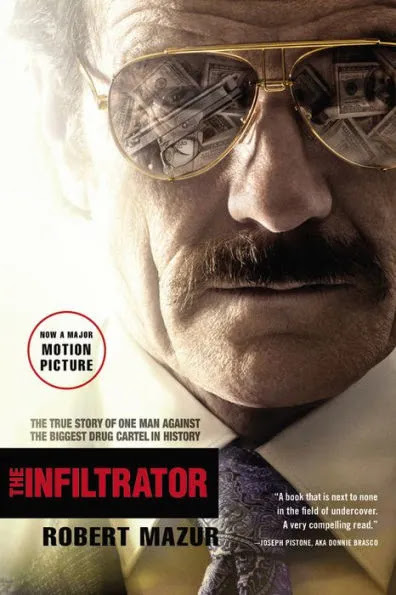
I am currently reading Robert Mazur’s excellent book The Infiltrator: The True Story of One Man Against the Biggest Drug Cartel in History. Mazur’s story is a riveting look inside his complicated and dangerous undercover assignment to infiltrate the Medellin Cartel in the 1980’s. Mazur used his business and family background to pose as money launderer. He simultaneously got close to high-ranking members of the cartel as well as corrupt banking officials at Bank of Credit and Commerce International (BCCI). The book, which I bought for research, reads like a spy novel. It is a must read for anyone interested in the 1980’s drug cartels or daring undercover operations.

I also just finished reading Yesterday’s Spy by Len Deighton, which is a classic, cold war era spy novel. It is Deighton, doing what he does best, weaving a tail of espionage, tradecraft, and betrayal. The two protagonists are bound to each other by their past working with the French resistance and find that their shared past has bearing on their present-day mission. Like all of his books, Yesterday’s Spy is effortlessly entertaining but not as serious (or as good) as the outstanding Bernie Sampson novels.
Visit Peter Colt's website.

My Book, The Movie: Back Bay Blues.

The Page 69 Test: Back Bay Blues.

Q&A with Peter Colt.

The Page 69 Test: Death at Fort Devens.

My Book, The Movie: Death at Fort Devens.

My Book, The Movie: The Ambassador.

The Page 69 Test: The Ambassador.

The Page 69 Test: The Judge.

My Book, The Movie: The Judge.

--Marshal Zeringue

Wednesday, May 8, 2024

Clea Simon

Clea Simon is the Boston Globe-bestselling author of three nonfiction books and thirty-one mysteries, including World Enough and Hold Me Down, both of which were named “Must Reads” by the Massachusetts Center for the Book.

A graduate of Harvard University and former journalist, she has contributed to publications ranging from Salon.com and Harvard Magazine to Yankee and The New York Times.

Simon’s latest mystery is Bad Boy Beat, which kicks off a fast-paced amateur sleuth series starring Em Kelton, a Boston crime reporter with a nose for news.

Recently I asked the author about what she was reading. Simon's reply:
This is such a great topic because, of course, writers are first and foremost readers first. The problem comes when I’m asked to name just one book. Like a lot of us (I suspect), I’ve always got a couple of books going.

I recently finished Caroline Leavitt’s new Days of Wonder and I’ve been dipping into Philippa Gregory’s Normal Women, a massive history of the half of humanity that’s been left out of 800 years of English history.

But the books I keep coming back to these days are Deanna Raybourn’s. I had not thought myself interested in her – too romance-y! Too soft! But after devouring her Killers of A Certain Age, I realized she was one of the smartest writers in any genre! Now that I’ve read through her Veronica Speedwell series, I’m devouring her Lady Julia Grey books. Yes, they are historical mysteries with a heady dash of romance (thanks to the infuriating Nicholas Brisbane), and they’re just wonderful! I’m currently out on the windswept moor with Silent on the Moor and loving it.
Visit Clea Simon's website.

The Page 69 Test: To Conjure a Killer.

The Page 69 Test: Bad Boy Beat.

--Marshal Zeringue

Sunday, May 5, 2024

Nolan Chase

Nolan Chase lives and works in the Pacific Northwest.

A Lonesome Place for Dying is his first book featuring Ethan Brand.

Library Journal's (starred) review said “Chase debuts his lonesome, reflective lawman with this well-written, complex case. Fans of Craig Johnson’s Longmire will enjoy.” Publishers Weekly's (starred) review called A Lonesome Place for Dying a “standout procedural ... Chase throws a lot of balls in the air, and he juggles them like a seasoned pro, managing to carve out a distinctly memorable protagonist in the process.”

Recently I asked Chase about what he was reading. The author's reply:
Post Captain by Patrick O’Brian

The Aubrey-Maturin novels great fun, and O’Brian evokes the period with knowledge, wit, and a violence which is both startling and entirely appropriate to the setting. They’re not easy reads, relying on a knowledge of nautical and medical jargon, Latin and Greek, geography and natural history and classical music. But they’re worth the effort for the camaraderie of the characters and the author’s storytelling prowess.

Sense and Sensibility by Jane Austen

Coming from the mystery genre, Austen’s world can seem small, but she turns that to advantage by creating characters who bump up against that claustrophobia. Money, family, gender roles, politics and fate all play important parts, and the marriages aren’t so much happy endings but peculiar arrangements of fate which the characters have to work for and sometimes adapt themselves to.
Visit Nolan Chase's website.

--Marshal Zeringue

Saturday, April 27, 2024

Seraphina Nova Glass

Seraphina Nova Glass is an Edgar Award-nominated author. Her fifth and latest book is The Vacancy in Room 10.

Named a New York Times Book Review Summer Read and an Amazon Editor’s Pick in Mystery & Thrillers, her last book, On A Quiet Street, earned her #1 bestselling status in the Thriller category on Amazon. It was also hailed by Bustle as one of “10 Must-Read Books” and one of “10 Top Thrillers To Read On Your Summer Vacation” in the Boston Globe.

Publishers Weekly has named her “a writer to watch” and Emmy-nominated producer Michael Terence quoted her writing as “page-turning and cinematic.”

Glass is currently working on her sixth novel, The Oleanders, and is also an Assistant professor and Playwright-In-Residence at the University of Texas, Arlington.

Recently I asked the author about what she was reading. Glass's reply:
I think everyone expects me to answer this question with a thriller title, but I haven’t read a thriller in a long while. My go-to in the past was often literary fiction, but these days I have fallen in love with personal development books like The Power Of Now by Eckhart Tolle and The Seven Spiritual Laws Of Success by Deepak Chopra. These books that have taught me to find the present moment and live in gratitude are the reads I spend my time with as of late and they have been transformative.

I’ve also recently read Malcolm Gladwell, Vishen Lakhiani, Brené Brown, and I’m currently re-reading You Are The Placebo by Joe Dispenza.
Visit Seraphina Nova Glass's website.

Q&A with Seraphina Nova Glass.

My Book, The Movie: The Vacancy in Room 10.

--Marshal Zeringue