Thursday, October 25, 2012

Yona Zeldis McDonough

Yona Zeldis McDonough is the author of the novels A Wedding in Great Neck, Breaking the Bank, In Dahlia's Wake, and The Four Temperaments, as well as nineteen books for children. She is also the editor of two essay collections and is the Fiction Editor at Lilith magazine. Her award-winning short fiction, articles, and essays have been published in anthologies and in numerous national magazines and newspapers. She lives in Brooklyn, NY, with her husband, two children and three very yappy Pomeranians.

A few weeks ago I asked the author what she was reading.  Her reply:
I recently read Heft, by Liz Moore. The protagonist of this wholly original, moving story weighs 500 pounds and has not been out of his house in years. His gradual emergence from his loneliness and seclusion is set against the story of a teen-aged boy who loses his mother—and who may or may not be his son. The characters were so real, so convincing and so deeply human it was impossible not to love them all, and to wish ardently for their happiness.

I also just finished Edith Pearlman’s Binocular Vision and was thrilled to have discovered this previously under-the-radar writer. Her stories are so complex, subtle, illuminating and powerful—yet they are also compulsively readable, the literary equivalent of a box of bons bons.

Finally, I have been dipping into the Collected Works of William Butler Yeats, a volume I bought when I was a freshman in college in the fall of 1974. There are poems I have been reading since that time and I love them every bit as much now as I did when I first encountered them. And reading a poem I have never read before is like discovering a new star or planet—everything glows a little brighter in its presence.
Visit Yona Zeldis McDonough's website.

Read--Coffee with a Canine: Yona Zeldis McDonough & Queenie, Willa and Holden.

The Page 69 Test: A Wedding in Great Neck.

--Marshal Zeringue

Wednesday, October 24, 2012

John Shelton Reed

John Shelton Reed is William Rand Kenan Jr. Professor Emeritus of sociology at the University of North Carolina, Chapel Hill, and a co-founder of the Center for the Study of the American South and the quarterly Southern Cultures. He has written or edited 19 books, most of them about the American South, and was recently Chancellor of the Fellowship of Southern Writers.

His new book is Dixie Bohemia: A French Quarter Circle in the 1920s.

Earlier this month I asked the author what he was reading.  His reply:
On the floor next to my side of the bed stands an enormous, teetering pile of books that I once began reading, or at least intended to read. The top dozen or so are still alive. Further down are books I abandoned some time ago, but haven’t wholly given up on; further down still are some remembered only faintly, if at all. At the very bottom are some that I fear may be turning to compost.

The bedside books still in play are of two kinds: either I’m in the middle of them and intend to complete them, or they’re the kind you can pick up and read just a bit from. Farnsworth’s Classical English Rhetoric by Ward Farnsworth, for instance, is a guide to rhetorical figures illustrated with examples from great writers and speakers, and it’s not necessary to read it from start to finish. You can dip into it almost anywhere. Even if you don’t care about formal rhetoric, the examples make for fine bedtime reading, and I rather hope that I’ll absorb a few lessons from them.

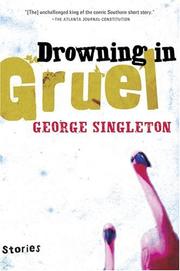
Also fine for reading a bit from now and then is Drowning in Gruel, a collection of 19 bizarre and delightful short stories by George Singleton, set in the imaginary town of Gruel, South Carolina. One of those stories at bedtime will set you up for some vivid dreams. I’ve read a couple of Singleton’s other books, and wish there were more.

The half-dozen books I’m in the middle of reading are a thoroughly mixed lot, which means there’s usually something I’m happy to spend some time with before turning out the light. John Gunstone’s Lift High the Cross, for instance, is a history of the Anglo-Catholic movement in the Church of England in the years after World War I. That sounds a little esoteric, and it is, but I once wrote a book called Glorious Battle about the movement’s origins and its history up to the 1890s, so I’m probably one of the few who are really, really interested in this book.

My wife and I have a daughter who has married a Texan (one of the real ones, a guy who can wear a cowboy hat without looking ridiculous) and we now have a Texas granddaughter, so we spend a good deal of time in the Lone Star state, and – typical professor – I’ve been reading a lot about it. One of the best books I’ve found on the subject is an oldie by the distinguished geographer Donald Meinig: Imperial Texas: An Interpretive Essay in Cultural Geography (1969). I’m in the middle of it right now.

Another distinctive and amusing Southern subregion is dissected by my pal Hardy Jackson (properly Harvey H. Jackson III) in The Rise and Decline of the Redneck Riviera: An Insider’s History of the Florida-Alabama Coast. It’s almost as much fun as the annual Mullet Toss at the Florabama Lounge. Great photographs.

Hardy’s not the only friend whose book I’m reading. Jason Berry is a loving critic of the Roman Catholic church whose reputation largely rests on Lead Us Not into Temptation, a book about clerical sexual abuse, but he has also written well about Louisiana politics and music. In Render unto Rome: The Secret Life of Money in the Catholic Church he looks at his church’s finances in a book that ought to be ranked right up there with Barbarians at the Gates, Liar’s Poker, and similar books about Wall Street.

Another friend, Curtis Wilkie, was the Boston Globe’s Southern reporter for many eventful years before getting out of practicing journalism (just in time) and going off to teach it. Somehow I missed his Dixie: A Personal Odyssey through Events That Shaped the Modern South when it came out in 2001, but I’m finally reading it and it is a corker.

Michael O’Brien, yet another friend, is a Cambridge historian who has written some seriously heavyweight books about the Old South. Mrs. Adams in Winter: A Journey in the Last Days of Napoleon is a departure for him: He looks at a 40-day trip taken by Louisa (Mrs. John Quincy) Adams and her young son from St. Petersburg to Paris in 1815. She is a fascinating woman, and the post-Napoleonic War Europe through which she traveled is not a landscape I knew anything about.

Daniel Woodrell is not a friend, but I wish he were. He’s a remarkable writer, whose novels and short stories I’m gradually consuming. Right now I’ve almost finished Woe to Live On, a novel set in Missouri that was the basis for the best Civil War movie I’ve ever seen, Ang Lee’s strangely neglected Ride with the Devil.

Finally, having just finished a book about New Orleans and having lived in the French Quarter for a good while to write it, I have begun to reread John Kennedy Toole’s A Confederacy of Dunces, perhaps the first great novel ever set in that strange and wonderful city. I loved it when I read it 25 years ago, and it’s even better now that I know the setting first-hand.
Learn more about  Dixie Bohemia at the Louisiana State University Press website and John Shelton Reed's website.

The Page 99 Test: Dixie Bohemia.

--Marshal Zeringue

Tuesday, October 23, 2012

Dan Josefson

Dan Josefson has an MFA from the University of Nevada, Las Vegas and lives in Brooklyn. He has received a Fulbright research grant and a Schaeffer Award from the International Institute of Modern Letters.

His new novel is That’s Not a Feeling.

Recently I asked the author what he was reading. Josefson tagged three books in his reply:
The Hour of the Star by Clarice Lispector

There’s an intensity to this book that is both frightening and fascinating—it tells too much, is too opinionated, and then it lurches back and places everything in a balanced, almost cosmic perspective. I worry a bit whether the narrator and author are being too dismissive, too cruel to the main character. But then I wonder whether this book doesn’t work like Don Quixote or Pnin, where the character is elevated by surviving her unfair treatment at the hands of the author. Either way, this book is unique and, I suspect, unforgettable. I’m enjoying arguing with myself about it almost as much as I’m enjoying reading it.

The People of Forever Are Not Afraid by Shani Boianjiu

This novel tells of a number of female friends serving the Israeli Defense Forces. It functions more or less like a novel in stories, but those stories are so deeply intertwined that each gains immensely from the others. What I’m enjoying most about this book right now is the rhythm of the voices. Not just the syntax, although that’s very cool, but the pace at which information is presented. There’re all sorts of new and unsettling information constantly interrupting, much of it violent: RPGs, knives, guns, fires, and bullets. But there are also lulls, ruminations, obsession repeated and lingered over. There’s something that feels very intimate and honest about this, the way larger questions loom in the background as the characters struggle to get through their days.

The Gospel of Anarchy by Justin Taylor

For a novel in which a set of concepts and ideals is so central, the descriptions of material reality are pretty amazing here. The way the looks of things are described—whether it’s an old falafel sandwich, a face, a shirt found in a closet, or an image on a computer screen— is stunning, and not only to me as a reader; the main character often seems overwhelmed by what he sees as well. How Taylor pulls this off is a bit of a mystery to me, but I suspect that this is how novels of ideas ought to be written: the ideas so inherent in the images that everything described almost glows with meaning, the way on certain overcast days the clouds will hold the light.
Visit Dan Josefson's website.

The Page 69 Test: That's Not a Feeling.

My Book, The Movie: That’s Not a Feeling.

--Marshal Zeringue

Monday, October 22, 2012

Douglas Smith

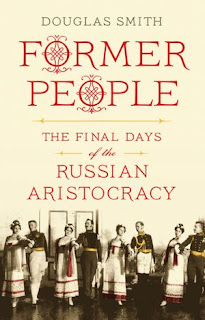
Douglas Smith is an award-winning historian and translator and the author of Former People: The Final Days of the Russian Aristocracy and three previous books on Russia. Before becoming a historian, he worked for the U. S. State Department in the Soviet Union and as a Russian affairs analyst for Radio Free Europe/Radio Liberty in Munich. He lives in Seattle with his wife and two children.

Recently I asked the author what he was reading.  His reply:
If there is one book, or series, that is, I would want everyone to pick up and read it would have to be the Patrick Melrose novels by Edward St. Aubyn. Acerbic, witty, unflinchingly honest and simultaneously heartrending and hilarious, St. Aubyn’s books—Never Mind, Bad News, Some Hope, Mother’s Milk, and At Last, published in the US earlier this year—are without doubt one of the great literary achievements in English of the past decades. St. Aubyn is one of those rare writers who has to be read and then read again and again.
Watch the trailer for Former People, and learn more about the book and author at Douglas Smith's website.

The Page 99 Test: Former People.

--Marshal Zeringue

Sunday, October 21, 2012

Joan Wickersham

Joan Wickersham was born in New York City. Her books include The Suicide Index, a National Book Award finalist. Her fiction has appeared in The Best American Short Stories and The Best American Nonrequired Reading. Her op-ed column appears regularly in The Boston Globe; she has published essays and reviews in the Los Angeles Times and the International Herald Tribune; and she has contributed on-air essays to National Public Radio. She has received fellowships from the National Endowment for the Arts, the MacDowell Colony, and Yaddo.

Her latest book is The News from Spain: Seven Variations on a Love Story.

Recently I asked Wickersham what she was reading. Her reply:
Right now I’m reading a big Hungarian novel: The Book of Fathers, by Miklos Vamos. It’s a family chronicle – it begins around 1700, and each chapter is the story of the firstborn son of that generation – but “family chronicle” is too docile a description for a book that has this particular mixed flavor of character study, folktale, magical realism, humor, and sobering (sometimes terrible) glimpses of what is going on in Hungary during the character’s lifetime.

This book is wonderful. But for me, reading it is also an attempt to satisfy a wistful Hungarian-fiction craving that began after a friend recommended Miklos Banffy’s great Transylvanian trilogy, first published in Hungary in the late 1930s but only recently translated into English. Banffy’s novels – They Were Counted, They Were Found Wanting, They Were Divided – take place in the decade leading up to World War I, in an aristocratic world whose characters go to balls and hunts, engage in doomed love affairs, drink, gamble, gossip, try to improve the lot of the peasants living on their land, and generally fail to read the political handwriting on the wall. I was mesmerized by the delicacy, subtlety, sophistication, and emotional frankness of these novels – could not bear to finish them. Since then I’ve been restlessly searching for more Banffy – a hopeless quest, since he wrote no other fiction, but a fruitful one, too, as it has led me to Vamos, and Dezso Kosztolanyi’s Skylark, and Tibor Dery’s Niki: The Story of a Dog, and the happy realization that there is a whole world of Hungarian novels waiting to be read.
Visit Joan Wickersham's website.

Writers Read: Joan Wickersham (January 2009).

--Marshal Zeringue

Saturday, October 20, 2012

Wendy Welch

Wendy Welch and her husband (Scottish folksinger Jack Beck) own and operate Tales of the Lonesome Pine Used Books in Big Stone Gap, Virginia. An Ethnography PhD, she rescues shelter animals (SPAY and NEUTER, thanks!) and is one of the world’s fastest crocheters. This is a good thing because between her day job teaching college courses on culture and public health, running special events at the shop, writing about stuff, and chasing kittens out of roads, she doesn’t have a lot of spare time.

Welch's new book is The Little Bookstore of Big Stone Gap: A Memoir of Friendship, Community, and the Uncommon Pleasure of a Good Book.

A couple of weeks ago I asked the author what she was reading.  Welch's reply:
I just finished Jael McHenry's The Kitchen Daughter. I enjoyed the sense of character she created, the terse first-person narrator who sees the world a little differently. The stranger elements of the plot (the main character conjures ghosts with her cooking) just added charm to a very human story--of people trying to get over grief, trying to get on with life, trying to get past old hurts. A pleasant story, it had turns, twists and recipes aplenty. I thoroughly enjoyed my time with The Kitchen Daughter.
Visit Wendy Welch's blog.

Read--Coffee with a Canine: Wendy Welch & Zora and Bert.

--Marshal Zeringue

Friday, October 19, 2012

Amy McNamara

Amy McNamara has an MFA in poetry from the Warren Wilson MFA Program for Writers. Lovely, Dark and Deep, her first novel, is now out from Simon & Schuster Books For Young Readers. She lives in Brooklyn, New York.

Early this month I asked McNamara what she was reading.  Her reply:
I'm reading a new chapbook of poems called Meridian by Kathleen Jesme. The poems are about loss—the slow leaving and death of her mother, the loss of her father years before, the inevitable loss of self we all cycle toward just by being alive. The poems are made of musical lyric lines, "one snow fell/down inside/ the other, two flocks/of gulls alighting/on a white beach" and lines written in a more narrative voice reorienting us in the world of objects much the way one experiences the very mode of being the poems describe—marvelous, terrifying, everyday, and beautiful all at once.

I'm also reading an astonishing collection of stories written by Miranda July called No one belongs here more than you. Oh, Miranda July. Everything she does (she's an artist, writer, and filmmaker), she seems to do with her eyes and her heart as wide open as possible. In the story "Ten True Things," she says, "We grew still and stared at each other. It seemed incredibly dangerous to look into each other's eyes, but we were doing it. For how long can you behold another person? Before you have to think of yourself again, like dipping the brush back in for more ink." I love this passage because instead of staying with the somewhat sentimental idea of losing oneself in the gaze of another, she tugs us down solidly within ourselves, an unflinching observation about the nature of being together and the truth of the inescapable self.

I am also reading David Levithan's novel Every You, Every Me, which is, as far as I can tell, really a poem. Like July's and Jesme's the voice in this novel speaks from head-on unapologetic regard for the intensity of feeling. The novel runs two conversations at once, the voice of the narrator/protagonist, Evan, and then his more interior voice which is on the page but with a line striking it out. It is like the project of erasure where one finds one kind of art within another through the means of removal. There's always the ghost of what's been taken away.

I read mysteries like a hurdler. I can't clear them fast enough. It seems to be cyclical for me. I'll read a batch of mysteries, then not think about the genre for a year or two, then suddenly, mysteries again. Tana French's work (Broken Harbor, Faithful Place) is really great because she has an incredible ear for dialogue. I don't read mysteries for the puzzle the way I know some do; I rarely predict whodunit nor do I always even entirely try to track the clues – I read more for the story itself, the pacing, the crowds of characters, and in French's books, the marvelous language they use to speak to each other. Her book Faithful Place was full of Irish slang I had to look up (banjaxed) and then gleefully employed around the house for a week or two, much to the dismay of my family.

Before Broken Harbor I happily dwelled in Kevin Wilson's The Family Fang, a story of two lost adult children of artists (is there a support group for that?) which made me laugh out loud on more than one occasion, and before The Family Fang, it was Helen Oyeyemi's Mr Fox, an incredible tale about the nature of writing a character into being that climbs through time and genre to construct itself, all the while making stunning observations about the nature of love. The last one I finished (in August) but loved, was The Starboard Sea, by Amber Dermont, a totally heartbreaking love story.

I think my current mystery kick is on the wane and Jason Shinder's last book of poems, Stupid Hope, is in the wings, as well as a nonfiction book about sleep (one of my favorite topics) called Dreamland: Adventures in the Strange Science of Sleep.
Visit Amy McNamara's website, Facebook page, and Twitter perch.

--Marshal Zeringue

Thursday, October 18, 2012

Michelle Cooper

Michelle Cooper's novels include The Rage of Sheep and The Montmaray Journals trilogy; the final volume of the trilogy, The FitzOsbornes at War, is now available in the US.

A few weeks ago I asked Cooper what she was reading.  Her reply:
I’ve read some excellent biographies recently. First was Brenda Maddox’s Rosalind Franklin: The Dark Lady of DNA, a fascinating account of a brilliant and determined scientist. Her X-ray crystallography photos were appropriated by James Watson and Francis Crick and used to construct their double helix model of DNA. They were awarded the Nobel Prize for this, but they failed to mention her contribution; meanwhile, she struggled to obtain research grants and access to facilities, at a time when women physicists were banned from working as instructors at Harvard and were not even permitted to set foot inside the physics building at Princeton. However, Rosalind Franklin was far more than “the Sylvia Plath of molecular biology, the woman whose gifts were sacrificed to the greater glory of the male”, and this well-researched biography paints a vivid portrait of a woman devoted to her family and friends, who loved good food and fashion and travel, and who died tragically young.

I also loved A. A. Milne: His Life by Ann Thwaite, about the author who had enormous success with his Winnie-the-Pooh books, then spent the rest of his life resenting being pigeonholed as a children’s writer. I’d had no idea that Alan Milne was also a gifted mathematician who won a scholarship to Cambridge, that he’d fought in the trenches in the First World War (and then, not surprisingly, became an outspoken pacifist) or that he wrote a number of popular plays and a magazine serial. His biographer does an excellent job of showing the contradictions of this intriguing man, who was ‘buttoned-up’ emotionally as a result of his Victorian upbringing, but could also be sensitive and empathetic; who was a romantic and an idealist, but also a hard-headed businessman; who was devoted to his young son Christopher Robin, but became bitterly estranged from Christopher in later life. This is the very best sort of biography – one that makes me want to track down not only Alan and Christopher Milne’s respective memoirs, but also read everything else that Ann Thwaite has written.
Visit Michelle Cooper's website.

Writers Read: Michelle Cooper (May 2011).

--Marshal Zeringue

Wednesday, October 17, 2012

Stephanie Spinner

Stephanie Spinner is the author of many books for young readers, including Damosel, Aliens for Breakfast, Paddywack, and Alex the Parrot: No Ordinary Bird. After a distinguished career in children's book publishing, she is now a full-time writer.

Recently I asked the author what she was reading.  Spinner's reply:
I'm always reading a few books at once--the stacks on my night tables are so high they're embarrassing. Right now I'm in the middle of Jane Gardam's Old Filth, about a retired judge who moves back to England after a long career in Hong Kong, only to find that he's living next door to a deeply loathed former colleague. This is one of those novels that manage to be funny, witty, and sad all at once. Its passages about the hero's childhood in Malaysia (and the British Raj) are rendered with wonderful precision--the author tells us a lot with very few words. By the end of the first page of Old Filth I was making a mental note to read all her other books.

I'm also right at the end of William Golding's The Double Tongue. This is an odd, cerebral novel, and definitely not for readers who want action-packed page-turners. However, its subject, a woman who becomes the oracle at Delphi rather unwillingly, is fascinating to me; I've written two young adult novels based on Greek myth and both include prophecy. Also, I'm happy to read any good writer's work about ancient Greece, however dry, and I truly enjoyed the heroine's acerbic observations about behind-the-scenes Delphi, the place of women in her society, and Greece on the verge of Roman rule.

I'm also enjoying Modern Dahlia Culture by W.H. Waite, written in 1928, a book given me by a friend. A small, short book full of wonderful photos (my favorite is one of the author standing next to a bed of dahlias that tower over him), it's telling me almost as much about dahlias as I want to know.

Finally, I'm working my way through two translations of The Iliad, the Fitzgerald and the Lattimore, because I've been told that each one is the best.
Read more about Alex the Parrot, and visit Stephanie Spinner's Facebook page.

--Marshal Zeringue

Tuesday, October 16, 2012

Amy Garvey

Amy Garvey is a former editor who now works on the other side of the desk as an author. She grew up reading everything she could get her hands on, watching too much TV, and wishing she was Samantha Stephens from Bewitched. (She still wishes that, actually.) She is the author of Cold Kiss. Garvey lives in West Chester, Pennsylvania, with her family.

Her new novel is Glass Heart.

Late last month I asked the author what she was reading.  Garvey's reply:
I just finished Small Damages by Beth Kephart, and it was beautiful. Beth’s writing always is, but for a novel about a teenage girl getting pregnant, it just knocked me out. Her facility with language is incredible, so every line reads more like poetry than prose. It’s set mostly in Spain, and the descriptions are so vivid, I really could picture everything, but she doesn’t stint on emotion. I cried though the last chapter, which is always a mark of a book that got under my skin in the right way.

Right now I’m reading Chris Bohjalian’s The Night Strangers and Gayle Forman’s If I Stay, neither of which are particularly light-hearted, either. (I might need to sneak in something funny or romantic to give myself a break.) I’ve been a fan of Bohjalian’s since Midwives, and this seems like a little bit of a departure for him, but he still draws his characters and their situation with real clarity. Plus, there’s the possibility of ghosts, or at least something not altogether right bumping around in the basement. This time of year, I always itch to read horror.

If I Stay is really thought-provoking—a teenager is the only survivor of a car crash, and as she hovers between life and death she has one momentous decision to make, stay or go. The idea of trying to figure that out at seventeen is mind-blowing to me. I’m loving the way Forman has drawn Mia and her family, too. They feel like people you actually might live next door to.

I’m also reading an old favorite of mine, Jane-Emily by Patricia Clapp, with my daughter. It’s a classic ghost story, and I’ve loved it since I bought my first copy at the school book fair in fourth grade. My daughter is gasping and laughing and frowning in all the right places, too, which makes me really happy.
Visit Amy Garvey's website.

--Marshal Zeringue