Friday, December 7, 2012

Gregory D. Johnsen

Gregory D. Johnsen, a former Fulbright Fellow in Yemen, is a PhD candidate at Princeton University. A frequent guest on NPR, he has contributed essays to the New York Times. His new book is The Last Refuge: Yemen, al-Qaeda, and America's War in Arabia.

Not so long ago I asked the author what he has been reading. Johnsen's reply:
For most of the past four years, as I have been writing The Last Refuge, I’ve read primarily fiction. I’m not really sure why this is, but I’m a big believer in reading what you like and so I just went where my tastes led.

Now that I’m finished with the book I’ve found my tastes running more toward non-fiction, particularly biographies. That change is represented in the books that are currently next to my bed, which are:

The Back Chamber (Donald Hall): Donald Hall is my favorite poet, and fall always puts me in the mood to read him. He reminds me of cold mornings, spiced apple cider, and New England – all things I associate with fall and the creep of winter’s beginnings.

A few weeks ago The New Yorker published an essay that mentioned that The Back Chamber was his final collection of poetry. I hope that’s not true. But if it is he has left us with a great one. The centerpiece and longest piece is “Ric’s Progress,” a biography as poem. Wonderfully spare and full all at once, it is the type of poem that I like to read late at night with a mug of something warm.

The Wisdom Books (Robert Alter): Next to the Psalms, the wisdom books of Job, Proverbs, and Ecclesiastes are my favorite books of the Bible. Browsing in my local bookstore a couple of weeks ago, I came across this translation with notes by Robert Alter. I was hooked immediately, and now I spend a little time most days reading a few chapters aloud to myself.

Every Love Story is a Ghost Story (D.T. Max): I have never read David Foster Wallace’s sprawling novels – Infinite Jest or The Pale King – preferring his non-fiction to his fiction. But this wonderfully readable biography by D.T. Max convinced me that I should do so, and soon. Max pulled off the rare feat of transforming a great article – a profile of Wallace for The New Yorker – into a fantastic book. Like most of my favorite reads, this one sucked me in to its own little universe for a few hundred pages before spitting me back out a little sadder and a bit more uncertain of the life I see around me. I turned the last page with a touch of regret.

I’m Your Man: The Life of Leonard Cohen (Sylvie Simmons): Other than loving “Tower of Song” and “Hallelujah,” I didn’t know much about Leonard Cohen. Several years ago a friend gave me a copy of Beautiful Losers, which I read one weekend in Yemen. I read Simmons' new biography of Cohen on my latest trip to Yemen. Not as well written as Max’s biography of David Foster Wallace, it still manages to bring Cohen and all his many foibles to life.

Sweet Tooth (Ian McEwan): I always get excited when I hear about a new Ian McEwan novel. I loved Atonement and Saturday. His earlier stuff, particularly his short stories, don’t have the same level of enjoyment for me, but knowing how talented he is I still look forward to each new release. I’m also a big fan of spy novels – particularly Alan Furst, and the latest by Charles Cumming was good as was Dan Fesperman’s The Double Game – and so when I heard Sweet Tooth was a spy novel I couldn’t wait to buy it. I found it at a bookstore before the official release date and finished it over Thanksgiving. It started out great and I was hooked, but I hated the end, which seemed, to me, too clever by half. It reminded me of the ending to Amsterdam, which I also disliked – although many others liked the tidiness of that ending.

Midnight’s Children (Salman Rushdie): On the way home from Thanksgiving I picked up a copy of Midnight’s Children. I’m a big fan of Salman Rushdie, particularly some of his early novels. Shame is my favorite, and still the best book I’ve read on Pakistan. I’m not terribly far into this one, but like the best Rushdie it has already captured me with its playful language and wonderful description of one character’s nose.
Read more about The Last Refuge at the W.W. Norton website.

--Marshal Zeringue

Thursday, December 6, 2012

Pallavi Aiyar

Award winning journalist and author Pallavi Aiyar spent six years living in a hutong home in the heart of the old imperial city of Beijing. She reported from across China for the Hindu and Indian Express in addition to teaching English at the Beijing Broadcasting Institute. She is the winner of the 2007 Prem Bhatia Memorial Award for excellence in political reporting and analysis for her dispatches from China. Her book Smoke and Mirrors: An Experience of China won the Vodafone-Crossword Popular Book Award for 2008. Aiyar's first novel, Chinese Whiskers, was published by Harper Collins India to excellent reviews, and is now available from St. Martin's Press in the US. She currently lives in Brussels with her husband, son and two Chinese cats, where she writes about Europe for the Business Standard. She has degrees in Philosophy, History and Media Sociology from St. Stephens College Delhi University, Oxford and the London School of Economics.

Late last month I asked the author what she was reading. Aiyar's reply:
I’ve just finished reading the most mesmerizing book called the Sly Company of People Who Care, by a cricket journalist, Rahul Bhattacharya. It's set in Guyana, a country I knew absolutely nothing about, and it's made me want to pack a bag and get the first ticket out there I can. The lilting, sassy, seductive, creolese used throughout the book was a particular draw for me.

I’ve also recently devoured (in a day) Amy Chua’s Battle Hymn of the Tiger Mother, possibly making me the last mother on the planet to have read it. It’s made me ponder some tough parenting questions as I battle with my own 4 year old trying to figure out just where to set the boundaries.

On my list to read is Indian literary critic Nilanjana Roy’s debut novel, The Wildings. It’s about cats and it's set in the neighborhood in Delhi I grew up in, so I’m pretty sure I’ll enjoy it.
Visit Pallavi Aiyar's website.

--Marshal Zeringue
Wednesday, December 5, 2012

Eileen Cook

Eileen Cook spent most of her teen years wishing she were someone else or somewhere else, which is great training for a writer. She is the author of The Almost Truth, Unraveling Isobel, The Education of Hailey Kendrick, Getting Revenge on Lauren Wood, and What Would Emma Do? as well as the Fourth Grade Fairy series. Her latest book is The Almost Truth.

Recently I asked Cook about what she was reading.  Her reply:
One thing you can count on is that you'll always find me reading something. I get anxious when I don't have a stack of books waiting to be read. I just finished re-reading John Green's The Fault in Our Stars. It was one of my favorite books of this past year. I wanted to re-read it with a writer's eye, versus when I read it the first time and cried all the way through.

I am currently reading Justin Cronin's The Twelve. This is a vampire, post apocalypse type book. I am obsessed with the TV show The Walking Dead so the next best thing to reading about zombies, is reading about vampires.

My next book to-be-read is The FitzOsbornes at War by Michelle Cooper. This is the third in a series. I've loved every book so I've been saving this one to be read over the Christmas holidays. If you like Downton Abbey you'll love this book and series.
Learn more about the author and her books at Eileen Cook’s website and blog.

My Book, The Movie: Getting Revenge on Lauren Wood.

My Book, The Movie: The Education of Hailey Kendrick.

--Marshal Zeringue

Monday, December 3, 2012

Philip Sington

Philip Sington is the author of The Einstein Girl and Zoia’s Gold. His latest novel is The Valley of Unknowing.

Last month I asked the author what he was reading. Sington's reply:
With two small children working an effective pincer movement on my free time, the reading I do at the moment is almost all of relevance to what I’m writing or plan to write. Right now that means books about the First World War. Navigating through the vast wealth of literature on this subject has been a study in itself, but two books in particular have stood out so far.

Among fictionalised accounts, Frederic Manning’s The Middle Parts of Fortune (1929) is almost unique in recording faithfully the ordinary private soldier’s experience at the front, and often in his own (distinctly foul) language. Ernest Hemingway called it ‘the finest and noblest book of men in war that I have ever read’, and yet for most of the last century it languished in obscurity. This was thanks firstly to its emasculation at the hands of editors alarmed at the obscenities – for which, in those days, they could be prosecuted. An unexpurgated version of the book did not become available to the public until 1977, forty-two years after Manning’s death. The other reason for its absence from the canon of First World War fiction was its author’s aversion to self-promotion. Editions published in his lifetime appeared not under his own name, but as the work of ‘Private 19022’.

Beyond its sheer authenticity, The Middle Parts of Fortune sheds a piercing light on the human response to the horrors and the demands of war: to the ever present possibility of death, the loss of comrades and friends, and the requirement to kill, often at close quarters. Like Remarque’s All Quiet on the Western Front, it’s one of those books you’ll be glad you read, even if you never really wanted to.

The other book that’s impressed me hugely is The Unknown Soldier (published in the US as Unknown Soldiers) by Neil Hanson (2005). It tells the story of the millions of men who were classified as ‘missing’ on the Western Front, and who to this day have no known grave. What make’s Hanson’s history so compelling is his decision to follow three individuals (a British ‘Tommy’, a German army officer and an American airman) right through their military careers, right up until the day they too are missing in action. Through their letters and those of their loved ones, we get to know these men and to care about them. This makes their disappearance in the carnage of war almost as appalling for the reader as it must have been for the people who knew them. Among recent histories, The Unknown Soldier brings home the stupidity and waste of war with special force.
Visit Philip Sington's website.

--Marshal Zeringue

Saturday, December 1, 2012

Joy Fielding

Joy Fielding is the New York Times bestselling author of Now You See Her, The Wild Zone, Still Life, Charley’s Web, Heartstopper, Mad River Road, Puppet, Lost, Whispers and Lies, Grand Avenue, The First Time, See Jane Run, and other acclaimed novels.

Fielding's new novel is Shadow Creek.

Last month I asked the author what she was reading.  Her reply:
I just finished reading 419, a novel by fellow Canadian Will Ferguson, which just won the prestigious Giller Prize for fiction. It's a fast-paced, literate thriller about the various financial scams coming out of Nigeria and their potentially deadly consequences. The book appealed to me because of its original premise and the fact I'm always searching for well-written thrillers - sadly, I don't find too many of them. This one was both beautifully written and a real page-turner. It was very hard to put down. I read two-thirds of it in one sitting!

I also recently purchased Salman Rushie's memoir, Joseph Anton, because it deals with the years he spent in hiding after the fatwa, and I thought his story would be fascinating. I've only just started it, and so far, so good.

Two other books I've just purchased are Ian Frazier's The Cursing Mommy's Book of Days, which promises to be hilarious, and Lynn Crosbie's Life Is About Losing Everything, which sounds anything but, but I know her and I'm curious to see what she's been up to. I've actually been called up for jury duty, and I'm taking The Cursing Mommy with me to read while I'm in the prospective jury pool, waiting to find out if I have to serve. Maybe if they see me laughing out loud repeatedly, they'll assume I'm crazy and send me home.
Visit Joy Fielding's website.

The Page 69 Test: Shadow Creek.

--Marshal Zeringue
Thursday, November 29, 2012

Felix Gilman

Felix Gilman is the author of the novels Thunderer, Gears of the City, and The Half Made World, which was one of Amazon's Top Ten SF/F novels for 2010, and was described by Ursula LeGuin as "gripping, imaginative [and] terrifically inventive ... we haven't had a science fiction novel like this for a long time." His most recent book, The Rise Of Ransom City, is out this month.

Recently I asked the author what he was reading.  Gilman's reply:
At the moment -- having just handed in a novel draft to my editor, and started laying down groundwork for a new project -- I'm mostly reading for research. This means a big pile of books on:

-- Manuscript illumination. Books about the lives of medieval scribes and illuminators - their work habits, their society, the economics of the profession. A couple of big glossy coffee-table books of illuminations, good for flipping through for inspiration. Books about technique and details (what kind of pens did they use? where does the ink come from? Etc). I'm reasonably certain that the book begins with an illuminator traveling on business, circa 1325, in England.

-- Medieval travel-writing. E.g. John Mandeville, who wrote a 14th century account of his (possibly apocryphal) travels to and from Jerusalem, in which useful advice about travel is mixed in with rumours of dragons and giants and et cetera; Benjamin of Tudela, a 12th century traveler from Spain, who wrote mostly about visiting Jewish communities between Spain and Africa; Ibn Battuta, who set off for Mecca in 1325 and wandered about for another thirty years; and whatever others I can get my hands on. So far Ibn Battuta is by far the most readable for modern tastes.

-- General historical works that have struck my fancy. I read Huizinga's Decline of the Middle Ages years and years ago at university; it's even better re-reading it than I remembered - a beautiful book. Very old now and probably outdated now but that's OK; I'm reading more for inspiration than for the sake of strict fidelity to facts. A lot of what I want is out of print and I don't have convenient library access at the moment, so I'm dependent on what happens to be available online at a reasonable price. That's OK too; I like the element of randomness/serendipity.

I'll let myself read fiction again when I have at least a few chapters + synopsis of the new thing under my belt.

Also, I have a 14-month old child so I spend quite a lot of time reading the kind of books where you point at a picture of a ball and say "Ball. Ball. Do you see the ball? It's a red ball. The ball is red. William? William? Do you see the red ball? It's a ball. No don't eat the book. No, don't."
Visit Felix Gilman's website and Twitter perch.

--Marshal Zeringue

Wednesday, November 28, 2012

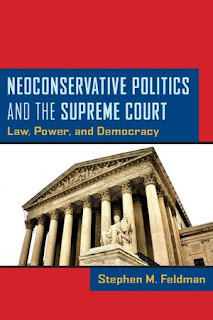
Stephen M. Feldman

Stephen M. Feldman is the Jerry W. Housel/Carl F. Arnold Distinguished Professor of Law and Adjunct Professor of Political Science at the University of Wyoming. Feldman’s new book is Neoconservative Politics and the Supreme Court: Law, Power, and Democracy. His previous books include Free Expression and Democracy in America: A History, and American Legal Thought From Premodernism to Postmodernism: An Intellectual Voyage. Free Expression and Democracy was featured in a joint National Archives and First Amendment Center book forum and chosen as Book of the Month by the American Booksellers Foundation for Free Expression. American Legal Thought has been translated into Japanese and Chinese and was supported by a National Endowment for the Humanities Fellowship.

Earlier this month I asked Feldman what he was reading.  His reply:
I just finished reading Ann Patchett’s The Magician’s Assistant. To say that I loved this book would be an understatement. The protagonist, Sabine, is a devoted resident of Los Angeles. Her gay husband has recently died, and through an evolving series of odd events, she ends up visiting his estranged family (mother, sisters, and nephews) in Alliance, Nebraska. I have never lived in L.A., and I don’t live in Nebraska. But I grew up in New York, lived in San Francisco, and currently reside in Laramie, Wyoming, only a few hours from Alliance. Patchett’s comedic contrast between life on the coast and in the heartland is brilliant. Her depiction of life (and winter) in the heartland is sensitive and subtle, particularly when compared with today’s New York Times (November 19, 2012) article describing Wyoming as if everybody in the state is a white, male, Protestant conservative (I can attest that this gross oversimplification is untrue). The Magician’s Assistant leaves one contemplating family relationships, both nuclear and extended, as well as the meaning of magic in the real world.
Learn more about Neoconservative Politics and the Supreme Court at the New York University Press website.

--Marshal Zeringue

Tuesday, November 27, 2012

Teresa Rhyne

Teresa Rhyne is a lawyer, writer, dog lover and breast cancer survivor (though definitely not in that order). She loves wine, books, coffee and dogs (still not in order) and loathes exercise, Christmas, and chocolate (probably in that order). She has lived in Southern California (it’s like its own state) for her entire life but only recently has she lived in any one house longer than five years. She shares said house with her boyfriend Chris and their irrepressible, diabolically cute beagle, Seamus (the Famous).

Rhyne's new memoir is The Dog Lived (and So Will I).

Recently I asked the author what she was reading. Her reply:
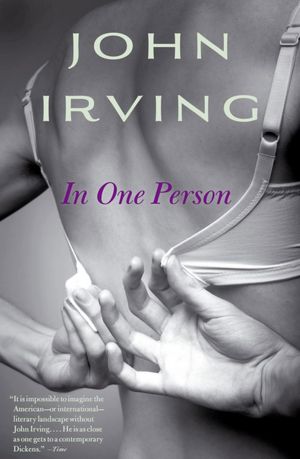
I recently finished A.M. Homes's May We Be Forgiven, which is an astoundingly good book. I was drawn into the characters and the drama immediately and am just in awe of her writing chops. I’d been reading a ton of non-fiction, because that’s what I’ve been writing, and this book brought me right back to my love of fiction. So next I picked up John Irving’s In One Person. John Irving is one of my favorite writers of all time and this recent book did not dampen my enthusiasm. I thought he handled a difficult subject (transgender and bi-sexuality) with great sensitivity. I was lucky enough to hear Mr. Irving’s talk at the American Library Association annual conference in Anaheim, CA this year and he read a bit from this book. It was enjoyable to read/hear the book in his voice as he envisions the characters, but his writing is so vivid and his characters so clearly drawn, the personal reading by the author isn’t necessary (just an added bonus). I tend toward the “dysfunctional family/ people” sorts of fiction because in the end, that’s all of us. It’s a universal experience. These two books were great reminders of that.

On the non-fiction front, I just finished Buddy: How a Rooster Made Me A Family Man by Brian McGrory. Memoirs about animals are my thing right now and after reading Sy Montgomery’s Birdology (which I read because I love her The Good, Good Pig), I was intrigued by a memoir about a rooster (though as these memoirs usually are, it’s really about so much more). I enjoyed the story and thankfully, did not rush out and get a rooster (nor did I get a pig after reading Sy’s book…but I wanted to).
Visit Teresa Rhyne's website and The Dog Lived (and so Will I) blog.

See--Coffee with a Canine: Teresa Rhyne & Seamus.

--Marshal Zeringue

Monday, November 26, 2012

Elana K. Arnold

Elana K. Arnold completed her M.A. in Creative Writing/Fiction at the University of California, Davis. She grew up in Southern California, where she was lucky enough to have her own horse--a gorgeous mare named Rainbow--and a family who let her read as many books as she wanted. She lives in Long Beach, California, with her husband, two children, and a menagerie of animals.

Arnold's debut YA novel is Sacred.

Recently I asked her what I was reading.  Her reply:
I’m pretty thrilled that I’ve been invited to teach a course called Adolescent Literature next quarter at UC Davis. I’ve been compiling a reading list, having a lot of fun revisiting some of my favorites. Two of the books I’m especially enjoying right now are The Golden Compass and Uses for Boys.

The Golden Compass—actually, Pullman’s entire His Dark Materials trilogy (which Pullman doesn’t consider to be a trilogy, but rather one long book) pretty much rocks my world every time. What I admire about Pullman’s philosophy is that he doesn’t hold up innocence as preferable to experience. His books don’t make a cult out of purity, and they put forth the notion that adulthood is a world full of mystery and magic, not just the depressing antithesis to idyllic childhood. As an adult, and as a parent to kids who will become adults, I find this notion reassuring and life affirming.

Uses for Boys by Erica Lorraine Scheidt actually isn’t even published yet, but I got ahold of an advanced reader’s copy last winter and ate it up in one sitting. It’s short, but not petite in any way—it’s a big story of pain and isolation and glimmers of hope without making any promises.

And (I’m a little embarrassed to admit) I’m rereading my own novel Sacred. It just came out this month, and it’s the first book I’ve ever published. It’s such a sensual pleasure to turn its pages.
Visit Elana K. Arnold's website.

--Marshal Zeringue

Saturday, November 24, 2012

Jessica Pierce

Jessica Pierce has taught and written about philosophy for many years. She is the author of a number of books, including Morality Play: Case Studies in Ethics and The Last Walk: Reflections on Our Pets at the End of Their Lives.

Earlier this month I asked Pierce what she was reading.  Her reply:
I was exposed to some of the most marvelous literary works long before I was actually capable of reading them for myself. Every night, from before I can remember to long past when I was too old, my father would read to me as I went to sleep. We read childhood classics like James and the Giant Peach, all the Little House on the Prairie books, and all the Wizard of Oz books. We worked our way into more advanced material: Anna Karenina, War and Peace, Oliver Twist. And we journeyed through The Iliad and The Odyssey. You might think that Homeric poetry would bore a child to tears, but you would be wrong (at least in my case): I was utterly enthralled by the wild adventures of Odysseus and his men.

Although there is something very powerful about hearing Homer’s epic poem, and about participating in some small way in the oral tradition, I set about reading the story (for the third or fourth time) a month or two ago. I had several motivations. First of all, my dog Ody (short for, and named in honor of, Odysseus) died recently, and I felt that reading the poem would be one way to honor his life. Like the human Odysseus, my Ody’s life was full of hardship and misadventure. The other motivation for revisiting The Odyssey is that I’ve been thinking a lot about myth and ritual, and The Odyssey is overflowing with myth that still resonates today. I was particularly attuned, this time through, to the role of animals in the story and about “appropriate” human relations to animals. The Cattle of the Sun story was particularly interesting in this regard.

I always have at least one “lighter” book going, and my latest pick was Tana French’s newest story, Broken Harbor. It is a psychological murder mystery, set in Ireland and featuring Murder squad’s rough-around-the-edges Mick “Scorcher” Kennedy (familiar from French’s earlier book Faithful Place), his rookie partner Richie, and (to complicate things) Scorcher’s mentally ill sister. French’s murder mysteries are complex and eerie, and I love becoming immersed in her descriptions of Ireland. Her heroes always have dark histories that are intertwined in surprising ways with the cases they are trying to solve.
Learn more about The Last Walk: Reflections on Our Pets at the Ends of Their Lives at Jessica Pierce's website and blog.

Read--Coffee with a Canine: Jessica Pierce and Maya.

--Marshal Zeringue