Sunday, April 14, 2013

Fiona Maazel

Fiona Maazel is the author of the novels Last Last Chance and Woke Up Lonely. She is winner of the Bard Prize for Fiction and a National Book Foundation “5 Under 35″ honoree, which feels less potent now that she is 38. Her work has appeared in Anthem, Bomb, Book Forum, Boston Book Review, The Common, Conjunctions, Fence, GQ, Glamour, Milwaukee Journal Sentinel, The Millions, Mississippi Review, N+1, The National Post, The New York Times, The NY Times Sunday Book Review, Salon, This American Life, Tin House, The Village Voice, The Yale Review, and elsewhere. She teaches at Brooklyn College, New York University, Columbia, and Princeton, and was appointed the Picador Guest Professor at the University of Leipzig, Germany, for the spring of 2012. She lives in Brooklyn, NY.

Recently I asked Maazel about what she was reading.  Her reply:
Right now I'm reading about 9,000 student stories and The Art of Subtext by Charles Baxter, which is the second of his essay collections on fiction, the first being Burning Down the House, which I consider a bible of sorts. A must-read for any writer--seasoned or new to the game. His observations about fiction and craft are so astute, it's often hard to know what is more pleasurable: reading the original fiction or his take on it. In one of my favorite essays from Burning Down the House, "On Defamiliarization," he offers up a reading of Sherwood Anderson's story "Adventure" that is so smart and engaging, I get a little tingly whenever I read it. Yep, I said tingly. The Art of Subtext is, so far, no less engaging. It's probably more disciplined than his earlier essays, but still sprightly and smart. I learn so much from reading Baxter's critical work, I just want him to write more. More, please. More soon.
Visit Fiona Maazel's website.

The Page 69 Test: Last Last Chance.

My Book, The Movie: Last Last Chance.

--Marshal Zeringue

Saturday, April 13, 2013

Jessica Soffer

Jessica Soffer earned her MFA at Hunter College. Her work has appeared in Granta, the New York Times, and Vogue, among other publications. She teaches fiction at Connecticut College and lives in New York City.

Soffer's new novel, her debut, is Tomorrow There Will Be Apricots.

Recently I asked the author about what she was reading.  Her reply:
Someone just gave me Virginia Woolf’s A Writer’s Diary and I can’t take it. I just can’t take it. Every word is gold. Every phrase I want tattooed on myself. Even her minutiae is brilliant. Especially her minutiae. And there are these moments in which you can tell, she tells you, that she is deeply, truly, “divinely” happy, as she puts it, and you forget how it ends. And then you remember and it’s heartbreaking.

I read George Saunders’ story, “Escape From Spiderhead,” three times the other day. It’s in his Tenth of December collection. And it’s amazing. It’s like a brilliant version of that “Kill Fuck Marry” game and generates the very same kind of self-doubt / self-loathing as you’re going along, reading, or playing, depending.

I was going to write a piece on which books not to give to your mother on Mother’s Day and so I was knee-deep in all manner of smut. I read Susan Minot’s novella, Rapture, which has been referred to as the 116-page blowjob. It is that, but it’s more than that too: an exploration of sex, disappointment, the disappointment of sex. Simply stated, it’s the most introspective act of oral sex I’ve ever come across and left me quite sure that introspection and oral sex should have nothing to do with one another. Ever.
Visit Jessica Soffer's website.

--Marshal Zeringue

Friday, April 12, 2013

Josh Berk

Josh Berk is the author of The Dark Days of Hamburger Halpin (Knopf 2010), named a best book for teens of 2010 by Kirkus Reviews and Amazon.com. It was also awarded a Parent's Choice Silver medal, a starred review from School Library Journal, and a perfect 10 from VOYA. His second comedy/mystery teen novel, Guy Langman: Crime Scene Proscrastinator, was published in 2012 (also by Knopf). His new series for younger readers begins this year with Strike Three, You're Dead. He has previously been a journalist, a poet, a playwright, and a guitarist (mostly in bands known for things other than fine guitar-playing). He is a librarian and lives in Bethlehem, Pennsylvania, with his family.

About a month ago I asked Berk about what he was reading. His reply:
The Art of Fielding by Chad Harbach. I'm a sucker for baseball novels of course and I have no idea why it took my so long to get around to reading this! It made a big splash in 2011 and I can see why. It's full of fascinating characters -- not just the slick-fielding shortstop Henry Skrimshander, but his mentor/catcher Mike Schwartz and University President Guert Affenlight. I really love Guert for some reason -- he starts off as a minor character but grows as the novel unfolds in unexpected ways. One really random note about the book: the blurb on the back caught my eye. James Patterson said "Chad Harbach's The Art of Fielding is one of those rare novels--like Michael Chabon's Mysteries of Pittsburgh ... that seems to appear out of nowhere." It caught my eye because Mysteries of Pittsburgh is a very odd book and one of my favorite novels. Isn't it kind of weird that James Patterson read and loved such a strange novel? Seems weird to me. Anyway, The Art of Fielding rules.

Feed by M.T. Anderson -- I'm teaching a class in Young Adult Literature at Moravian College this semester. The syllabus tries to include a huge variety of YA from various time periods and genres so really I'm reading (or re-reading) a ton of YA right now. One genre I wasn't really looking forward to teaching was science fiction, but the chair of my department suggested Feed and I'm so glad he did! It's one of the funniest books I've read in quite a while. The science fiction elements are fascinating but they don't overwhelm the human stories or the biting satire and hilarious one-liners. Plus it has one of the best opening lines I can think of: "We went to the moon to have fun, but the moon turned out to completely suck."
Visit Josh Berk's website and blog.

Writers Read: Josh Berk (March 2010).

--Marshal Zeringue

Thursday, April 11, 2013

Tricia Fields

Tricia Fields lives in a log cabin on a small farm with her husband and two daughters. She was born in Hawaii but has spent most of her life in small town Indiana, where her husband is an investigator with the state police. A lifelong love of Mexico and the desert southwest lead to her first book, The Territory, which won the Tony Hillerman Award for Best Mystery. Scratchgravel Road, the follow-up to The Territory, was released last month. Fields is currently working on the fourth book in the series, Fire Break, featuring border town Chief of Police, Josie Gray.

A couple of weeks ago I asked Fields about what she was reading.  The author's reply:
I just finished Ian McEwan’s newest book, Sweet Tooth. It was a masterpiece – a perfect mix of mystery, romance, intrigue – all wrapped up in McEwan’s beautiful prose. As in all of the books I’ve read from McEwan, I was amazed at the structure, at the way he unwraps the story so that the ending not only has impact, but leaves the reader in a satisfied state of wonder.

In the first paragraph, the reader receives the set up for the mystery, and the rest of the book slowly unfolds Serena Frome’s story all the way through the last sentence: the most satisfactory ending I’ve read in many years. Following is the first paragraph:
My name is Serena Frome (rhymes with plume) and almost 40 years ago I was sent on a secret mission for the British Security Service. I didn't return safely. Within eighteen months of joining I was sacked, having disgraced myself and ruined my lover, though he certainly had a hand in his own undoing.
The story is set in London during the cold war, a fascinating time of secrets and double crosses and serious men in dark suits. Serena, who struggles with the limitations of being an intelligent young woman in the 70’s, is recruited for a job with the British Intelligence Service, MI5. Her obsession with books lands her an undercover job in an operation code named Sweet Tooth.

The plot is revealed so smoothly that I don’t want to spoil anything for the reader, but I will say that one of the pleasures of the book is that Serena reads short stories written by her lover. The short stories felt a bit like a bonus read in the middle of the novel.

Sweet Tooth is worth reading for the ending alone. The last 20 pages reveal an alternate reality for the reader, as line by line, the story comes together as a complete surprise. I don’t know anything about McEwan as a writer, but I plan to do some digging. I’m curious to find out how he structures such a seamless plot. I hope to find out it is meticulous planning – at least that means there is hope for the rest of us.
Visit Tricia Fields's website and blog.

The Page 69 Test: Scratchgravel Road.

--Marshal Zeringue

Wednesday, April 10, 2013

Alison Pearlman

Alison Pearlman is a Los Angeles–based art historian and cultural critic who blogs under the name the Eye in Dining. She teaches modern and contemporary art and design history at Cal Poly Pomona.

Pearlman is the author of Unpackaging Art of the 1980s and numerous articles on contemporary art and consumer culture. Her new book is Smart Casual: The Transformation of Gourmet Restaurant Style in America.

Last month I asked the author about what she was reading. Pearlman's reply:
It’s typical for me to keep several disciplinary tracks of readings going simultaneously, and for the sum of these commitments to get out of control. I might be on page 108 in a book about restaurants and page 9 in an anthology on art or design while ten other books and numerous articles on various Zeitgeist-defining concerns from The New Yorker or from Food, Culture & Society or from Design and Culture or Art Journal are forming a pile. I regularly move stacks of books and articles that have recently accumulated to larger ones made in previous weeks standing farther away. When the far heap reaches a height that frightens me or threatens to topple onto one of my dogs, I create a clearing in my schedule and get to work on the ones I deem crucial.

It’s also not unusual for a book to so appeal to me that I read it in full immediately, losing myself to it for a full, hermit-like day. That’s how I recently read Back of the House: The Secret Life of a Restaurant by Scott Haas. Haas spent eighteen months as a fly on the wall and sometimes kitchen worker at chef Tony Maws’s award-winning Craigie on Main in Boston. The book’s brilliant mix of engrossing story, behind-the-scenes viewpoint, and insight into the restaurant business likens it to the now-classic Kitchen Confidential (2000) by former chef Anthony Bourdain. But Haas brings an unusual perspective to the behind-the-kitchen-door genre that Bourdain popularized. Haas is not only a longtime food writer and journalist. He’s also a clinical psychologist. Don’t worry. There’s no jargon in the book. Haas uses the best device of nonfiction—an engaging combination of storytelling and reflection—to convey what drives the restaurant’s restlessly creative and often angry chef/owner and what about the chef drives the restaurant. In the process, Haas leads us to reflect on the power of individual personality traits, interpersonal dynamics, family dynamics, stressors and comforts of particular occupations, workplace operational systems (or lack thereof), and class structures to shape our everyday social institutions.
Visit Alison Pearlman's website and blog.

The Page 99 Test: Smart Casual.

--Marshal Zeringue

Tuesday, April 9, 2013

Tammy Kaehler

Tammy Kaehler’s career in marketing and technical writing landed her in the world of automobile racing, which inspired her with its blend of drama, competition, and welcoming people. Her debut, Dead Man’s Switch, was praised by mystery fans as well as racing insiders, and she takes readers back behind the wheel in Braking Points, the newly released second Kate Reilly Racing Mystery.

A couple of weeks ago I asked Kaehler about what she was reading.  Her reply:
One unexpected consequence of making the rounds of mystery conventions each year as a published author is buying and reading a whole lot more books. (If you ask my husband, that’s not actually possible, given how many books I buy, own, and read each month.) Since my return from the Left Coast Crime mystery convention at the end of March, I’ve been reading a bunch of great books written by authors who I saw or met for the first time there.

I’m just finishing Blood, Ash & Bone, by Tina Whittle, a fellow author at Poisoned Pen Press. This is the third book in the Tai Randolph series, and I am really enjoying it. Partly I love it because I adore how conflicted and yet confident and collected Whittle’s protagonist Tai is—“conflicted” seems the only appropriate response for a liberal feminist who inherits a confederate-themed gun store in a city that requires citizens to own guns. And partly I appreciate the story because Whittle gives outsiders a tour of the South’s own conflicted psyche by tackling the role of the Klan and the ongoing legacy of the Civil War in the modern-day world.

Just as soon as I finish that book, I’m going to pick up Termination Orders, by Leo J. Maloney. It’s going to be a bit darker and more suspenseful than my usual reading list, but I met Maloney at the convention and found him to be a friendly, outgoing, and funny guy. He’s got the greatest platform I’ve ever heard of for writing thrillers about a former undercover operative for the CIA—he was one. I’m not sure how much of the book is fiction and how much is real, but I’m fascinated to read his work.

You never know what you’ll find in the crime fiction arena—everything from cozy mysteries with cats and recipes to trained assassins completing assignments for the good of the country … but I’m pretty sure my TBR (to be read) pile has them all!
Visit Tammy Kaehler's website and blog.

The Page 69 Test: Dead Man’s Switch.

My Book, The Movie: Dead Man's Switch.

Writers Read: Tammy Kaehler (August 2011).

The Page 69 Test: Braking Points.

--Marshal Zeringue

Monday, April 8, 2013

James M. Tabor

James M. Tabor is the bestselling author of The Deep Zone, Blind Descent, and Forever on the Mountain and a winner of the O. Henry Award for short fiction. A former Washington, D.C., police officer and a lifelong adventure enthusiast, Tabor has written for Time, the Wall Street Journal, the Washington Post, and Outside magazine, where he was a contributing editor. He wrote and hosted the PBS series The Great Outdoors and was co-creator and executive producer of the History Channel’s Journey to the Center of the World.

Tabor's new novel is Frozen Solid.

Late last month I asked him about what he was reading. Tabor's reply:
Son of the Morning Star by Evan Connell

Light Years by James Salter

I just finished reading (literally—this very morning!) Son of the Morning Star, Evan Connell’s exhaustive, discursive, novelistic biography of George Armstrong Custer. I came late to Connell, having read other Custer biographies—most recently, Nathaniel Philbrick’s The Last Stand—first. Though tempted to say that was a mistake, in the end I’m glad to have capped my Custer works with Connell. Philbrick is far and away the best of the rest: eminently readable, primary-sourced to a fair-the-well, and painfully accurate. (We learn, among other things, that Custer’s assailants shoved an arrow up his penis, though no one could say whether it was peri- or post-mortem. Also that the gruesome information was not divulged until after Mrs. Custer had died in 1933.)

All that said, I liked Connell better and here’s why. Pure chroniclers in any discipline tend to be linear—Vermeer, Beethoven, Philbrick. There is value in being able to stand in a room in 1658 with Vermeer’s milkmaid (who was not really a milkmaid—she did not pull milk from cows—but a kitchenmaid preparing bread pudding) and know her world exactly, photographically, right down to the heft of her forearm, the folds of her apron, and the holes in her footwarmer on the crumb-scattered floor. As there is in knowing that grim fact about Custer’s corpse and, for example, that no fewer than 105 arrows pierced a cavalry trooper’s body.

Evokers (for lack of a better word)—Monet, Bach, Woolf, our contemporary novelist James Salter (about whom more later), and Connell—tend to be non-linear, suggestive, poetic. A neurosurgeon once told me that autistic children are like great poets in that they make non-linear associations beyond the grasp of “normal” brains. We see “cloud” and think “sky.” They see “cloud” and think “love” or “porpoise” or “window.” While by no means suggesting that Connell was autistic, I did revel in his Monet-like evocation of Custer. A novelist before he was a biographer, Connell happily wanders off on multi-page digressions. They include Custer’s peculiar fascination with taxidermy and, despite trumpeted love for wife Libby, sly dalliances with Native American women. A narcissistic sociopath, Custer treats his dogs like men and his men like dogs, fattening and pampering the former while starving and whipping the latter. For his own dining pleasure, he hauls along a massive, cast-iron cookstove while eschewing Gatling guns (that might have saved his bacon at the Little Bighorn) because the combined weight would have slowed overmuch his headlong dash to destruction. By themselves, such details do little more than hint at aberration. Taken altogether, they—like the countless dots and dabs in Monet’s Rouen Cathedrals—reveal something ineffable that straight description, no matter how comprehensive and precise—can never approach. I came away from Philbrick’s book knowing what Custer did, down to the last (so to speak) detail. From Connell’s I emerged knowing, for better and mostly worse, who he was.

Not long before opening Son of the Morning Star, I closed James Salter’s great novel, Light Years. In earlier times, a writer like Salter might have been brought before an inquisitory panel on charges of magery for the things he can make words do. We humans all work and play with words, of course, for infinitely varied reasons and with equally various degrees of skill. We can do so by the time we are four years old and frequently right up to the end of our lives. (“My wallpaper and I are fighting a duel to the death. One or the other of us has to go,” quipped Oscar Wilde from his hotel deathbed. Who doesn’t hope to go out like that?) Similarly, any one of us can throw a ball starting and ending at about the same ages. But then there are people who do things with balls—Koufax, Seaver, Clemens—far beyond the norm. So far beyond, in fact, that they come to seem (as Arthur C. Clarke famously said of imponderably advanced technology, if you will allow me to further muddy an already ridiculously mixed metaphor) like magic.

A very few writers make magic with words. Virginia Woolf, Tillie Olsen, Annie Proulx, Charles Frazier. I read them and smack my head (in frustration and envy) and go, “How in the hell did they do that?” For my money, Salter is the best. I’ve read all of his books at least twice and this last trip through Light Years was my third. Here’s why:
We dash the black river, its flats smooth as stone. Not a ship, not a dinghy, not one cry of white. The water lies broken, cracked by the wind.
My God. Those are the opening sentences and the book continues like that for 308 pages. It is emphatically not page-turning, speed-reading prose. You have to take writing like this in very small, very slow portions, making sure to mine the secrets of every sentence before turning a page. And even after having done that 308 times, when you return to the show after months or years, the mage unveils new delights you could not have imagined the last time he performed.
Visit James M. Tabor's website.

--Marshal Zeringue

Sunday, April 7, 2013

Martin Edwards

Martin Edwards's many novels include The Frozen Shroud and five previous Lake District mysteries.

Recently I asked Edwards about what he was reading.  The author's reply:
In between writing novels, I like to catch up with some fun reading. Since finishing work on The Frozen Shroud, I’ve read a dozen or more of those “forgotten books” that I write about each Friday on my blog, as well as a few contemporary novels by colleagues whose work I especially enjoy.

I’m a fan of Golden Age fiction, and one of my favourite American writers of the past was Q. Patrick, also known as Patrick Quentin and Jonathan Stagge. In fact, those pseudonyms concealed a complex and fascinating set of collaborations that over the years involved two men and two women. The most famous of the quartet was Hugh Wheeler, an Englishman who spent most of his life in the States, but Murder at the ‘Varsity, also known as Murder at Cambridge, was a solo effort by another expatriate Englishman, Richard Webb. It’s a classic whodunit, written from the point of view of an American studying at Cambridge University, and the final twist is one that I never saw coming. Yet the clues were there, along with some sizeable red herrings – a good example to all writers of whodunits, of any generation!

I also enjoyed Patrick Quentin’s Puzzle for Fiends, written by Wheeler and Webb, which begins brilliantly with Peter Duluth waking up after an accident causes amnesia to find himself surrounded by a family he doesn’t recognize, and whom he soon comes to suspect of murderous plans. A terrific premise for any suspense novel, and there’s a characteristic whodunit twist thrown in by way of added value.

People say that the Golden Age books were cosy, but that generalization ignores a good many exceptions. Another Q. Patrick story, The Grindle Nightmare, is one of the darkest whodunits you’re ever likely to come across – assuming you’re lucky enough to find a copy of this book, which is as elusive as it is gripping.

Among modern books, I’ve enjoyed the latest by Ann Cleeves, whose latest Shetland-based novel is Dead Water, and Peter Lovesey’s The Tooth Tattoo, which offers a twisty investigation into a murder mystery with a musical theme. The settings – a remote Scottish island and the charming city of Bath respectively – add as much to the quality of the books as the enjoyable characterization of those contrasting cops, Jimmy Perez and Peter Diamond. I admired the work of Ann and Peter before they became friends, and to my mind, their literary virtues have plenty in common with the Q. Patrick combo. They are all wonderful storytellers, and set a fine example to any writer of detective novels. Including me, as I start to think about the seventh Lake District Mystery - and what happens now to Hannah Scarlett and Daniel Kind.
Visit Martin Edwards’s website and blog.

--Marshal Zeringue

Saturday, April 6, 2013

Katia Lief

Born in France to American parents, Katia Lief moved to the United States as a baby and was raised in Massachusetts and New York. She teaches fiction writing as a part-time faculty member at the New School in Manhattan and lives in Brooklyn.

Lief's Karin Schaeffer novels include You Are Next, Next Time You See Me, Vanishing Girls, and the recently released The Money Kill.

A few weeks ago I asked her what she was reading.  Her reply:
As soon as I read a review of Far From the Tree, a nonfiction book by Andrew Solomon with the subtitle Parents, Children, and the Search for Identity, I knew that I had to read it. As the mother of two wonderful teenagers, one of whom has decided that he just may be too dynamically creative to bother with college despite the fact that both his grandfathers and his mother were or are college professors, grappling with accepting your children for who they are as individuals has been much on my mind lately.

Solomon brilliantly examines the lives of families raising a child who is somehow different either from his or her parents or society at large. What is it like for hearing parents to raise a deaf child, and what is it like for a hearing child to be raised by deaf parents? What if your child grows up to become a criminal when you are the most solid of citizens? What if you find yourself with the challenge of raising a prodigy? Solomon expertly interweaves personal stories with factual analysis. I felt like a wiser mother and better person after reading this fascinating book.

Immediately upon finishing Far from the Tree, I picked up The Crazy School, a can't-put-down mystery novel by Cornelia Read. I had always been a little afraid to read The Crazy School knowing that it's based on the now-defunct and indeed crazy boarding school where I endured eighth through tenth grades before decamping early to college as a means of escape. But when I met Read and we talked, I knew I had to stiffen my spine and read the book. Her depiction of a tyrannical principal who plays head games on adolescents in turmoil is dead-on. Cornelia Read is a tremendously witty writer who brings this story to vivid life in this truly compelling mystery. My favorite part (spoiler alert!) is the inventive way in which she dispatches with the school principal at the end.

And then...last but not least, having just the other day finished reading Jeffrey Eugenides' The Marriage Plot, I have to weigh in to say that he has once again written the novel every novelist wishes he or she had written. In pure literary alchemy, in which character is story is plot is character, Eugenides has reinvented the nineteenth century marriage plot for the modern reader.
Visit Katia Lief's website.

Writers Read: Katia Lief (November 2010).

The Page 69 Test: Next Time You See Me.

My Book, The Movie: Next Time You See Me.

The Page 69 Test: Vanishing Girls.

Writers Read: Katia Lief (July 2012).

--Marshal Zeringue

Friday, April 5, 2013

Jennifer Cody Epstein

Jennifer Cody Epstein is the author of international bestseller The Painter from Shanghai. She has written for the Wall Street Journal, the Asian Wall Street Journal, Self, Mademoiselle and NBC, and has worked in Hong Kong, Japan and Bangkok, Thailand. She lives in Brooklyn, NY with her husband and two daughters.

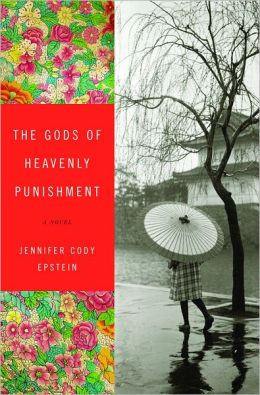
Epstein's new novel is The Gods of Heavenly Punishment.

Recently I asked the author about what she was reading.  Her reply:
I seem to be on a paranormal kick at the moment, which is odd for me but (I find) highly addictive. I just finished Heidi Julavits’s The Vanishers, which is a super-smart, darkly-comic novel about catty female psychics attacking each other from both beyond and before the grave. I’m also mid-way through Karen Russell’s Vampires in the Lemon Grove, which covers everything from the citrus-loving undead to Japanese girls who turn into living silkworms to mysteriously life-defining seagulls in a small town in the ‘70s. Lastly, I just started Andrew Pyper’s The Demonologist, in which a Milton-quoting atheist suddenly finds himself chased around the globe by very real and spooky demons. I’ve loved all three books, though I will admit they make me feel rather ploddingly uninventive and overly-earnest in terms of my own work…like maybe I need to throw a werewolf who communicates with the dead or an empathetic cross-dressing ghost into my next historical novel. Or something.
Visit Jennifer Cody Epstein's website and blog.

The Page 69 Test: The Painter from Shanghai.

The Page 69 Test: The Gods of Heavenly Punishment.

--Marshal Zeringue