Sunday, May 16, 2010

Patrick Madden

Patrick Madden is the author of Quotidiana (Nebraska, 2010), a collection of personal essays. He teaches creative writing at Brigham Young University.

Not so long ago I asked him what he was reading. His reply:
Having just finished out the winter semester, I'm once again able to do some reading for pleasure and enlightenment, beyond all the stuff I assign to my students. I'm enjoying several books at the moment. Here are a few.

Most of my reading is in the realm of creative nonfiction, typically the more essayistic side of that unwieldy category. So I'm excitedly reading Need for the Bike by Paul Fournel, current president of Oulipo, which group every writer should know (and emulate). This book, however, is not Oulipian in any formal way. Instead, it's a collection of vignettes tracing the author's love of cycling, from Fournel's formative years (and crashes) to the Tour de France, with plenty of quick excursions (cyclical and mental) in between. “The bike always starts with a miracle,” writes Fournel, expressing his reverence, which sentiment permeates his book.

I'm also devouring Donald Morrill's newest collection, Impetuous Sleeper, which brings together memoirs of travel and prose poems with meandering meditations on dreaming and waking. Interspersed between the more traditional-seeming prose pieces are bursts of aphorisms, called “Saccades,” which lend a profundity to the whole. Here's one: “Sleep is our second, lesser-known past. Our memories of it are hearsay from a witness reputed to be our self but who seems a stranger.”

After hearing an NPR piece about established authors self-publishing, then reading a piece at the Rumpus about Steve Almond's venture into this realm, I bought This Won't Take but a Minute, Honey, and I'm finding affirmation in the “essays” side of the little book, in which Almond offers advice on writing. I find that his oath “Never confuse the reader” works for nonfiction as well as for fiction, as do most of the exhortations, which come in thirty one-page numbered sections. There're also thirty very short stories if you flip the book over, which I intend to do soon, because I while I focus mainly on nonfiction, I very much enjoy novels, short stories, and poems, too.

For instance, I've just finished Silence by Shusaku Endo, a Japanese Catholic writer. The book follows a Portuguese Jesuit missionary in Japan during the seventeenth century, a time of backlash repression against Christians. Psychologically, it deals with the troubling question of God's silence in the face of persecution as believers are forced to apostatize or face brutal tortures. Literarily, it is serene, measured, never showy, a wonderful example of peaceful, powerful prose.

That seeming peace, of course, reveals inner turmoil, which is true also of Lynn Kilpatrick's In the House, a collection of short stories revolving around domestic themes. I don't have the same theoretical background in stories as I do in essays, so I'm consistently surprised and pleased by the formal moves Kilpatrick makes, seeming to dance around plot, to keep plot alive in the spaces between sections or in the words not written.

But when it comes to poetry, I prefer words written, not omitted, poems that make sense as sentences first, then work within lines. So I'm smitten with Marc Sheehan's second book, Vengeful Hymns, whose poems are mini-essays, thought-experiments, memory-probes, vehicles for ideas-from-life. Sheehan is intelligent, it's obvious, with a stunning command of the medium of words, an ability to startle me into presence and understanding.

I ought to mention, too, a few others that I've sampled or heard wonderful things about, and which I'll be reading very soon: Mary Cappello's Called Back, Steven Church's Theoretical Killings, Christopher Cokinos's The Fallen Sky, Kim Dana Kupperman's I Just Lately Started Buying Wings, Kyle Minor's In the Devil's Territory, Peggy Shumaker's Just Breathe Normally… I hope the summer lasts!
Visit Patrick Madden's website to read hundreds of classical essays or sample his essays.

--Marshal Zeringue

Saturday, May 15, 2010

Daniëlle Hermans

Daniëlle Hermans works as a freelance communication consultant and lives in Bilthoven, the Netherlands. Her debut mystery is the recently published The Tulip Virus.

I recently asked her what she was reading. Her reply:
Sometimes, my reading-days go by without me getting really excited about what am reading. But there are periods – they are always periods, I don’t know why – that I read a book that I love. And then another, and another.

The last couple of weeks, I read three books in a row that got under my skin. You probably have already read them, as I am Dutch and translations take some time. If you haven’t, please do!

Two of the books on my joyful reading list are by R.J. Ellory. The reason I bought them was because they received excellent reviews here in Holland. I first read Ellory’s A Quiet Belief in Angels. We follow the life of Joseph Vaughan as he grows up in a small town terrorized by the brutal killings of young girls. During his life, as a boy, a teenager and a grown-up, he is determined to find out who the murderer is. I completely fell for the In Cold Blood-atmosphere that Ellory paints in this superb thriller.

I couldn’t wait to get my hands on his novel that was released here in Holland recently: A Quiet Vendetta. When Catherine Ducane, the daughter of a senator, is kidnapped, Ernesto Perez contacts the police. Ernesto tells them he will release Catherine if they first listen to his story. We learn all about his life as a cold-blooded killer for the mafia. I don’t usually like books about the mafia, but this one is different. It’s an epic novel about a man’s life as a mafia hit man in the USA during three decades. As a writer, I especially enjoyed the ingenious way Ellory composed this book.

My third favorite is written by Gillian Flynn: Dark Places. The main character Libby Day was seven when her mother and two sisters were murdered. She fled the house and testified that her fifteen-year-old brother, Ben, was the killer. For twenty-five years, with her brother behind bars, Libby lives off a trust created by well-wishers who’ve long forgotten her. But her money has run out. We not only follow Libby, but also flashback to her mother and brother. Libby Day isn’t a nice person at all. She is manipulative, narcissistic and very irritating. As the story revolves, we come to understand her, even like her. Dark Places is a psychological thriller at its best.
Learn more about The Tulip Virus at the publisher's website and visit Daniëlle Hermans' website.

--Marshal Zeringue

Thursday, May 13, 2010

Bill Crider

Bill Crider is the author of more than fifty novels, including the Sheriff Dan Rhodes series. He is the winner of the Anthony Award and has been nominated for both the Shamus and Edgar Awards. His latest novel, co-written with Clyde Wilson, is Mississippi Vivian.

Recently I asked him what he was reading. His reply:

I’m currently reading a private-eye novel called Epitaph for a Loser by James T. Doyle. It was published by Walker Books in the late 1980s, and as far as I know it was Doyle’s second and last private-eye book. Why am I reading it? That’s a good question. Every Friday, a good many bloggers review a “forgotten” crime novel. I picked this one up in a thrift shop not long ago and read the first couple of paragraphs. It looked interesting, so I bought it specifically to read for one of my Friday reviews. I’m glad I did, because it turns out that it’s a very good novel in the hardboiled vein.

Shortly before picking up Epitaph for a Loser, I read something completely different, Charlie Williams’ Stairway to Hell. It’s almost impossible to describe, but let’s say that Jimmy Page (yes, the rock star) was a warlock in the ‘70s and transferred the soul of David Bowie into the body of a baby named Rick Sutton, who grows up to become a British club singer calling himself Rik Suntan. Suntan narrates his present-day adventures, and they’re quite funny since he’s one of those people who’s completely confident in his talent, sex-appeal, and superior intelligence, whereas it’s clear to the reader that he’s wrong about all those things. It’s hard to sustain a story based on such a zany premise (and it gets even zanier), but Williams manages it.

And speaking of being quite funny, I just wrote a review of Donna Moore’s Old Dogs, a screwball crime novel that also has a plot that’s almost impossible to describe. Two former hookers, now in their 70s, decide to steal a couple of valuable statues of dogs from a museum. Complications ensue. Lots of complications. The statues get around as fast as the pea in a shell game, and so do the fake statues of the same dogs. So does a corpse, for that matter. It’s all hilarious, and if Donna gets to cast the movie, I suggested Judy Dench and Helen Mirren as the leads.

Visit Bill Crider's website and blog, and read his My Book, The Movie entry for the Sheriff Dan Rhodes novels.

Author Interviews: Bill Crider.

My Book, The Movie: Mississippi Vivian.

--Marshal Zeringue

Wednesday, May 12, 2010

Sarah Quigley

Sarah Quigley is the author of TMI, her first YA novel.

A couple of weeks ago I asked her what she was reading. Her reply:
I rarely read books I don’t like because I’m always getting great recommendations from my writer friends. I regularly share my thoughts about kick-ass books on my blog. Here are some of my favorites from the past few months:

How to Say Good-Bye in Robot by Natalie Standiford

While most seniors would enter a new school hoping to party with the popular kids, Beatrice would rather stay up late listening to a quirky call-in radio show and patrol bookstores with Jonah. Nicknamed Robot Girl and Ghost Boy, the two strike up an unusual friendship that hovers near romance but can’t seem to land.

I loved the way Standiford made Beatrice cynical but not overly bitter, allowing herself to finally care about someone while pushing away the in crowd. Beatrice and Jonah choose to be outsiders, and it’s a refreshing change from the usual YA storyline in which the protagonists try to fit in at all costs.

If I Stay by Gayle Forman

I read If I Stay almost a year ago and continue to think about it often. Seventeen-year-old Mia is in a car accident that puts her in a coma, kills her parents, and leaves her brother in critical condition. The story alternates between the present, as Mia’s loved ones rally around her at the hospital, and the past, which paints a portrait of a wholly likable, closely-knit family. Mia knows she must choose between the present and the past, life and death. Will she join her family?

Forman presents this tragedy with masterful grace. It would have been easy for this book to become heavy-handed and utterly depressing. As I read, my sadness for Mia was tinged with hope. I felt such a connection to this family, it was as if I were sitting at their kitchen table. Forman pulled me into a beautiful, loving world.

The Dead-Tossed Waves by Carrie Ryan

This is the companion to Ryan’s smash debut, The Forest of Hands and Teeth. It’s about the zombie apocalypse. Let me clarify up front that I am not the sort of person who typically enjoys books about zombies, vampires, and other manner of paranormal freakitude. Yet I gobbled up these two books faster than a Breaker the Dark City (you’ll have to read the book to get the references).

Why? Let me count the ways:

1. Gorgeous, lyrical prose
2. Sprays of blood
3. Ever-escalating tension and suspense
4. Zombie love triangle
5. Nautical theme

So if you enjoy shallow breathing and white knuckles, this is the book for you.
Read an excerpt from TMI, and learn more about the book and author at Sarah Quigley's website.

My Book, The Movie: TMI.

--Marshal Zeringue

Tuesday, May 11, 2010

Matthew Green

Matthew Green is an assistant professor of Politics at the Catholic University of America in Washington, D.C. Originally from northern California, he worked as a congressional aide for five years before getting his Ph.D in political science at Yale University. He teaches a variety of courses on American politics, but he has a particular passion for Congress. Green's new book is The Speaker of the House: A Study of Leadership (Yale University Press).

Recently I asked him what he was reading. His reply:
I tend to read a lot of American history in my spare time, interspersed with the occasional work of fiction. I'm currently reading three books: the first falls in the former category, the other two in the latter.

The first is Zachary Schrag's The Great Society Subway: A History of the Washington Metro. A graduate student in my department recommended it to me, and I'm glad he did. I've always assumed that the D.C. subway system, popular among the thousands of tourists who visit the nation's capital, was equally popular when it was first proposed, developed, and constructed. But in fact, it had to compete with highways for attention and funding, was nearly killed by a stubborn and petulant congressional committee chairman, and faced strong resistance from many local communities who did not want stations nearby. Schrag describes how the subway was affected by the profound political and social changes that took place in the 1960's and 1970's, and how the leadership of individuals, ranging from ordinary citizens to the President of the United States, made its construction possible.

The second is Jeff Smith's graphic novel series Bone. It's routinely on the "top ten" lists of comics and graphic novels, but I was always a little put off by the peculiar-looking hero (a white blob-like figure) and the fact that it's often stocked in the children's section of bookstores. But I finally decided to take the plunge and start the series. I just finished volume 6, so it's safe to say that I'm enjoying it a lot. The artwork alone is beautiful: Smith has a wonderful eye for color (which you'll miss if you get the black and white edition) and an elegant style clearly influenced by the great comic artist Walt Kelly. The story is basically a fantasy: it involves dragons and monsters as well as humans, and it's set in a middle-ages sort of world. But unlike many works in the fantasy genre, Bone doesn't take itself too seriously: the dialogue is witty and sometimes downright hilarious, and the author isn't afraid to make the occasional odd anachronistic reference (Moby Dick pops up a lot). Sometimes the plot gets bogged down in long stretches of dialogue, but there's nonetheless enough action to keep a reader's interest.

The third is Steig Larsson's The Girl With the Dragon Tattoo. I don't really want to say much about this book because (a) it's more fun to read it without any prior knowledge of the plot, and (b) it's so popular that many people have already commented on it elsewhere. But I do recommend it highly -- especially if you've ever visited Sweden (and especially Stockholm), in which case you'll appreciate many of the details and references Larsson includes in the story.
Learn more about Matthew N. Green at his faculty webpage and Amazon author page.

--Marshal Zeringue

Sunday, May 9, 2010

Adam Schuitema

Adam Schuitema’s stories have appeared in numerous magazines, including Glimmer Train, North American Review, TriQuarterly, Black Warrior Review, Crazyhorse, The Carolina Quarterly, and The Florida Review. He is an assistant professor at Kendall College, where he teaches creative writing, as well as rhetoric and literature courses.

His new book is the story collection, Freshwater Boys.

Late last month I asked Schuitema what he was reading. His reply:
I’m currently reading The Autobiography of Benjamin Franklin. I have a little hundred-year-old copy of the book with type so small I have to squint, but there’s something lovely about holding it in my hands. He focuses primarily on his professional rise as a printmaker, inventor, and highly engaged citizen. In fact, one of the most remarkable elements of the narrative is how little of his personal life he reveals. Franklin spends several pages discussing his methods for trying to obtain moral perfection, yet only one paragraph on meeting and marrying his wife, and only three sentences on the death of his four-year-old son. (And neither are named.) Still, Franklin’s prose is exceptionally readable, even to an American of the twenty-first century.

I recently read Bonnie Jo Campbell’s latest story collection, American Salvage. It’s been receiving tremendous critical acclaim, and rightfully so. Campbell zooms in on small-town, blue-collar life in Southwest Michigan, the settings so earthy they seem to put dirt under your fingernails. There’s sex and drugs and violence, and yet—remarkably—loveliness. This is the result, in large part, to her incredible prose. But just as important is the dignity with which Campbell treats her characters.

And I just read Faulkner’s As I Lay Dying for the third or fourth time. What struck me this time around was the voice of Vardaman, who is often quoted for his bizarre but striking lines like, “My mother is a fish.” But this time around I was moved by some of the other passages where his observations are so clearly those of a child who notices and describes those types of things that, as we age, we either forget or forget to communicate. I especially love his descriptions of the burning barn: “The barn is still red. It used to be redder than this. Then it went swirling, making the stars run backward without falling. It hurt my heart like the train did.”
Visit the official Freshwater Boys website.

--Marshal Zeringue

Friday, May 7, 2010

Laura Grace Weldon

Laura Grace Weldon lives on Bit of Earth Farm with her family. She writes mantras on her feet, poems on beehives and words all over mannequins, although she makes a living writing on more conventional surfaces. Her essays appear in numerous anthologies as well as publications such as Farming, Geez, New Awareness, Mothering, Natural Life, Grit and Cleveland Plain Dealer. Her poems have most recently appeared in Christian Science Monitor, Atlanta Review, Mannequin Envy and Dirty Napkin.

Her recent book examines the power of holistic education in Free Range Learning: How Homeschooling Changes Everything (Hohm Press, 2010).

A couple of weeks ago I asked her what she was reading. Her reply:
Here are a few of the books surrounding me now.

We grow and preserve a lot of our own food, so it’s a natural step to start concocting homemade beverages as well. No one wants to hear about canning applesauce but everyone wants to know more when I mention Sacred and Herbal Healing Beers: The Secrets of Ancient Fermentation by Stephen Harrod Buhner.

I’m familiar with Buhner’s deep connection to the natural world after reading several of his rambling yet powerful books. In fact, I keep The Secret Teachings of Plants: The Intelligence of the Heart in the Direct Perception of Nature in my backpack. That book is best in small doses, read outdoors.

This work is more focused but informed with the same passion. As Buhner unveils ancient approaches to the sacred through plant fermentation, I’m discovering more about indigenous approaches to knowledge. I’m also learning some radical history. Beer was made around the world for healing, religious ceremonies and daily use. Certain plants were intentionally included to give beer stimulating, aphrodisiacal, euphoria-producing, even psychotropic properties. Hops weren’t commonly used, since hopped ale diminished sexual desire and dulled the senses. Then, around the time of the Protestant Reformation, authorities instituted regulations imposing the use of hops. Now our definition of beer has shrunk to that tame ale.

Buhner provides recipes from earlier times. He also says, “Sipping from the ancient fermentations of our ancestors is also taking a drink from the Well of Remembrance.”

Katharine Weber’s True Confections was discussed at our recent book group. Written as a protestation of innocence by narrator Alice Tatnall Ziplinsky, the novel is by turn witty and suspenseful. The history and art of candy-making are delightful asides in this story of racism, betrayal, family loyalty and the shaky structure of lies.

Weber has hit a sweet spot as a book marketer too. I’m told she has appeared at candy conventions, on cooking shows and all over the food blogosphere. Smart lady. Chocolate sells.

My copy of Original Wisdom: Stories of an Ancient Way of Knowing by Robert Wolff has found its way to my desk. When I should be working I find myself rereading uniquely restorative passages.

Wolff describes, completely without pretension, how he came to know and learn from the reclusive Sng'oi people of Malaysia. The Sng'oi live simply, follow their dreams and intuitions completely, and perceive in ways we have forgotten. They teach Wolff deeper and fuller ways of living. They affirm that all of us still have such potential. I’ve given copes of this book away many times. Its quiet truth isn’t easily described but it has a lasting impact.

I’ve nearly finished a meandering book called The Bread of Angels: A Journey to Love and Faith by Stephanie Saldana. It’s an account of Saldana’s fellowship in Syria, a country where Christians and Muslims have lived together for a thousand years. There she is studying Islam by learning the Quran, in Arabic.

Saldana finds lodging in a once elegant house where she’s watched over by her elderly landlord, who calls her “Grandfather.” Saldana explains that to call a loved one by the name of another loved one is traditional, “suggesting that you are so close to them that, as though bound by a cosmic force, you can no longer tell the difference…”

Her stay in Syria is a form of escape for this well-traveled woman. She comes to know people who put her own problems in perspective, such as Hasan, an Iraqi poet, professor and artist now living in exile. This gifted man tells Saldana that a great poet needs no paper, he lives poetry. He explains, “Poetry is an invisible energy that exists between everything, holding it together, giving it meaning. The job of every human being is to search for the poetry hidden within the midst of things.”

Saldana finds a scholar to guide her through the Quran. Saldana writes, “The Sheikha has memorized every single word of the Quran, so that I sometimes feel that she contains it. Often when she discovers a new meaning of a word in the Quran, I have a sense that her entire interior self is slightly shifting, like a plate moving beneath the ocean of her being.”

Already I adore the people and the contemplative light that seems to shine over this country, thanks to Saldana’s writing.

I first encountered Scott Russell Sanders’s work while reading library books aloud to my kids. It’s always a pleasure to discover finely crafted sentences in books written for small people. Now I’m reading through Sanders’ oeuvre. In A Private History of Awe Sanders writes about growing up wide awake. He recalls being held in his father’s arms, watching as sudden flash of lightening burst a huge oak tree apart. Sanders writes, “I still ring with the astonishment I felt that day when the sky cracked open to reveal a world where even grownups were tiny and houses were toys and wood and skin and everything was made of light.” Although we’re from different generations I easily identify with Sander’s coming-of-age reflections, his ethical quandaries over religion and militarism, his tender insistence on love.
Learn more about Free Range Learning, check out Laura Weldon’s blog, and find out what’s up on the farm.

--Marshal Zeringue

Wednesday, May 5, 2010

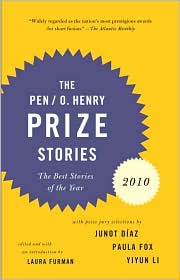
Laura Furman

Laura Furman is series editor of The PEN/O. Henry Prize Stories. The 2010 edition will be published in May 2010. Her new collection of stories, The Mother Who Stayed, will be published in February 2011 by The Free Press, a division of Simon & Schuster. She is Susan Taylor McDaniels Regents Professor of Creative Writing in the English Department, University of Texas at Austin.

Recently I asked her what she was reading. Her reply:
This spring semester, I'm teaching at the Sorbonne, Paris 3, and my students and I are reading "The Turn of the Screw" by Henry James. Though I very much like the long-story form, I hadn't read "The Turn of the Screw" for a long time and remembered it vaguely. It was a pleasure to read and fun to try to figure out its twists and turns.

James differentiated between a short story and a tale--a work too long to be a story and too short to be a novel--and one of the rich things about "The Turn of the Screw" is its form: It's the written testimony of the nameless governess who, when she was very young, was in charge of two beautiful orphans and failed them in almost every way possible. The manuscript has come to Douglas, now middle-aged, possibly in love with the governess in his youth. He, in turn, is introduced to the reader by a narrator who sets the scene for the reading of the governess's testimony, and who gives the reader the necessary background for us to understand the governess's motivations and character. The framing devices of the custom of telling ghost stories at Christmas and the setting of an isolated country house in winter, are a sharp contrast to the real creepiness and hysteria of the main story.

It's a complicated, twisted story, though nothing much happens outside of the imagination of the young governess. The reader's question is whether or not to believe her visions of ghosts and evil. "The Turn of the Screw" is a monument to ambiguity and possibility. One has the sensation of being haunted oneself, by the tale and by its masterful author.
© Laura Furman. All rights reserved.
Learn more about Laura Furman and The PEN/O. Henry Prize Stories.

--Marshal Zeringue

Monday, May 3, 2010

Bonnie J. Rough

Bonnie J. Rough is an American writer living in Amsterdam. Her memoir, Carrier: Untangling the Danger in My DNA, is now out from Counterpoint.

Late last month I asked her what she was reading. Her reply:
A year ago, I moved overseas from the U.S. to Amsterdam. Since then, travel, home, and the limbo between belonging and foreignness are the tensions I’ve felt. I explore them from every angle on my blog, The Blue Suitcase, and through the lenses of the books I read. As an expatriate airline family, travel is a lifestyle for us. Whenever we leave the places we visit—a warm winter’s weekend in Portugal, a late-summer laze in Croatia, five disquieting days along the Nile—it feels like putting down a book I hope to open again.

With its lacy, square cover, When Wanderers Cease to Roam: A Traveler’s Journal of Staying Put (Bloomsbury 2008) is not a memoir I would have picked up if I hadn’t heard about it first. I’m so glad to be reading it. Each night I get lost in Vivian Swift’s reminiscence of her years traveling the globe, alongside her meticulous and thought-provoking observations (and tender drawings and paintings) of the backyard world she discovered when she decided to hang up her luggage. Through her beautiful memoirs “in miniscule chapters” and her close readings of raindrops and mud, her journey speaks to me. I know my time for staying put will come, and I am often caught between dreading and yearning for it.

Sometimes I worry that by the time I decide to settle down, staying put will be so old-fashioned that I will be rendered totally obsolete. Writing from my own native landscape in The Far Corner: Northwestern Views on Land, Life, and Literature (Counterpoint 2009), John Daniel helps me think it out, especially in the essay “A Word in Favor of Rootlessness.”

I’m reminded to live where I am. Amsterdam: A Brief Life of the City (Vintage 2001) by Geert Mak and translated from the Dutch by Philipp Blom, keeps showing me the riches — historical, cultural, social — of my new city. Listen to this, my first favorite passage of the book:
It must look like a battlefield under the surface of Amsterdam: beams, floor tiles, nails, grindstones, fishing hooks, riding spurs, pots, weights, bullets, scythes, compasses, scraps of wool and linen, coins, spindles, buckles, buttons, necklaces, shoes, keys, knives, spoons made from wood, pewter or bone, oil lamps, pilgrims’ insignia, devotional pictures, dice, and, last but by no means least, purses. Little by little, enough objects have been found in the ground to keep a medieval town going, yet at the same time every single shoe in the mud holds its own little secret.
I live in a 400-year-old canal house that was once a barrel warehouse in the midst of a tanning district. To leave the house each day, I descend three flights of spiral stairs then pass through the cellar before coming up into the light. Thanks to Mak’s book, I have begun to wonder what relics live inside those half-buried walls, what artifacts are preserved in the loam beneath the floor. To be tugged by the history of my own walls tells me I am finally feeling a sense of home here. Then I hear the tolling of the bells in the Westerkerk tower—the same steeple Anne Frank saw from the attic window of her hideaway—and I am reminded that history is more than curiosa; it is sometimes so blindingly recent and real that it is too enormous to hold. But I try, with these two books close at hand: The Diary of a Young Girl and The Last Seven Months of Anne Frank.
Visit Bonnie J. Rough's website and blog, The Blue Suitcase.

--Marshal Zeringue

Saturday, May 1, 2010

Mark Yakich

Mark Yakich is the author of Unrelated Individuals Forming a Group Waiting to Cross (National Poetry Series, Penguin 2004), The Making of Collateral Beauty (Snowbound Chapbook Award, Tupelo 2006), and The Importance of Peeling Potatoes in Ukraine (Penguin 2008).

He is an associate professor of English at Loyola University New Orleans. Yakich divides his time between the bedroom and the kitchen.

Recently I asked him what he was reading. His reply:
I am currently finishing Sisters: Catholic Nuns and the Making of America by John J. Fialka. I happened upon the book by happy accident, because I wouldn't normally think to read a book about nuns. My only experience with nuns was Sister Beverly Jean who taught 5th grade. I was in her class for three weeks, very much not enjoying the experience, the final straw bending when she made me sing the Star-Spangled Banner by myself in front of the class (I had a ten-year-old singing voice that made flowers flatulate.) But this book, Sisters, has dispelled me of nuns as being only knuckle-crushers. Sisters/nuns are responsible for a great many of the schools and hospitals in the country, and over the years they have been as courageous as soldiers. In fact, sisters served on both sides of the Civil War, treating patients, often diseased, whom no one else would treat. One of my favorite narratives of Sisters is how nuns helped found the Wild West. In one Colorado gold mining town, there were seventy-something saloons and not one hospital until a group of sisters showed up.

I am also reading Frank Stanford's The Light the Dead See, a posthumous collection of his poems. Stanford is one of those cult poet figures; he died at 29 by shooting himself in the chest three times ... but not before leaving behind some exquisite work that no one has been able to imitate readily. (Maybe Gregory Orr's early work compares in some way that makes sense only in my mind.) Here is a small poem from Stanford:

The Minnow

If I press
on its head,
the eyes
will come out
like stars.
The ripples
it makes
can move
the moon.

I almost always loathe poems that contain "the moon," and yet and yet....

One more:

Farewell

Is a word
That must be
Like a sword
That has worn out
The scabbard

Neither of these poems is absolutely representative of Stanford's oeuvre; they are meant to tease you into discovering him on your own.
Visit Mark Yakich's website and blog. Read sample poems from Unrelated Individuals Forming a Group Waiting to Cross, The Making of Collateral Beauty, and The Importance of Peeling Potatoes in Ukraine.

--Marshal Zeringue