Sunday, December 19, 2010

Gerry Bartlett

Gerry Bartlett is a former teacher and now writes full time. She also owns an antique business on the historic strand in Galveston, Texas.

The latest installment in her Glory St. Clair Real Vampires series, Real Vampires Have More to Love, is out now from Berkley.

Recently I asked her what she was reading. Her reply:
My tastes in reading are very eclectic. Of course, since I write paranormal romance, I read a lot of what’s out there in that genre. Most of it is very dark and my stuff is comedy, but I do enjoy reading a well written dark paranormal. I’ve just discovered a series by Adrian Phoenix. The first book is A Rush of Wings. Phoenix creates an interesting world and a very complex, tortured hero. I think that’s what really draws me to a book, fascinating characters. Be prepared for some violence, but that’s a real trend in urban fantasy which is where this book is shelved. The action is fast paced and there is a conspiracy and mystery that kept me turning the pages and running out to buy book two. I really enjoy books in series and following a group of characters. Another series I love is J.R. Ward’s Brotherhood. It’s urban fantasy too, but with more of a romance. Very rough language, but such interesting world building. Like most series, the problem is that the authors don’t write fast enough.

I enjoy reading straight mysteries too and just finished one by a favorite author—John Sandford. His Rough Country is a Virgil Flowers novel and takes that detective to northern Minnesota to solve a crime. I love the way Sandford develops his characters and have read every one of his Lucas Davenport books as well as his Kidd novels. He’s a great storyteller and, if I want to know how to write male point of view, I know where to look for inspiration. Sandford always manages to surprise me and keeps me turning the pages. Too often these days I put books down and don’t finish them. That never happens with a John Sandford book.

My to-be-read pile is huge and I won’t list them all but they include the new Scarpetta novel and mysteries by Iris Johansen and Linda Howard. It’s fun to note that Johansen and Howard got their start writing romance. Love that!
Read an excerpt from Real Vampires Have More to Love and visit Gerry Bartlet's website and blog.

See--Coffee with a Canine: Gerry Bartlett & Jet.

The Page 69 Test: Real Vampires Have More to Love.

--Marshal Zeringue

Friday, December 17, 2010

Larry Bennett

Larry Bennett is professor of political science at DePaul University. He is the author and coauthor of numerous books, including Fragments of Cities: The New American Downtowns and Neighborhoods, Neighborhood Politics: Chicago and Sheffield, and It’s Hardly Sportin’: Stadiums, Neighborhoods, and the New Chicago.

His new book is The Third City: Chicago and American Urbanism.

Last month I asked him what he was reading. His reply:
I’ve been an avid reader since youth, for instance, reading and rereading Tom Sawyer, Huckleberry Finn, and A Connecticut Yankee several times. These days I read books for a variety of reasons: to keep up with research on urban studies topics, “trying out” books that I may decide to assign in the DePaul University classes that I teach, and pleasure. Some of this reading overlaps. This past summer I very pleasurably read the late Gerald Boyd’s memoir, My Times in Black and White. Boyd was one of the Times editors bounced in the wake of the Jayson Blair plagiarism scandal in the early 2000s. Boyd’s book is a candid exploration of the particular challenges that will be encountered by a black man moving into the upper reaches of American institutional (in this case, media) culture. The book’s excavation of the inner workings of the Times newsroom is fascinating. And—the students in my American Political Culture course showed up for class and chewed over the book very effectively. I’m not a classroom lecturer; having the students do a sizeable share of the intellectual work by way of discussion is my aim. I can recommend Boyd’s memoir for multiple reasons.

Academic urban studies books are often “formidable”: writing that ranges from eccentric to simply inept; frequently presupposing a theoretical apprenticeship that most general readers will not have. A very notable exception is Sharon Zukin’s recently published Naked City: The Death and Life of Authentic Urban Places. Zukin is a New York-based sociologist and pioneer of what I characterize as the sociology of place. Her new book’s subtitle takes its cue from Jane Jacobs’ famous The Death and Life of Great American Cities. What Zukin offers in Naked City is an illuminating tour of contemporary New York neighborhoods—Harlem, the Lower East Side, Brooklyn’s Red Hook, and more—assessing the positives and negatives of gentrification, considering how the corporate “adoption” of public spaces (such as Union Square Park) at once enhances and distorts the city’s public life. This is a book for both New York enthusiasts and readers who are trying to process what precisely is the substance of the central city “comeback” of the last 20 years.

I host a summer (yes, I confess) urban studies reading group. This past summer my friends and I read Naked City, and wandering a bit farther afield, Justin Fox’s The Myth of the Rational Market. For readers who feel that having a working understanding of derivatives and other esoteric investment “products” is important, Fox’s very accessible “history of risk, reward, and delusion on Wall Street” does a commendable job of opening up this very special world whose peculiarities have spilled over (and nearly drowned) our world in recent years. Fox’s particular subject is the group of mathematicians and mathematically inclined economists and business school profs who developed the far-out investment tools that brought us the Bear Stearns, AIG, and Lehman Brothers collapses. One does not need a mathematics background to follow the narrative. Fox’s explanations of both the mathematical logic and investment applications are lucid. He closes his book with a brisk tour of the main incidents leading to the 2008 financial meltdown. The Myth of the Rational Market isn’t uplifting; it is riveting.

Ah pleasure (with no auxiliary purpose). This summer my wife and I toured Nova Scotia, Cape Breton Island, and Prince Edward Island, and I did not take with me the collected short stories—Island—of Cape Breton’s bard, Alistair MacLeod. I had in my possession a perfect (right down to the dust jacket) borrowed copy, but I was not going to desecrate my friend’s book via overstuffed backpack, airplane meals, ferry decks, picnic beverages, or coffee shops. Instead, I read just about half this wonderful book before flying to Halifax, then extended my vacation several days by finishing the stories when I returned to Chicago. MacLeod’s tales—most but not all set on Cape Breton Island—take us back to the early to mid-20th century and a Maritime Canada that was still a very wild place. Nor was life easy, but between its sharply etched descriptions of physical locale, hints of the otherworldly that dance through its plot lines, and MacLeod’s adroitly scattered humorous touches—in one story virtually all of the young men in a seaside community, including itinerant peddlers emigrated from the Levant, are named Angus—Island transports you.

So what did I read while on the trip? There was the 13th novel in the Patrick O’Brian Aubrey/Maturin series, but several flotillas worth of ink has previously been devoted to those books. I will merely note that I plan to finish the series, happily. The other travel book this year was Richard Holmes’ The Age of Wonder, a history of early 19th century “Romantic” science. Holmes’ principal subjects are the astronomers William and Caroline Herschel, and chemist Humphrey Davy. His theme is the curious—at least from the standpoint of rationalistic science—and various relationships linking early 19th century scientists, explorers, and artists. For me, The Age of Wonder drops another foundation stone into my comprehension of how the modern world took shape. That’s quite an accomplishment for a book that is also a page-turner.
Learn more about Larry Bennett's The Third City at the publisher's website, and read an excerpt.

The Page 99 Test: The Third City.

--Marshal Zeringue

Wednesday, December 15, 2010

Richard Harvell

Richard Harvell is the author of The Bells, a novel about a castrato in the eighteenth century. The Bells was an Indie Next Pick in October 2010 and is being translated into twelve languages. He grew up in New Hampshire and now lives in Switzerland.

Recently I asked him what he was reading. His reply:
I’m currently reading Michael Newton’s Savage Girls and Wild Boys. I actually found it by entering “Wild Boys” into the local university library catalogue, and it’s just what I hoped it would be—a history of feral children, from wolf-children to the tragically neglected.

I find my way into the novels I write through other people’s carefully researched studies of out of the ordinary themes—for The Bells it was Patrick Babier’s The World of the Castrati (as well as the somewhat less scholarly Castration: The Advantages and Disadvantages, by Victor T. Cheney).

Newton’s Savage Girls and Wild Boys is just the kind of book that sets me tingling as I stroll the library stacks. The book satisfies my thirst for answers (Can kids really be raised by wolves?—Yes), and yet it is leaving me with an even larger dose of wonder than I began with. Lots of new questions (If a child learned to speak, and then from age three to ten was raised by wolves, would she be able to speak when she returned? How would she sound?). Newton gives me lots of details (which I scribble on note cards) that could be the stuff of a future novel (reclaimed feral children tend to have bad teeth and are non-repentant thieves), and yet he also strays into the philosophical frame: in 1726 Jonathan Swift was interested in whether Peter the Savage, a feral child, could have a soul, whereas in 1970 researchers at UCLA hoped that Genie, a neglected girl raised in a dark, LA bedroom, could prove or disprove theories of universal language.

Such books as Newton’s can’t be the last word on a theme, because they are a first word on so many others. It’s a web that draws me back into the stacks for more—Gulliver’s Travels and Edgar Rice Burroughs' Tarzan are next on my list.
Visit Richard Harvell's website.

--Marshal Zeringue

Monday, December 13, 2010

Suzanne Loebl

Suzanne Loebl's first book, Fighting The Unseen: The Story of Viruses, earned her a Sloan Science Writing Fellowship at the School of Journalism, Columbia University. Since then, she has written fourteen books. Her America's Art Museum's: A Travelers' Guide to Great Collections Large and Small prompted some people to tour America in search of art.

Her new book is America's Medicis: The Rockefellers and Their Astonishing Cultural Legacy.

Recently I asked her what she was reading. She reported that she was currently reading four books:
Howard Jacobson’s The Finkler Question, my bookgroup’s monthly choice; Laura Esquivel’s Like Water for Chocolate, because it came my way; Annie Cohen-Solal’s, Leo & His Circle: The Life of Leo Castelli, because it is about a man who was very influential in shaping the New York art market during a crucial period, and Isabel Allende’s Island Beneath the Sea, because she is one of my favorite authors.

Chocolate wins hands down. It has the magical element so typical of Latin American writers: a tsunami from nowhere wipes out a flock of chickens and doves, a vicious mother who insists that her second daughter marries her youngest daughter’s sweetheart, turning into a ghost, or an illicit pregnancy that is not. Recipes that ordinary cooks will never make accompany this delicious book.

The Castelli biography starts out by being cumbersome, but picked up speed as Leo was the first to recognized the talents of the emerging artists of the New York School.

Islands Beneath the Sun once again demonstrated Allende’s poetic style, but so far I have not been captivated by the story. I am just at the beginning of The Finkler Question and as yet have no opinion. During the summer I also read: The Invisible Bridge by Julie Orringer and found it fascinating.
Visit Suzanne Loebl's website.

The Page 99 Test: America's Medicis.

--Marshal Zeringue

Saturday, December 11, 2010

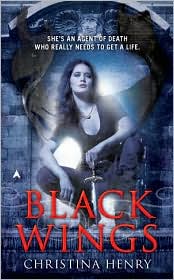
Christina Henry

Christina Henry is a graduate of Columbia College Chicago and enjoys running long distances, reading anything she can get her hands on and watching movies with samurai, zombies and/or subtitles in her spare time. She lives in Chicago with her husband and son.

Black Wings, her first Madeline Black novel, was released last month by Ace/Penguin.

Late in November I asked her what she was reading. Her reply:
I love to read pretty much anything I can get my hands on. I have about 25 magazine subscriptions, ranging in various topics from hockey to astronomy to running to cooking to fitness. I also have a gigantic to-be-read pile of fiction and nonfiction books that is getting more gigantic every day, because I now buy way more books than I actually have time to read.

When I am writing a new novel I can read fiction until I get about a third of the way through the book. At that point I stop reading fiction until I’m done with the first draft. I don’t like to be unconsciously influenced by other writers when I’m trying to hammer out the story. At that point I’ll switch over to reading nonfiction – again, just about anything will do as long as it catches my eye. The next two books in the nonfiction heap are Salt: A World History by Mark Kurlansky and Flower Confidential by Amy Stewart.

I just recently finished writing the second book of the Madeline Black series and haven’t gotten too deeply into writing the third so I am trying to cram as much fiction into this period as possible.

Right now I am in the middle of Jim Butcher’s Side Jobs, a collection of short stories from the Dresden Files. I had read many of these stories before in other anthologies but it’s been fun to go back and revisit Harry-through-the-years. The collection also features one new story, which takes place after the most recent Dresden Files novel Changes. I’m trying to work my way slowly through the book so that I can savor the new story when I get to it. Butcher is one my favorite writers and it’s such a treat to get an extra Dresden story when he normally only releases one Dresden novel per year.
Read chapter one of Black Wings, and learn more about the book and author at Christina Henry's website.

--Marshal Zeringue

Thursday, December 9, 2010

Erin Blakemore

Erin Blakemore is a writer, entrepreneur, and inveterate bookworm.

Her debut book, The Heroine's Bookshelf: Life Lessons, from Jane Austen to Laura Ingalls Wilder, includes an exploration of classic heroines (such as Anne Shirley, Jo March, Scarlett O’Hara, and Jane Eyre) and their equally admirable authors (like Jane Austen, Harper Lee, and Laura Ingalls Wilder).

Last month I asked her what she was reading. Her reply:
Right now I'm rereading Madame Curie: A Biography, a book written by Marie Curie's daughter Eve. It's a weird combination of eulogy and biography that really caught my attention when I picked it up as a little girl (how I got my hands on a gorgeous first edition is beyond me; I have a feeling it was at a library sale). When I was a kid the book represented possibility (discovering elements in a damp shed in an exotic country! Sign me up!) and courage. But this read is reminding me of the perils of biography. It's difficult enough to talk about someone else's life, much less write objectively about your own mother! And yet somehow it still has the ability to transport me to that dusty, inhostpitable shed where a steely woman plodded on even after her dearest companion had died.
Visit Erin Blakemore's website and the official The Heroine's Bookshelf website.

The Page 99 Test: The Heroine's Bookshelf.

--Marshal Zeringue

Tuesday, December 7, 2010

Allison Leotta

Allison Leotta is a federal sex-crimes prosecutor in Washington, D.C. She has been a federal prosecutor for ten years. Like the heroine in Law of Attraction, her debut legal thriller, Leotta started out in the U.S. Attorney’s Office prosecuting misdemeanor domestic violence cases. She now handles the most serious sex crimes in D.C. Allison is a graduate of Michigan State University and Harvard Law School.

A couple of weeks ago I asked her what she was reading. Her reply:
It’s embarrassing to admit this as a thriller writer, but I put down the top thriller of our time to read a non-fiction book about the 2008 presidential race.

The Girl with the Dragon Tattoo is pretty much required reading for folks in my profession, and I’ve been meaning to read it for a while. I was about 75 pages into Dragon Tattoo, when I casually picked up Game Change by John Heilemann and Mark Halperin. My husband had the political tome sitting innocently enough on our dresser. I flipped to the first page. It starts: “Barack Obama jerked bolt upright in bed at three o’clock in the morning.”

I was hooked.

I’ve heard that you can become addicted to crack after trying it just one time. For me, Game Change was like that. I’ve been taking hits whenever I can. Babies are napping? Read a few pages. Going to the bathroom? Read a few pages. Waiting for the finicky computer to reboot? Read a few pages. Luckily, the stuff is free, otherwise I might’ve re-mortgaged my house to get a few more hits.

I’m rationalizing my addiction as research. I’m a sex-crimes prosecutor in Washington, D.C., and my own legal thriller, Law of Attraction is about love and violence in this city. My next book will be about a political sex scandal in the nation’s capital. Surely this political story is research?

But – no. If I’m being honest, I will admit I’m just reading it because it’s a great story.

Game Change takes a behind-the-scenes look at the last presidential election. The authors somehow interviewed everyone involved and wrote it all up in an addictive tell-all / political commentary / thriller narrative. The tone is somewhere between The New York Times and The National Enquirer. We all know the ending, of course, but I still can’t wait to hear what happens next. Some of the stories – especially about the candidates’ marriages – are so intimate and embarrassing, I feel like I should take a shower after reading them. But there’s also a glimpse behind the curtain of political showmanship, to the hearts of the players involved, that is simply breathtaking. It has made me watch CNN with a new perspective.

I’m almost done with the book. I’ll miss the story, but, unlike finishing a novel, I know I’ll still be able to follow the characters – on the nightly news.

Afterwards, I’m looking forward to reconnecting with Stieg.
Visit Allison Leotta's website and blog.

--Marshal Zeringue

Sunday, December 5, 2010

Stanley Harrold

Stanley Harrold is professor of history at South Carolina State University. Among his recent books are Subversives: Antislavery Community in Washington, D.C. 1828-1865 and The Rise of Aggressive Abolitionism: Addresses to the Slaves.

His new book is Border War: Fighting over Slavery before the Civil War.

Last month I asked him what he was reading. His reply:
I’m reading Douglas R. Egerton’s Year of Meteors: Stephen Douglas, Abraham Lincoln, and the Election That Brought on the Civil War, which Bloomsbury Press published this past September. “Year of Meteors” comes from Walt Whitman’s poem expressing his feelings about the months between the December 1859 execution of John Brown for treason against the state of Virginia and the presidential election of November 1860. Whitman called it a “brooding year,” as the specter of southern secession and civil war hung over the nation.

One of Egerton’s achievements lies in lending a sense of immediacy to the political events involved in 1860’s momentous presidential campaign. He portrays the conflicting goals, sensibilities, versions of American nationalism, personal ambitions, strengths, and weakness of the men who sought to shape the country’s future. Some readers may wonder why Egerton places Stephen Douglas before Abraham Lincoln in his book’s subtitle. As they read, however, they will understand that the shattering of Douglas’s Democratic Party was key to the outcome of the election and the events that followed.

Egerton is at his best in describing the “national” conventions that produced four contenders for the presidency in 1860. His analysis of the political maneuvering at Democratic conventions in Charleston, Richmond, and Baltimore, as well as the Republican convention in Chicago and Constitutional Union Party in Baltimore are riveting. They remind me of the time before almost universal primary elections deprived modern national conventions of drama. Those who read Year of Meteors will witness the interaction of forces that turn history into drama. Among them are loyalty, disloyalty, vanity, practicality, hope, and fear.
Read more about Stanley Harrold's Border War at the publisher's website.

The Page 99 Test Border War.

--Marshal Zeringue

Friday, December 3, 2010

Catherine Gildiner

Catherine Gildiner wrote her doctoral thesis on the influence of Darwin on Freud, and has been a clinical psychologist in private practice for several years. She also writes a psychological advice column for Chatelaine magazine and has written numerous newspaper articles.

Her first book, the memoir Too Close to the Falls, was published in Canada, the US and the UK to wide acclaim. It is followed by After the Falls which covers her life from the ages of 13-21.

Recently I asked her what she was reading. Her reply:
I just reread David Copperfield by Charles Dickens. I read it in high school but a friend of mine writes Victorian mysteries and he was saying that rereading Dickens helped him to create character. I remembered Peggoty and all the characters from the book for so many years I decided to reread it. I wanted to figure out how Dickens could make a memorable character in just a few lines. I loved rereading the book from the point of view of the writer. Once a character is created he never steps out of character. No matter how good or bad he becomes you understand his core. I am now rereading all of Dickens. I am now a bit stuck on Our Mutual Friend which is more 'modern' than some of the others and spins less of a yarn.

I also just finished Let the Great World Spin by Colum McCann. The literary device of using the tightrope walker who travels between the Twin Towers in New York is a magical device. Usually literary devices of that kind have such a false ring, but since New York is so crammed together and so its inhabitants are so disparate in income the tightrope walking spectacle brings the most unlikely people together. The writing is gifted in the way that so much Irish writing is-- The profundity seems so effortless.

I just finished The Imperfectionists by Tom Rachman. It is about a small English speaking newspaper in Rome. Rachman's description of place is spot on. You can smell the musty carpet and all of the machines that don't work. While each character is flawed they are all admirable and I liked the book very much.

I also just reread Villette by Charlotte Brontë. I didn't like it as a teenager and decided I must have been immature. I just finished it and really didn't like to again! The problem is the protagonist, Lucy Snow: she is so passive, secretive and repressed that the reader loses interest in her.
Visit Catherine Gildiner's website and blog.

The Page 99 Test: After the Falls.

--Marshal Zeringue

Thursday, December 2, 2010

Leighton Gage

Leighton Gage has been a copywriter, an advertising creative director, a magazine editor, and a writer/producer/director of documentary films and industrial videos.

His latest novel in the Chief Inspector Mario Silva series, Every Bitter Thing, is now out from Soho Crime.

Last month I asked him what he was reading. His reply:
Last year, I was one of the judges for the “first best” jury for the Mystery Writers of America.

As anyone who’s ever had the experience will tell you, it’s a reading marathon that doesn’t give a writer a heck of a lot of time to read anything else, particularly if he/she expects to get any work done during the process.

Two books I loved didn’t garner the necessary votes from my colleagues to make the final cut, but both have stuck with me through time, and I continue to think that both of them should have been so honored.

I can’t really recommend one over the other. You’re gonna have to read them both.

One is Lenny Kleinfeld’s Shooters and Chasers, a story that begins in Chicago and ends in the California wine country.

Lenny’s romp through the lives of a couple of star-crossed contract killers is an absolute delight. He has a rare talent for being able to tie-up murder, mayhem and humor in a neat, satisfying package.

The other book is Jeffrey Siger’s Murder in Mykonos. Jeff writes the kind of stuff I write, police procedurals set outside the United States. His particular area of expertise is Greece, which he knows inside out. As well he should. He’s American by birth, but has maintained a home on the aforementioned island for more than twenty-five years.

The only defect these two books have is that they’re too short. Once you start reading, you want them to go on and on.

I can only hope that you’ll enjoy them as much as I did. Which was a lot.
Read more about Every Bitter Thing.

Visit Leighton Gage's website and the Murder is Everywhere blog.

The Page 69 Test: Blood of the Wicked.

My Book, The Movie: Buried Strangers.

The Page 69 Test: Dying Gasp.

--Marshal Zeringue