Sunday, January 23, 2011

Shawn Goodman

Shawn Goodman is a writer and school psychologist. His experiences working in several New York State juvenile detention facilities inspired his debut novel, Something Like Hope. He has been an outspoken advocate for juvenile justice reform, and has written and lectured on issues related to special education, foster care, and literacy. Goodman lives in Ithaca, New York, with his wife and children.

Earlier this month I asked him what he was reading. His reply:
I am in the middle of what might be my favorite read of the year: Soon I Will Be Invincible, by Austin Grossman. This book is so intelligent and fun that I can't stop pushing it on people. It's your basic superhero storyline, but it's perfectly wrapped in pulpy comic book cliches, and told from the alternating points of view of Dr. Impossible, the world's leading supervillain, and Fatale, a six-foot-three cybernetically enhanced woman with serious self-esteem issues.

What sets this book apart is Grossman's love of the genre: he revels in every aspect of it - from the costumes, invented names, and origin stories, to the inevitable quirks and flaws that accompany life with superpowers. The characters are entirely real and believable, even when they are invincible, half-crazy, or ridiculous. Like the scene where Dr. Impossible guides us through the sad underworld of supervillainy where losers, freaks, and mad geniuses get together at an abandoned shopping mall for their approximation of social contact. After walking four miles, and changing into his costume in the bushes, his villain colleagues ignore him, and he is bullied by Kosmic Klaw, a slow-witted Ukrainian Mercenary who wears a suit of armor from a wrecked spaceship.

The basic story is familiar, but it's a fresh take, and the writing is terrific. It might be the perfect book to entertain and distract from the cold and gloom of January.
Visit Shawn Goodman's website.

--Marshal Zeringue

Friday, January 21, 2011

Whitney Strub

Whitney Strub is an assistant professor of history at Rutgers University, Newark. His writing has appeared in American Quarterly, Journal of the History of Sexuality, Journal of Social History, PopMatters, and Bad Subjects.

His new book is Perversion for Profit: The Politics of Pornography and the Rise of the New Right.

Recently, I asked him what he was reading. His reply:
Life on the academic calendar, at least in my experience, means lots of reading but fairly little pleasure reading except during breaks and holidays. So I’m trying to make the most of this semester break with some things that’ll be tough to squeeze in once the grind resumes. Next up for me is Charles Willeford’s I Was Looking for a Street, a recently reissued autobiography from my nominee for America’s greatest-ever pulp novelist. I am a sucker for crime fiction in general, and few literary niches satisfy me more than the seedy, lurid 1950s hardboiled fiction that operated as both dimestore spectacle and unblinking critique of Ike’s America. Jim Thompson gets the most attention, but Willeford’s novels are even bleaker, taking perverse delight in exposing the much-vaunted “normalcy” of the decade as a fundamentally psychotic enterprise. His staggeringly grim—but hilarious—Pick Up might be my favorite novel of the decade, so I have high hopes for this memoir of growing up during the Depression—I’m sure it’ll be as brilliantly sardonic as everything else Willeford wrote.

Also on the fiction queue is Samuel Delany’s Phallos. Normally any novel whose back cover calls it “a Lacanian riddle to delight” would be immediately tossed into my maybe-if-I-live-forever-and-have-nothing-left-to-read pile, but Delany is perhaps the one exception to this rule. My admiration for this author knows no boundaries; as he evolved from young SF genre novelist in the early 1960s to memoirist of subterranean queer life in later decades, his work has been beautifully informed by critical theory and sharp analyses of race, sexuality, and gender—yet has remained compulsively readable across genres and styles, not an easy task. I regularly assign his anti-redevelopment polemic Times Square Red, Times Square Blue in my classes, because its fierce defense of stigmatized public-sex culture generates engaging classroom discussions of both heteronormativity and a homonormativity that would disavow porn-theater cruising. I’m not even sure exactly what Phallos is about beyond a grad student whose quest for an elusive porn novel leads into some sort of mediated exegesis of its ancient tale, but I’m looking forward to delving in. Hopefully without having to contend with Lacan; I’m on break, after all.

Of course, even on break I’m never free from the imperative of keeping abreast of current scholarship, and the recent academic book I’m most excited about is Marc Stein’s Sexual Injustice: Supreme Court Decisions from Griswold to Roe. Stein is an amazing historian, who wrote a community study of lesbian and gay Philadelphia (City of Sisterly and Brotherly Love) that ranks among the great works of LGBT history. His new book expands on an article he wrote a few years back on the ways the Court carefully patrolled the borders of sexual citizenship during the less-than-revolutionary so-called sexual revolution; that article very much informed my own work as a grad student, as I worked on the dissertation that became my book, so I can’t wait to see where Stein has taken his analysis in the new project.

Finally, a book that combines scholarly and personal interest for me is Lucas Hilderbrand’s Inherent Vice: Bootleg Histories of Videotape and Copyright. Hilderbrand takes a fascinating approach to VHS, combining an historical argument for its democratizing role in changing the ways people engage with media with a reading of the affective/nostalgic attachment to the format that persists among some despite its current obsolescence. I’m certainly hailed by this text; as someone who came of age scouring now-dead independent video stores for everything from Italian cannibal films in clamshell cases to forgotten Elliott Gould movies that have yet to appear on DVD, I find that Hilderbrand’s impassioned book resonates with me not just intellectually, but emotionally too—a rare feat for an academic monograph, and quite impressive.
Read more about Whitney Strub's Perversion for Profit at the publisher's website.

--Marshal Zeringue

Wednesday, January 19, 2011

Matthew Gallaway

Matthew Gallaway is a writer originally from Pittsburgh, Pennsylvania. He now lives in New York City.

His recently released debut novel is The Metropolis Case.

Earlier this month I asked him what he was reading. His reply:
I just finished (for the second time, because it's a favorite of mine) the first volume of The Man Without Qualities by Robert Musil. Written in the 1930s, the novel takes a somewhat satirical look at Vienna in the years leading up to the first world war, when a committee is assembled under the leadership of striving aristocratic idealist (the wife of a mid-level diplomat) to celebrate the 75th year in power of the Austrian Emperor Franz Joseph. As you might expect from the title, there's a detached, frank quality to the prose and observations that generally makes it feel as much like a philosophical treatise as a literary drama (I mean this in a good way); it's less likely that you will be "swept away" by the unfolding story here and more likely that you will find moments of enlightenment and beauty in Musil's discussion of his characters' psychologies and their relation to the society in which they live, particularly in his understated but often-breathtaking use of simple but poetic metaphor, e.g., "irrationalism...haunts our era like a night bird lost in the dawn." I highly recommend this book for anyone interested in the interaction -- sometimes elegant, sometimes chaotic -- between ideas and reality in modern culture.

In books I read and loved that were published this year (or in 2010): Light Boxes by Shane Jones is a a short, amazingly textured novel in the form of a post-modern fairy tale or fable about a small town whose inhabitants decide to wage war on February. In addition to a period of time — namely the month so many of us know and dread — February in this book is cold and sad and indefinite in duration, and may or may not also be a god or a misunderstood man, an outcast who terrorizes the townspeople with snow and ice (and moss!), leading to the end of flight (paper airplanes, balloons, and kites) and more sinisterly to the kidnapping and murder of children. To read Light Boxes is like having a dream (and one of the miracles of this book is that it feels like the reader’s dream, not Jones’ or even one of the character’s) in which your unconscious communicates with you via an array of signs and symbols.

In Darin Strauss's memoir Half a Life, Strauss as a 40-something year-old man confronts an event from his past that I suspect would be impossible to really fathom for those who have not experienced it: as a high-school senior, he was driving on a road near his house on Long Island, when a girl (also from his high school) on a bike, for no apparent reason, swerved directly in front of his car (two lanes over) and was killed in the resulting collision. (This is not a spoiler, by the way.) While there was no question of negligence on Strauss's part (although predictably, there was a lawsuit involving the worst, most predatory kind of lawyers), the accident and its aftermath (both short- and long-term) haunted him in many ways, all of which he examines in the book with candor and insight (and beauty) as he digs back and assesses (and reassesses) what did and did not happen to him as a result. The book is both harrowing and gripping; you won't want to put it down. In the end, it becomes less about an accident and something more universal and transcendent by offering readers the hope that, with enough effort, we might also achieve a kind of ambivalence with regard to the past, by acknowledging its power but dismissing its tyranny.
Read an excerpt from The Metropolis Case, and learn more about the book and author at Matthew Gallaway's website.

The Page 69 Test: The Metropolis Case.

My Book, The Movie: The Metropolis Case.

--Marshal Zeringue

Monday, January 17, 2011

Daniel H. Wilson

Daniel H. Wilson is an engineer who earned his PhD in robotics at Carnegie Mellon University. His books include Bro-Jitsu, How to Survive a Robot Uprising, Where's My Jetpack? and How to Build a Robot Army.

His latest novel for readers age 9-12 is A Boy and His Bot.

Not so long ago I asked him what he was reading. His reply:
I'm reading three books right now. First, The Forever War by Joe Haldeman. This is widely regarded as a sci-fi classic, yet it slipped past my radar screen for all these years. Reading it now, I can see why so many people love it. Reading this book is like eating candy, and I've found myself slowing down as I realize that I'm nearing the finish. Next, I'm reading an advanced reading copy of Ready Player One by Ernie Cline. It's a crazy adventure into a future that is obsessed with the pop culture of the 1980s -- and I mean all the pop culture, from Family Ties to MechaGodzilla. Incredibly fun. If this book were a living room, it would be faux wood panelled. Last, I'm reading Our Posthuman Future: Consequences of the Biotechnology Revolution by Francis Fukuyama. This is for research on the novel I'm writing, called AMP. New technology is starting to creep into our bodies, and the ethical consequences are striking. Like thinking about whether you are willing to upgrade your child before it's born so that it will be able to compete in a society of super-humans. Neat!
Visit Daniel Wilson's blog.

My Book, The Movie: A Boy and His Bot.

--Marshal Zeringue

Sunday, January 16, 2011

James J. Connolly

James J. Connolly is Professor of History and Director of the Center for Middletown Studies at Ball State University and the author of The Triumph of Ethnic Progressivism: Urban Political Culture in Boston, 1900–1925.

His new book is An Elusive Unity: Urban Democracy and Machine Politics in Industrializing America.

Recently I asked him what he was reading. His reply:
Like a lot of academics, I usually have two stacks of reading, one for work and one for fun. For work I’ve been reading about the history of reading. The fun pile generally includes lots of mysteries, spy novels, and a little nonfiction.

The reason I’m reading about reading involves my current research. I’m collaborating with my colleague Frank Felsenstein on a book called “What Middletown Read.” It uses recently uncovered library circulation records to explore print culture in Muncie, Indiana (the city best known as the subject of Robert and Helen Lynd’s Middletown books) during the 1890s. I’ve been working through Print in Motion: The Expansion of Publishing and Reading in the United States, 1880-1940, volume 4 of the History of the Book in America series. Edited by Carl Kaestle and Janice Radway, it’s filled with terrific essays on topics such as the place of public libraries in the community (Wayne Weigand), local print cultures (Kaestle), and clubwomen’s reading (Elizabeth Long and Elizabeth Henry). The best parts of the book are the overviews Kaestle and Radway provide to open each section. Together they constitute a sophisticated account of the interplay between the modernization of American life and the evolution of print culture. I’ve also learned a good deal recently from Christine Pawley’s Reading on the Middle Border and Radway’s Reading the Romance. Up next is Robert Darnton’s The Case for Books. This is a new field for me, so I find all of this work fresh and exciting.

Away from work, I’ve been reading Alan Furst’s spy novels, most recently Spies of the Balkans, Dark Voyage, and The Foreign Correspondent. Furst recreates the tense, churning environment of life in Europe during the early part of World War II. His characters tend to be antifascist outsiders—émigrés, sailors, journalists—navigating through the upheaval of that time. That process provides the reader with a compelling portrait of life at this fraught moment, one that historians can only envy.
Read more about An Elusive Unity at the publisher's website.

The Page 99 Test: An Elusive Unity.

--Marshal Zeringue

Friday, January 14, 2011

Blaize Clement

Blaize Clement is the author of the Dixie Hemingway mysteries: Curiosity Killed the Cat Sitter, Duplicity Dogged the Dachshund, Even Cat Sitters Get the Blues, Cat Sitter On A Hot Tin Roof, Raining Cat Sitters and Dogs, and the newly released Cat Sitter Among the Pigeons.

A couple of weeks ago I asked her what she was reading. Her reply:
Whenever I'm asked what I'm reading, I immediately wish the question had come the week before, when I might have been reading something less revealing of who I am. When asked for this post, I considered lying and saying I was currently reading Michael Gruber's The Good Son, a fantastic book that I read twice and from which I learned more about the situation in Afghanistan than from anything I've read in any news accounts. But I read that several weeks ago. Then I looked through my stack of other recent reads to find one that would make me seem especially smart and cool. But only two books actually sat on my bedside table, and the fact that I was reluctant to name them forced me to ask myself a crucial question: why am I so reluctant to be open about the fact that I'm a spiritual seeker? I'm not sure if I want to keep that side of myself private, or if I fear ridicule from those who think spirituality is synonymous with the Bible-thumping, moralistic, self-righteousness that H.L. Mencken called "jealousy wearing a halo."

The truth is that no matter what else I'm reading, the same two books are always beside my bed. For several weeks now, I've read and re-read Eckhart Tolle's The Power of Now. That book speaks to me in the same way that Deepak Chopra's The Seven Spiritual Laws of Success has spoken to me for almost twenty years. I read Chopra at least once a year, usually two or three times a year.

Christmas came while I thought about how to explain why those two books are so important to me, and the answer came from the youngest member of my family. The day was difficult for my family because my daughter-in-law died a few weeks after Christmas last year. Christmas had always been especially important to her, and my son and grandchildren did their best to recreate all the decorations and the dinner that she would have made. Everybody was trying hard to pretend they were having a jolly old time, but my little great-granddaughter was too young to be dishonest about her feelings. During Christmas dinner, she put her head on the table and sobbed. Freed of the need to pretend their hearts weren't hurting, the adults immediately cried too.

In the same way, Eckhart Tolle's book frees me of the burden of playing phony roles. It teaches me how to just Be. If I feel like it, I can put my head down on the table and sob like a child because I miss somebody I loved. I can also turn my attention away from all the stupid things and people in the world and let them be what they are. I can even hope to reach a level at which I don't label things and people "stupid." And if I'm asked what I'm reading, I can be brave enough to talk about the spiritual books on my bedside table and not try to come up with a good lie.
Visit Blaize Clement's website and blog.

The Page 99 Test: Even Cat Sitters Get the Blues.

The Page 99 Test: Cat Sitter on a Hot Tin Roof.

The Page 69 Test: Raining Cat Sitters and Dogs.

--Marshal Zeringue
Thursday, January 13, 2011

Sharon Fiffer

Sharon Fiffer collects buttons, Bakelite, pottery, vintage potholders, keys, locks, and other killer stuff. She is coeditor of the anthologies Home: American Writers Remember Rooms of Their Own, Body, and Family: American Writers Remember Their Own, and the author of the Jane Wheel mysteries as well as the nonfiction book Imagining America.

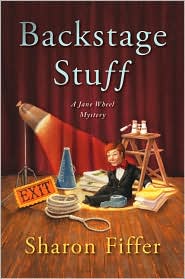
Backstage Stuff, the seventh Jane Wheel mystery, is out now from Minotaur Books.

At the start of the year I asked Fiffer what she was reading. Her reply:
My reading habits, always eclectic, have grown even more exotic and scattered over the past few years. And contrary to the topic of the day for most readers and writers, the change has nothing to do with e-readers vs. paper and board books. It has to do with multi-tasking.

I hate everything about that word—the multi and the tasking and the use of it as a verb. But, for better and worse (and no, that’s not a typo—it is better and sometimes, when I’m swamped, it is worse), it is what I have to do to balance my own version of the life of the mind. I teach writing workshops and so like to keep up with books recommended by my writing students; I chair author events and attend mystery conferences where I sit on panels and I like to read the books of those with whom I engage in discussion; I write books about an avid collector/junker, so read non-fiction about obsession and hoarding as well as price guides for depression glass; and I read for pleasure, pure pleasure.

So, in that order here is what I’ve read most recently.

One Day by David Nicholls --because Francie from the workshop asked me what I thought of the point-of-view shifts. (seamless—they worked beautifully and I laughed and cried. I didn’t read it to judge it—I just found myself totally enjoying it—thank you, Francie)

Other Eyes by Barb D’Amato and Negative Image by Vicki Delany --because I am moderating a discussion at Aunt Agatha’s Bookstore in Ann Arbor, MI in February where the three of us will be signing our newly released books together. Each one of our novels is so different that the closest I can come to a common thread might be the different roads women writers take to tell their stories—intelligently researched suspense, police procedural and humorous accidental detective. Fascinating to think about—women are writing with such strong voices and heading out in such interesting directions.

Second-hand Shabby by Diana Durkes. This is my first e-book purchase—a pdf I downloaded on my laptop (no e-reader yet) with great pictures and articles on upcycling. This is written by a master in the trash-to-treasure field--Diana is the author of the wonderful blog, Fine diving in Chicago, where she chronicles her make-overs of dumpster/alley finds. I would claim this reading is for my own Jane Wheel mystery series research but it definitely spills over into pure pleasure.

And in the purely pure pleasure category? My husband gave me Bill Bryson’s latest, At Home, for the holidays ; my daughter gave my Maira Kalman’s autobiography with pictures, The Principles of Uncertainty. (Kalman is one of my favorites both for pictures and prose) and I plan to buy myself The Sherlockian by Graham Moore. Pleasure, pleasure and pleasure.
Learn more about Backstage Stuff and the author at Sharon Fiffer's website.

The Page 69 Test: Scary Stuff.

--Marshal Zeringue

Tuesday, January 11, 2011

Sarah Kreps

Sarah E. Kreps is an Assistant Professor in the Department of Government at Cornell University. She previously held fellowships at the Belfer Center for Science and International Affairs, Harvard University, and the Miller Center for Public Affairs, University of Virginia. Between 1999-2003, Kreps served as an active duty officer in the United States Air Force.

Her new book is Coalitions of Convenience: United States Military Interventions after the Cold War.

A couple of weeks ago I asked her what she was reading. Her reply:
Over the break I've been reading popular history accounts of American wars (a nerdy academic's version of the airport novel). In particular, I’ve enjoyed re-reading David Halberstam's The Best and the Brightest, which I picked up again because I’ve been thinking about the question of how smart people end up getting the US involved in costly wars. It’s obviously difficult to generalize from the Vietnam experience, since it was probably sui generis in a number of ways, but I’m fascinated by a couple of things. First, the role of individuals. There was certainly a sense that intelligence was a sufficient condition for effective formulation of policy, that bringing a bunch of academics from Cambridge, MA to Washington, DC would result in sound foreign policies. Instead, it seems that bringing like-minded individuals into the administration created a good deal of group think and reinforced each others’ biases, including the unflinching belief in American power as a force for good. That France hadn’t been successful in Vietnam had no application to the US experience, according to Kennedy’s and Johnson’s advisers, since France was no longer a great power and the US was the US. Those who challenged these prevailing views, such as George Ball or James Thomson, were relegated to the unenviable position of “devil’s advocate” and not considered particularly credible. The result is these presidents’ advisers offered a limited menu of options and tended to marginalize any perspective other than their preference for escalation.

Second, the role of domestic politics. What’s interesting about Vietnam is that it was not an unpopular war until the late 1960s. If anything, domestic pressures helped contribute to the war. Kennedy had nearly outflanked Nixon on the right in the 1960 election, committing to fight communism with gusto, and making it difficult to back down from fights even in the inauspicious setting of southeast Asia. Johnson came along and had these and yet additional domestic pressures to contend with. He worried that his flagship legislation, the Great Society programs, would be blocked by a coalition of Republicans and conservative Democrats in Congress if he withdrew from—or “lost”—Vietnam. So we think of domestic politics as the reason why there was ultimately pressure to withdraw from Vietnam, but they also have something to say about why the US got involved and then escalated its involvement.

As Twain said, history may not repeat but it may rhyme, so I’ve been reading accounts of American wars with an eye towards how the US becomes involved in costly wars and why, once involved, withdrawing becomes difficult. For this reason, Halberstam’s book The Coldest Winter about the Korean War is likely to be my next “airport novel” over the holiday break.
Read more about Sarah Kreps' Coalitions of Convenience at the Oxford University Press website.

--Marshal Zeringue

Monday, January 10, 2011

Darren Dochuk

Darren Dochuk is a professor at Purdue University and a former Fellow at the Center for the Study of Religion at Princeton University.

His new book is From Bible Belt to Sunbelt: Plain-Folk Religion, Grassroots Politics, and the Rise of Evangelical Conservatism.

Recently I asked him what he was reading. His reply:
I always look forward to Christmas break because it allows me to cut loose from the “publish-or-perish” pressures of academia and indulge in some book reading for pleasure. Granted, the pleasure is never guilt-free; there always seems to be another article or tome to read in preparation for next semester’s work. This year, however, I’ve been able to minimize the guilt by reading two books that touch on my scholarly interests at the same time they tell riveting tales. Both are highly acclaimed and likely familiar to HEPPAS readers, but they have provided me with hours of fresh insight and enjoyment. My pairing of the two was unplanned yet auspicious: while one book features a man obsessed with discovery in South America’s densest jungle, the other profiles a man set on subduing this tangled terrain; while the first takes the reader from the Victorian era to the 1920s, the other moves from the 1920s to World War II. Together they open up the fascinating world of Amazonia, where, in the early twentieth century, so many interlopers saw their lofty dreams collide with nature in violent and tragic fashion.

I picked up David Grann’s The Lost City of Z: A Tale of Deadly Obsession in the Amazon first and immediately found myself immersed in three parallel universes: first, that of Percy Fawcett, the British explorer whose 1925 quest for an ancient Amazonian civilization (the city of Z) and subsequent disappearance captured world attention, secondly, that of countless journeymen who tried to find out how, where, and why the explorer vanished, and thirdly, that of Grann himself, an author-turned-reluctant-adventurer determined to piece the entire puzzle together. The first and third storylines drive the book’s fast-paced narrative. Fawcett’s account has been told elsewhere as a window onto the turbulent soul of Victorian Britain and an entry into the modern mania of global exploration, but in Grann’s hands the account becomes a psychological thriller about one man’s inability to curtail his curiosities for the unknown. Wanting to escape personal demons rooted in his family’s past, Fawcett sets off to map some of the most remote parts of the world, and on most occasions he succeeds in his quest, thereby solidifying his reputation as the world’s greatest path-breaker. Fawcett’s last campaign into the Amazon, however, goes awry. Wanting to explain why, Grann marshals evidence from a host of sources (including one of Fawcett’s long lost diaries) in order to account for the explorer’s final days. Along the way he provides thick and rich description of the extreme dangers that led to Fawcett’s demise. But Grann does not stop there. Unsatisfied with secondary accounts, he beats his own path into the Amazon jungle. A self-avowed risk-avoider, Grann fights demons of his own while tracking Fawcett to his last known destination. Though hard-fast answers to his mystery are hard to come by, Grann’s blow-by-blow account of his own difficult journey into the heart of darkness is sufficient explanation enough for why Fawcett probably failed.

Percy Fawcett went missing in the mid-1920s at about the same time Henry Ford entered the Amazon on his own mission. As Greg Grandin shows in Fordlandia: The Rise and Fall of Henry Ford’s Forgotten Jungle City, Ford’s mission was very different. Whereas Fawcett, the brooding Victorian Brit, found sustenance in the shadows of the Amazon, Ford, the emboldened American, set out to impose order and light on this “uncivilized” realm. He did so as an idealist who wanted to export Midwestern Puritanism to South America, and as a capitalist who wanted to produce rubber for his cars back home. These interests converged in the creation of Fordlandia, a Delaware-sized tract of land located in the middle of the Brazilian Amazon. For a decade and a half, from the mid-1920s to early 1940s, this “rain forest boomtown” operated on the model of Ford’s company towns in Michigan by congregating workers (drawn from local villages) and managers (drawn from Detroit) in a place where labor, profit, moral purpose, and lifestyle were meshed into one peaceful, Main Street existence. Such was the dream, at least. Behind the pastoralism waged a “proxy fight,” one Grandin poses as such: “Ford represented vigor, dynamism, and the rushing energy that defined American capitalism” while “the Amazon embodied primal stillness, an ancient world that had so far proved unconquerable.” In truth, Ford was taken by the primal stillness too and wanted to harness it so that he could restore the pristine qualities of capitalism he feared lost in America. But the overriding narrative—and Grandin’s take-home message—is that Ford lost the fight, on all counts. By the 1940s, after years of struggle with the unconquerable environment and mounting debt, Fordlandia succumbed to its shortsightedness and was sold to the Brazillian government in a desperate cost-saving measure. More importantly, in Grandin’s estimation, Fordlandia’s higher ideals succumbed. As much as he underscores the mistaken steps in this colonization project, Grandin gives Ford credit for trying to reclaim a “holistic” capitalism in which “the extraction and processing of raw materials, integrated assembly lines, working-class populations, and consumer markets created vibrant economies and robust middle classes.” By the 1940s, however, restraint was antiquated as Ford’s pastoralist vision gave way to an advanced capitalism, which today pursues low-wage labor and high-yield corporate profits at any cost on a global stage.

So it is that Grann and Grandin both speak to the “restlessness” and “frustrated idealism” of modernity in brilliant fashion. I learned much from these two books. But most of all, I enjoyed being caught in “the grip” of discovery as these two phenomenal writers swept me out of the wintery cold and into the hot, humid, dangerous jungles of a faraway place.
Preview From Bible Belt to Sunbelt, and learn more about the book at the publisher's website.

The Page 99 Test: From Bible Belt to Sunbelt.

--Marshal Zeringue

Saturday, January 8, 2011

Jon Talton

Jon Talton is the author of eight novels, including the David Mapstone Mysteries: Concrete Desert, Cactus Heart, Camelback Falls, Dry Heat, Arizona Dreams and South Phoenix Rules. Dry Heat was named 2005 fiction book of the year by Arizona Highways magazine. The Pain Nurse, is the first of a new series, The Cincinnati Casebooks. He also wrote the thriller, Deadline Man.

The Washington Post BookWorld said Concrete Desert is “more intelligent and rewarding than most contemporary mysteries.” In a starred review, Booklist called it “a stunning debut.” The Chicago Tribune lauded Camelback Falls for its “twisty and crafty” plot. For Dry Heat, Publishers Weekly wrote, “Taut prose helps tighten the screws, and the winning, sensitive portrayal of the Mapstones ¬– both of them a relief after too many hard-nosed PIs who are all gristle and no brain – lends credibility to the noirish narrative."

Talton is also a veteran journalist and blogger. He writes the “On the Economy” column for the Seattle Times and is editor and publisher of the blog Rogue Columnist.

I recently asked him what he was reading. His reply:
I’m reading Crisis Economics by Nouriel Roubini and Stephen Mihm for my day job as economics columnist for the Seattle Times. It’s a provocative look at the recent crash and the instability we have ahead.

Like Mapstone, I read “history porn” for pleasure — most recently Ivan’s War: Life and Death in the Red Army, 1939-1945 by Catherine Merridale.

In between my books, I sample some genre fiction. This time it included Dennis Lehane’s Darkness, Take My Hand, a masterpiece by a truly gifted writer. It’s intimidating.
Visit Jon Talton's website.

The Page 69 Test: South Phoenix Rules.

--Marshal Zeringue