Friday, May 10, 2013

Erika Robuck

Erika Robuck is the author of the novels Hemingway’s Girl and the newly released Call Me Zelda.

Recently I asked the author about what she was reading.  Robuck's reply:
In preparation for a short story anthology for which I’m a contributor, I’m immersing myself in short fiction. Because I loved Simon Van Booy’s novel, Everything Beautiful Began After, I thought I’d read some of his short story collections. I just finished Love Begins in Winter and I’m halfway through The Secret Lives of People in Love. I am now officially obsessed with his writing, and rather than give lists of effusive adjectives describing his command of language, the way he utilizes surprise to engage the reader, his fearless confrontation of life-altering accidents and troubling relationships, and his exquisite rendering of nature, I’ll proved a list of quotes from his work so you can get a flavor for his creative brilliance. I can not recommend his work enough.

“I think music is what language once aspired to be. Music allows us to face God on our own terms because it reaches beyond life.” Simon Van Booy, Love Begins in Winter

“Solitude and depression are like swimming and drowning. In school many years ago, I learned that flowers sometimes unfold inside themselves.” Simon Van Booy, Love Begins in Winter

“He awoke in the early hours of the morning, and although it was still dark, his room glowed with the soul of the snow that lay outside upon the streets and smoky roofs.” Simon Van Booy, “Some Bloom in Darkness,” from The Secret Lives of People in Love

“I suppose the key to a good life is to gently overlook the truth and hope that at any moment we can all be reborn.” Simon Van Booy, “Little Birds,” from The Secret Lives of People in Love
Visit Erika Robuck's website and blog.

My Book, the Movie: Hemingway’s Girl.

--Marshal Zeringue

Thursday, May 9, 2013

Ben Greenman

Ben Greenman is an editor at The New Yorker and the author of several acclaimed books of fiction, including Superbad, Superworse, and A Circle is a Balloon and Compass Both: Stories About Human Love. His fiction, essays, and journalism have appeared in numerous publications, including the New York Times, the Washington Post, The Paris Review, Zoetrope: All Story, McSweeneys, and Opium, and he has been widely anthologized.

His new novel is The Slippage.

A couple of weeks ago I asked him about what he was reading.  Greenman's reply:
I try to imagine that I am a delicate balance that can be upset. That's hard to do, because it requires self-deception, but the result is that I try always to read two different things at the same time: maybe poetry and history at the same time, or well-wrought domestic fiction and something wildly experimental. I figure this way I'll lay tracks in two directions rather than just one. This past week I've been reading Robert Alter's Book of Psalms, because I think those are spiritual songs I feel I should understand better, and then along with them the new Walter Mosley, because it's violent and sexual and looks at relatively contemporary American culture. What I find, usually, is that the two very different things are in fact the same, that the Alter and the Mosley both touch on issues of love and faith and weakness and bravery.
Visit Ben Greenman's website.

The Page 99 Test: A Circle Is a Balloon and Compass Both.

--Marshal Zeringue

Wednesday, May 8, 2013

Caroline Leavitt

Caroline Leavitt is the New York Times bestselling author of Pictures of You, which sold to six countries, went into five printings, and was a San Francisco Chronicle Lit Pick, a Costco "Pennie's Pick" and a NAIBA bestseller. Pictures of You is also a USA Today ebook bestseller and is on the Best Books of 2011 List from the San Francisco Chronicle, Providence Journal, Kirkus Reviews and Bookmarks Magazine. It's also one of Kirkus Reviews Top 5 books of 2011 about the Family and love.

Leavitt's new book -- her 10th novel -- is Is This Tomorrow.

Last month I asked the author about what she was reading.  Leavitt's reply:
I am an equal opportunity believer. I believe in tarot cards and science. This might explain why I’m so completely obsessed with this book called Weird Life: the Search for Life That is Very Very Different From Our Own by David Toomey. I know a few quantum physicists and they all tell me that the universe is far stranger than we can ever imagine, and this wonderful book supports that. Toomey delves into biology, science, physics and more in a way that’s as accessible as it is fascinating. He talks about parallel universes, how life might not look anything like what we imagine, and how (this one kept me up at night), we might actually be computer generated images at the whim of some master programmer.

What is life? Does it have to look like our own? After reading this book, I’m not so sure I know the answer to those questions, but truthfully, I like it that I don’t know, because it opens up so many wonderful and wondrous possibilities. Who knows if a whole world is living on your fingernails?
Visit Caroline Leavitt's website and blog.

The Page 69 Test: Pictures of You.

My Book, the Movie: Pictures of You.

Writers Read: Caroline Leavitt (January 2011).

--Marshal Zeringue

Tuesday, May 7, 2013

Larry D. Sweazy

Larry D. Sweazy's Josiah Wolfe, Texas Ranger western novels include The Rattlesnake Season, The Scorpion TrailThe Badger's Revenge, The Cougar's Prey, The Coyote Tracker, and the newly released The Gila Wars.

A couple of weeks ago I asked the author about what he was reading. Sweazy's reply:
I’m currently reading A Place in Time: Twenty Stories of the Port William Membership (Counterpoint) by Wendell Berry. Short stories are a passion of mine, especially when they are combined with defined sense of place. Berry knows his land and characters very well, and excels as not only an accomplished writer, but as a great storyteller. Reading his dialogue feels like eavesdropping. You can feel the weather on, and under, you skin.

The stories are in chronological order starting in the Civil War and ending in the present day. The characters are strong, flawed, independent, humorous, and sad. The stories range in emotion, but all are firmly rooted in the land, in the sense of place. Berry’s writing style is deceptively simple and accessible. He’s been compared to Twain and Hemingway. These stories demonstrate why. Wendell Berry is a modern master, and it’s always a pleasure to spend time in his company.
Visit Larry D. Sweazy's website and blog.

Coffee with a Canine: Larry D. Sweazy & Brodi and Sunny.

The Page 69 Test: The Gila Wars.

--Marshal Zeringue

Monday, May 6, 2013

Amy Sue Nathan

Amy Sue Nathan lives and writes near Chicago where she hosts the popular blog, Women's Fiction Writers. She has published articles in Huffington Post, Chicago Tribune and New York Times Online among many others. Nathan is the proud mom of a son and a daughter in college, and a willing servant to two rambunctious rescued dogs.

Her new novel is The Glass Wives.

Not so long I asked the author about what she was reading.  Nathan's reply:
When I read a lot for freelance editing, I tend to read less for pleasure. I know, I know, but there is only so much my eyes can take. That being said, right now I’m only reading one book other than a client’s manuscript that’s 500 pages, and my own words of my new novel—and that’s an advance copy of The Wednesday Daughters by Meg Waite Clayton. I’ve been waiting for this book because The Wednesday Sisters was one of my all-time favorite novels. This new book isn’t a sequel, but it does have some of the characters, now all grown-up, and has the same exploration of friendships and secrets as Meg’s other books. I can’t help but meld the two together in my head as I read, because the main characters, who are daughters (duh) of the original Wednesday Sisters, explore perceptions and memories of their mothers’ joint and individual pasts, as well as the brand new story in this book. I’m only about 50 pages in but cannot wait to see where the story takes me.
Visit Amy Sue Nathan's website, Facebook page, and Twitter perch.

Read--Coffee with a Canine: Amy Sue Nathan & Mitzi and Lizzie.

My Book, The Movie: The Glass Wives.

--Marshal Zeringue

Sunday, May 5, 2013

David Walton

David Walton won the 2008 Philip K. Dick Award for his debut novel, Terminal Mind.

His new novel is Quintessence.

Last month I asked the author about what he was reading. Walton's reply:
I'm currently reading Prophet of Bones, by Ted Kosmatka, an intelligent thriller full of biological intrigue. I'm about halfway through it, but it won't take me long to finish. It's the kind that's hard to put down.

The last book I finished was Icefall, by Matthew Kirby, an incredible book about courage and storytelling. It is marketed as a middle grade fantasy novel, but it's not really a fantasy, and it's an enjoyable read at any age. There's nothing supernatural in the book at all, unless you count the magic of subtle and deep characters, all of them sympathetic, including the traitors. Solveig is a second child, sandwiched between a beautiful older sister destined to marry a chieftain, and a younger brother destined to claim his father's position as chief. But who is Solveig? The story is her journey to find her place in the world, which she does marvelously. Highly recommended.

Before that, I read a very different book: Ark, by Stephen Baxter. It's the sequel to Flood, which tracked the slow rise of the oceans over a generation to cover all land on Earth. Ark is a much smaller, intimate book, following the select few selected to escape Earth on a mission to plant humanity elsewhere in the stars. It's not always a pretty book, and all the characters are flawed, but it was inventive and striking.
Visit David Walton's website.

--Marshal Zeringue

Saturday, May 4, 2013

"Henriette Lazaridis Power"

Henriette Lazaridis Power is a first-generation Greek-American who has degrees in English literature from Middlebury College; Oxford University, where she was a Rhodes Scholar; and the University of Pennsylvania. She taught at Harvard for ten years, serving as an academic dean for four of those. She is the founding editor of The Drum, a literary magazine publishing exclusively in audio form. A competitive rower, Power trains regularly on the Charles River in Boston.

Her new novel is The Clover House.

Recently I asked the author about what she was reading. Power's reply:
I’ve had the great pleasure of reading two books in a row by writers I know, and while they are very different novels, both of them have struck me with their excellence at conveying an entire world and a set of ideas. I’ve followed those two up with a novel by a writer I don’t know. But I’ll start with the books by friends first.

I don’t cry at novels, generally. Movies and television (even commercials), yes. Sporting events, ditto. But for reasons unknown to me, it’s a rare novel that elicits my tears. Ann Patchett seems to have the knack, with both Bel Canto and State of Wonder working their lachrymose magic. As does the Greek writer Elias Venezis, whose Aioliki Gi made me awkwardly wipe my face as I finished it on a crowded plane. Chris Castellani’s All This Talk of Love hit me powerfully--not only on an emotional level that had me wiping my eyes as I turned page after page, but also on an intellectual level as I admired the crafting of the story, the richly drawn characters. Castellani’s language is eloquent and elegant; his insights into families and individuals are profound and moving. But I was struck early on by one of his simpler sentences. As Antonio Grasso, the family patriarch, walks the streets of his Wilmington neighborhood, he thinks of the village he left behind in Italy and of the way his fellow immigrants have tried to replicate that life in America. They have failed, he thinks, “because there’s never two of anything.” To me, that phrase evokes the ideas at the heart of Castellani’s book--the difficulty of repetition, the impossibility of recreating even the most deeply loved experience in a new time and place. It’s striking that a novel so focused on the poignantly ephemeral should leave such a lasting mark, as I think it will on anyone who reads it.

Ladette Randolph’s Haven's Wake immerses the reader in the world of a Mennonite farm in Eastern Nebraska. There’s a fascinating combination of starkness and richness in Randolph’s prose and in the novel’s setting. Richness in the sounds and the specific look and feel of the farmland and the meadows beyond it, and starkness in the clean and clear prose that evokes that world and all the complicated and tangled relationships of the Grebel family. I don’t want to give the impression that there is anything cold about this book, though, since that would be far from the truth. Randolph is dealing with powerful emotions here--family bonds frayed or maintained despite tragic experiences, the challenges of faith in the modern world--but she does so with tremendous control. The novel feels in a way like a sparely furnished Mennonite home (or at least what I imagine one to be like) peopled by intense and complex characters. The book is structured in a series of very short chapters (three or four pages at a time) focusing on the point of view of various characters. Even though I could have read the book in these small bites, the pace and the depth of the narrative made me want to keep reading, taking in more and more.

Having studied English literature in college and graduate school, I’ve sort of imprinted, like a duckling, on writers from the UK. It seems I can’t go too long without reading a novel by a British writer. So after Castellani’s and Randolph’s novels, I pulled Julian Barnes’ The Sense of an Ending from my pile. Barnes' narrator is a bit mysterious to me, his narration likely unreliable, and the narrative arc is--so far--not entirely clear. I’m enjoying this uncertainty, along with sentences I admire for their sounds and diction. “Water fizzed and steam rose at the impact,” Barnes says of a woman tossing a frying pan into a sink, “and she laughed, as if she had enjoyed causing this small havoc.” I love the use of the word havoc there--such a grand idea for an action contained in a kitchen sink. And later: “History isn’t the lies of the victors, as I once glibly assured Old Joe Hunt; I know that now. It’s more the memories of the survivors, most of whom are neither victorious nor defeated.” The idea here is intriguing--and I am an easy mark for reflections on history and a personal past--but the construction of the sentence is masterful, too. The reference to Old Joe Hunt, the narrator’s schoolteacher, pulls the reader back to the past, and builds into the sentence itself a sense of correction, revision, alteration. I’m struck by this notion of how history is shaped, and immensely satisfied to see a significant moment in the novel (the end of Part One) constructed so beautifully.
Visit Henriette Lazaridis Power's website and blog.

--Marshal Zeringue

Friday, May 3, 2013

Bob Harris

Bob Harris's books include Who Hates Whom (2007), a pocket guide to global conflict; Beyond Caprica (2010), a mock travel guide to the 12 colonies of the Caprica/Battlestar Galactica universe; Prisoner of Trebekistan (2006), a memoir of 13 Jeopardy! games over 10 years; and the recently released  The International Bank of Bob: Connecting Our Worlds One $25 Kiva Loan at a Time.

Last month I asked Harris about what he was reading.  His reply:
My own work has been mostly narrative non-fiction about difficult subjects (war, poverty, cancer, etc.), so reading fiction is way to constantly keep myself focused on storytelling. I tend to graze from several books at once, channel-surfing between fiction, non-fiction, and humor.

I'm about a third of the way into Deborah Levy's Swimming Home. My editor on The International Bank of Bob recommended it. There's a marvelous sense of predation and menace, and I'm savoring it, reading each piece first for fun, then again to try to study how she achieved it.

I recently finished Arthur Phillips's The Tragedy of Arthur, which I consider to be one of the best things — not just books, but things — that I've ever seen.

I also re-read several of Kurt Vonnegut's works, especially Slaughterhouse Five, about as often as my grandfather claimed to read read the Bible. There's an economy in Vonnegut's work that I appreciate more every time. The longer I live, the fewer words I hope to learn to use.

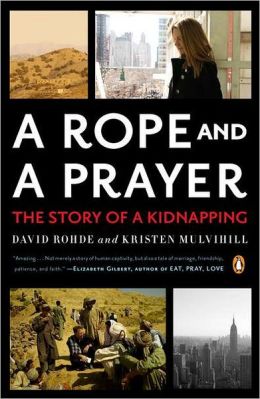
In non-fiction, I'm reading David Rohde's books Endgame, about the Srebrenica massacre in Bosnia, and A Rope and a Prayer, about his kidnapping by the Taliban. I met David when he hosted an event about Bank of Bob at the Strand in New York, he's charming and funny and kind of amazing — if I'd been through half of what he has been through, I'd probably lose my mind. But no, there he is, gracious and humble and plowing ahead with his life. So I'm reading his books partly to try to get inside his head and try to understand how he stayed sane. Also, I was in Bosnia for a chapter in Bank of Bob, and I met people who work with women who survived the massacre. As I read Endgame, my horror at the tragedy and appreciation for the work is only deepening.

I'm about halfway into Bill Bryson's At Home, which bears his usual exuberance over details most of us wouldn't even think to notice, an enthusiastic curiosity that remains with you long after you read. His African Diary was one of the inspirations for what became The International Bank of Bob.

John Hodgman's three encyclopedias of Complete World Knowledge, most recently That Is All, have been making my bathroom a much more enjoyable place for years.
Visit Bob Harris's website.

The Page 69 Test: Bob Harris's Prisoner of Trebekistan.

--Marshal Zeringue

Thursday, May 2, 2013

Joanna Hershon

Joanna Hershon's latest novel is A Dual Inheritance.

Recently I asked the author about what she was reading.  Hershon's reply:
I’m finally reading The Brief and Wondrous Life of Oscar Wao, which—because it’s written by Junot Diaz—is just cracking with energy and humor and bravura from page one. I’m looking forward to getting into the history of the Dominican Republic, getting lost in an unfamiliar world. But I keep cheating on this novel with a book of short stories, Glory Goes and Gets Some by Emily Carter, which I bought at WORD bookstore in Greenpoint, during an event for Emily Books. Emily Carter’s stories are poetic, funny, sharp, sad and sometimes monotonous (which seems about right, as they’re all tales of addicts or recovering addicts).

I also keep getting distracted by issues of The New Yorker. I’m half way through a story by Tessa Hadley, which is right where I want to be because when I’m reading a story by Tessa Hadley I never want it to end.

Also, on my bedside table is My Scarlet Ways, a book of poetry by my friend Tanya Larkin. We met as teenagers and would go to an Italian restaurant and write together in our journals, reading passages to each other aloud. It’s thrilling to see that my adolescent notion of her brilliance was, in fact, correct.
Visit Joanna Hershon's website.

Hershon is also the author of Swimming, The Outside of August, and The German Bride. Her writing has appeared in One Story, The Virginia Quarterly Review, Post Road, the literary anthology Brooklyn Was Mine, and was shortlisted for the 2007 O. Henry Prize Stories.

The Page 69 Test: The German Bride.

My Book, The Movie: The German Bride.

--Marshal Zeringue

Wednesday, May 1, 2013

Kimberly McCreight

Kimberly McCreight attended Vassar College and graduated cum laude from the University of Pennsylvania Law School. After several years as a litigation associate at some of New York City’s biggest law firms, she left the practice of law to write full-time. Her work has appeared in such publications as Antietam Review, Oxford Magazine, Babble, and New York Magazine online.

McCreight's new novel is Reconstructing Amelia.

Last month I asked the author about what she was reading. McCreight's reply:
I just finished Emily Brazelon’s wonderful Sticks and Stones. I was interested because my novel involves bullying, but also as a mother. In my own research, I’d already read about a number of the incidents recounted in Ms. Brazelon’s book, but she shed a new and insightful light on each one. I particularly appreciated how she explored bullying from numerous vantage points—that of victims and perpetrators, as well as parents and school administrators. Ms. Brazelon did an excellent job of portraying bullying as the complex social problem it is.

On the fiction front, I just finished The Fault in Our Stars. I picked it up because of the deafening roar of praise coming from all directions. And wow, the book is just as incredible as everyone says. I say that not as an adult reading a YA book, either, but as a person reading a fantastic book, period. The Fault in our Stars is truly one of the best books I’ve read in a very long time, maybe ever. The characters are so nuanced and yet so utterly relatable and the writing is subtle and lovely. Every time I had to put it down I could not wait to get back to reading it.
Watch the trailer for Reconstructing Amelia, and learn more about the book and author at Kimberly McCreight's website and blog.

The Page 69 Test: Reconstructing Amelia.

--Marshal Zeringue