Wednesday, June 24, 2015

Alexander H. Harcourt

Alexander H. Harcourt is Professor Emeritus in the Anthropology Department at the University of California, Davis. He is the coauthor of Gorilla Society and Human Biogeography and co-editor of Coalitions and Alliances in Humans and Other Animals.

His new book is Humankind: How Biology and Geography Shape Human Diversity.

Recently I asked the author about what he was reading. Harcourt's reply:
Bernard Cornwell’s Waterloo.

Waterloo was published in 2014, but I came across it just this last month, May 2015, in the wonderful Daunt Books on Fulham Rd. in London. Let me give an example of the store’s excellence. I had just got back from Sicily. A friend told me about Leonardo Sciascia, a writer from there, dead 15 years ago. In a spirit of extravagant, even ridiculous optimism, I asked the salesperson behind the Daunt counter if by any chance they had any Sciascia. Instead of a puzzled look, he took me straight to the foreign authors bookshelves, and there pointed to five books by Sciascia. I bought the lot.

Back to Waterloo. Much has been written about the battle of Waterloo. But Bernard Cornwell with his skill as a fiction writer, most relevantly of the Richard Sharpe Napoleonic Wars series, energetically and fascinatingly describes that awful day. And the aftermath - the wounded left for days some of them, stripped by looters, even killed if they struggled.

The book reminded me once again of the tactical and strategic brilliance of Wellington (I am not one of Wellington’s several detractors). Taken completely by surprise just three days previously at Napoleon’s sudden appearance with a massive army, Wellington as so often deployed his army along a ridge, so forcing Napoleon to attack uphill. And the rest is history, improved in the retelling.

Cornwell’s book is about only Waterloo. For a general history of Wellington’s soldiering, Elizabeth Longford’s Wellington. The Years of the Sword is outstanding.

Ben Pastor’s Tin Sky.

This is the fourth in Ben Pastor’s Martin von Bora series from the almost always superb Bitter Lemon Press. The Press publishes mostly non-English language crime fiction translated into English. Going for a dozen years now, it has produced the works of around fifty authors from across the world.

Ben Pastor’s detective is Wehrmacht officer Martin von Bora. All the von Bora books take place during WWII. Others in the series are, in order, Lumen, Liar Moon, and A Dark Song of Blood. Of the previous two that I reviewed on Amazon, I wrote:
Fascinating. A combination of whodunit, and psychological exploration of conflict of loyalties - personal, professional, idealogical. P.D. James could not have penned it better.

A flawless interweaving of detective story, conflict of loyalties, and unexpected complexity of character in a time, WWII, when our sympathies should be straightforward, but which Ben Pastor skillfully manipulates down unexpected paths.
Tin Sky is set in the Ukraine during the 1943 German counter-offensive there against the Russians. The book promises to be as excellent a read as the others, judging from praise in Publishers Weekly, Booklist, and the Sunday Times, and from the first few pages that I have read, along with page 99 - where if von Bora does not buy the magnificent stallion, its owner will kill it to sell its flesh.
Learn more about Humankind at the publisher's website.

--Marshal Zeringue

Tuesday, June 23, 2015

Patricia Abbott

Patricia Abbott is the author of more than 125 stories that have appeared online, in print journals and in various anthologies. She is the author of Monkey Justice and Home Invasion and co-editor of Discount Noir. She won a Derringer award for her story "My Hero."

Abbott's new novel is Concrete Angel.

Recently I asked th eauthor about what she was reading. Her reply:
As a writer of short stories, I am always drawn to a collection of stories and Russell Bank's new collection, A Permanent Member of the Family, went right on my kindle. Two of Banks' earlier books, Continental Drift and Affliction, were landmark works for me. In this collection we read about, mostly men, at pivotal moments in their lives. The title story was especially poignant: a divorced father watches his children's visits diminish after the family dog, who lives with him, dies. It was all about the dog is what he must take away.

Bad Feminist (Roxane Gay) is a brilliant series of essays about being a black woman in 21st century America. She writes beautifully, and I was especially taken aback by her experiences teaching at a university in northern Michigan. Every person she met assumed that because she was black she was from Detroit. Although Gay discusses big ideas in Bad Feminist, she presents them in a down to earth way making them very accessible. And her references to pop culture icons and events makes it a treat to read. She can't help but charm you.

Hush Hush (Laura Lippman) Lippman returns to her Tess Monaghan series with an especially strong entry. Her subject is motherhood and she manages to make us see the difficulties, perplexities, and joys of the condition in equal measure. When a mother, who killed her infant daughter in a post-partum depressive state, is released from the hospital, trouble ensues. A highly thought-provoking book.

The Slaves of Solitude was written by Patrick Hamilton in 1947. It's an unusual book where very little happens and yet you cannot put it down. A woman must leave her job and home when the Blitz endangers her. She finds a home in a fairly horrible boarding house where a fellow boarder takes it on himself to bully her. How she finally rids herself of him keeps the paging turning. The subject and writing is mesmerizing.

The Boys in the Boat was a selection of my book club and I was not enthusiastic about reading a book about rowing. Yet I found myself turning page after page in a frenzy. Daniel Jackson Brown pulls in all sorts of events of the time to enrich the story. We learn about rowing, the lives of the boys, Seattle in the thirties, the boat-maker and boat-making, the coach, the Depression, the dust bowl, various illnesses and their treatment in the times, Nazi German, Olympic politics, Leni Riefenstahl. Just an amazing book.

And finally, right now I am reading Hold Still (Sally Mann). Especially amazing is how thorough she is in keeping artifacts from her life to highlight the book. Again, lovely writing. I have only gotten as far as the murder/suicide of her in-laws, which kept me up too late.
Visit Patricia Abbott's website.

The Page 69 Test: Concrete Angel.

--Marshal Zeringue

Monday, June 22, 2015

Jessica Alcott

Jessica Alcott lives with her husband and their two cats. She graduated from Bennington College and has worked at a children’s publisher in the UK. Even When You Lie to Me is her first novel.

Recently I asked the author about what she was reading. Her reply:
The last book I read that made a huge impression on me was Station Eleven by Emily St. John Mandel. It's won tons of prizes and it's a bestseller to boot, so most readers will probably be familiar with the plot, but just in case: it's an elliptical narrative about the end of the world we know and the beginning of a new one for the survivors of a deadly plague. That makes it sound much more dystopian than it is; what it's really about is loss and sadness and the meaning and importance of art, how there must be more to existence than survival. Of course that kind of theme is going to be catnip to a writer's ego, but it's such a lovely, quiet, ruminative, melancholy (and throw in any other positive adjectives you can think of) book that it's stayed with me for months.

On the YA side of things, I recently reread Judy Blundell's stunning What I Saw and How I Lied, which won the National Book Award. This book does not get nearly the amount of attention it deserves; it's a coming of age with noir elements, set in 1947 in Florida, and the heat of it makes you stick to your seat. It's gorgeously written and tightly plotted, and the last few lines are some of my favorite ever.

Finally, I just started William Fiennes' The Snow Geese, which is a beautifully written non-fiction account of migration, of both birds and people. It's warm and empathetic and observant of the kind of details that most people miss. Unfortunately it's out of print in the US, but it is well, well worth seeking out.
Visit Jessica Alcott's website.

--Marshal Zeringue

Sunday, June 21, 2015

Brandon R. Brown

Brandon R. Brown is a Professor of Physics at the University of San Francisco. His writing for general audiences has appeared in New Scientist, SEED, the Huffington Post, and other outlets. His biophysics work on the electric sense of sharks, as covered by NPR and the BBC, has appeared in Nature, The Physical Review, and other research journals.

Brown's new book is Planck: Driven by Vision, Broken by War.

Recently I asked the author about what he was reading. Brown's reply:
I’m reading two books, one quickly and one very slowly. The faster book is The Voice of Dolphins and Other Stories, a mostly forgotten collection by the late physicist Leó Szilárd. A friend loaned this book to me after seeing my biography of Max Planck. Szilárd was one of the physicists who set up the first nuclear reactor and, fleeing Nazi Germany, contributed to America’s Manhattan Project during WWII. He advocated using the bomb in demonstration only and was horrified to see it dropped on cities. He wrote the Dolphins pieces of fiction circa 1960, and the main story casts a forward-looking history to 1985. He accurately foresees the cold war, many specific issues in the Middle East, and the formation of the EU. The title relates to the fact that we’ve figured out that dolphins are more intelligent than humans and we start turning to them for advice. Even this bit of fantasy is handled seriously, right along with the speculative narrative of geopolitics, and the tone of dry history works perfectly. The book is simultaneously provocative and giggle inducing.

The slower book is an academic collection, Subjective Time: The Philosophy, Psychology, and Neuroscience of Temporality. I am becoming increasingly obsessed by the biology of time, and this book covers the technical ABC’s of how we think about time and what we observe of the brain as it processes time. Every page warrants rereading, chewing, and contemplating, so I’m taking it slowly, with lots of note taking along the way. As with other topics related to consciousness, it can be alternately disturbing and exhilarating to realize how much of our standard daily reality is a functional, comforting illusion. The perception of time is no different, but time is so fundamental to existence and thinking itself that it offers extra pretzel twists for the reading brain.
Visit Brandon Brown's website.

My Book, The Movie: Planck.

--Marshal Zeringue

Saturday, June 20, 2015

Jax Miller

Jax Miller was born and raised in New York but currently lives in the Irish countryside. In 2013 she was shortlisted for the Crime Writers Association Debut Dagger award for her first (unpublished) novel titled The Assassin’s Keeper under the pseudonym Aine O Domhnaill.

Her new novel is Freedom's Child.

Recently I asked the author about what she was reading. Miller's reply:
I’ve just started The Axeman’s Jazz by Ray Celestin. I was first attracted to its fabulous cover before reading the back. It’s a fiction that surrounds the real life crimes of the New Orleans serial killer, The Axeman, who butchered 6 people in 1919. From the get-go, the characters are written so incredibly well that you can feel them breathing next to you, not to mention the colorful setting that’s worded so incredibly that you can taste the Cajun spice on your tongue. While I’m a person who really tries not to read while writing (lest that author’s voice bleeds into my own), I can’t seem to put this one away. I’m still early on, and a dreadfully slow reader, so I can’t wait to see how this turns out.
Visit Jax Miller's website.

My Book, The Movie: Freedom's Child.

The Page 69 Test: Freedom's Child.

--Marshal Zeringue

Friday, June 19, 2015

Laura Dave

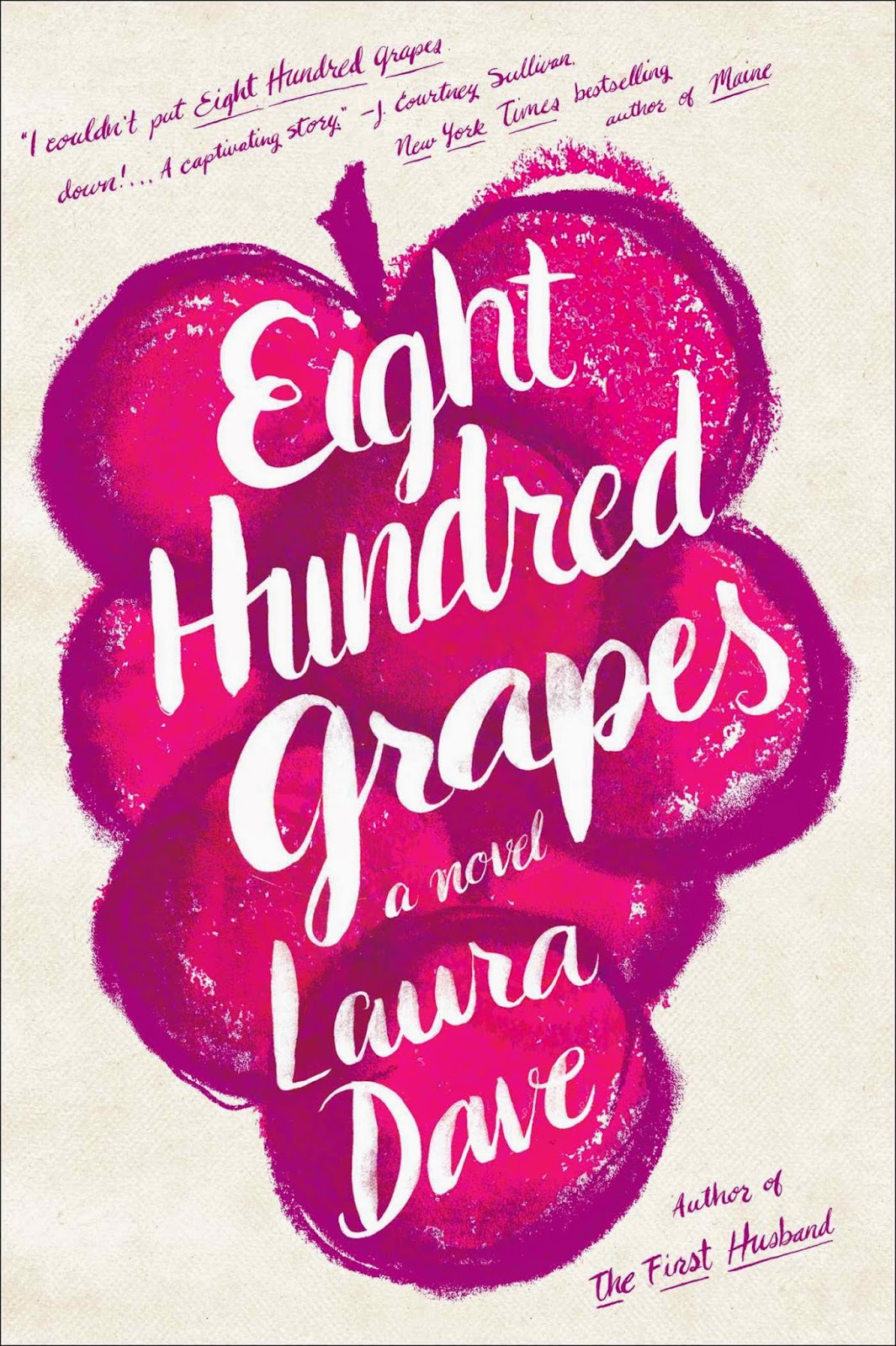
Laura Dave is the author of the critically acclaimed novels The First Husband, The Divorce Party, London Is The Best City In America, and the newly released Eight Hundred Grapes.

Three of her novels have been optioned for the big screen with Dave adapting Eight Hundred Grapes for Fox2000.

Not so long ago I asked the author about what she was reading. Dave's reply:
The Rocks, by Peter Nichols

Romantic, heartbreaking and generously told, Peter Nichols The Rocks is a love story that spans six decades, affecting not just the torn-apart lovers, but also their families and those they care about. And if the drama isn’t enough to get you digging in, the novel is set against the backdrop of a seaside community. I keep stealing time to read this novel, which reminds me of another of my favorite love stories: The Lost Legends of New Jersey by Frederick Reiken. In rewarding ways, each novel looks at love and forgiveness, and the myriad of ways love stands (and fails) the test of time.
Visit Laura Dave's website.

--Marshal Zeringue

Thursday, June 18, 2015

Conevery Bolton Valencius

Conevery Bolton Valencius is an associate professor in the Department of History and also affiliated faculty of the School for the Environment at the University of Massachusetts Boston.

She is the author of The Lost History of the New Madrid Earthquakes.

Not so long ago I asked Valencius about what she was reading. Her reply:
I read in the course of my research as an American historian, I read for my own pleasure and my own soul, and I read as part of a family. Now that we are through with a spring semester made grueling in Boston by seven feet of snow and nearly a month of missed school, I am having a great time with all three.

In my research, I’m interested in the history and technology of fracking. Right now I’m learning from the vivid writing and observation in Gregory Zuckerman’s The Frackers and the historical insights of Brian Frehner’s Finding Oil: The Nature of Petroleum Geology, 1859-1920.

In August, I get to travel to Mumbai, India to visit Ummeed Child Development Center, a fabulously innovative developmental pediatrics clinic I’ve been privileged to see grow over the past decade and a half. In preparation, I’m reading recent award-winning Indian fiction, starting with Aravind Adiga’s The White Tiger and Kiran Desai’s The Inheritance of Loss.

For our family of five, reading aloud is a way to survive long car trips—we traverse a good chunk of North America each summer, and simply getting across the length of Tennessee is daunting—and a way to find common ground, common humor, and shared time. The Discworld novels of Terry Pratchett are imaginative, funny, full of action, and accessible across many levels of experience, vocabulary, and teenage cynicism. In the best of his books, Pratchett wrestles with fears, hopes, and moral compass in ways that move me to the core. We’ve been reading the novels featuring hard-bitten police commander Sam Vimes (just now starting Feet of Clay), but I once talked myself into a job largely on the strength of Pratchett’s Going Postal. Pratchett’s four-part Tiffany Aching series is an immensely powerful story of growing up girl. Plus, it has small blue fairy-men that fight, drink whiskey, steal sheep, and have accents so hilarious that a child of mine once laughed milk out his nose at a roadside restaurant listening to his daddy read in their voices. Wee Free Men, the first in the series, now tops my list of books to give any young teenager within reach—along with Michelle Tea’s new, luminous Mermaid in Chelsea Creek.

When my husband and I are too tired from chores and kid-herding to think straight, we read aloud. We courted and built a family reading the Harry Potter books as fast as J.K. Rowling wrote them; the Aubrey-Maturin seafaring novels of Patrick O’Brian (the “Master & Commander” series) kept us sailing smooth despite a stretch of high winds. We’ve recently been on a noir bend, most recently with Raymond Chandler’s The High Window and The Lady in the Lake. Dialogue that zings coolly by, insights that sting, and shady nighttime intrigue: as summer heat lowers down upon us, these books offer pleasure cool as a martini!
Read more about The Lost History of the New Madrid Earthquakes.

--Marshal Zeringue

Wednesday, June 17, 2015

K. David Jackson

K. David Jackson is professor of Portuguese and director of undergraduate studies of Portuguese at Yale University. His new book is Machado de Assis: A Literary Life.

Recently I asked the author about what he was reading. Jackson's reply:
I'm reading Among the Sinner: a novel by Karen von Kunes, published in 2013. Karen is Czech, escaped in her teens, and writes from a deep human experience. After invoking the meaning of "zazemí" (what one needs in life, background, education, position) the novel follows the live and struggles of Milena. Karen teaches Czech and is a colleague and friend at Yale.
Learn more about Machado de Assis at the Yale University Press website.

--Marshal Zeringue

Tuesday, June 16, 2015

Brenda Bowen

A former children’s book publisher, Brenda Bowen is now a literary agent and children’s book author. Her new novel is Enchanted August.

Recently I asked the author about what she was reading. Bowen's reply:
At last year’s Book Expo conference in New York, I was accosted by a wilting publicist at the Scribner booth. It was almost the end of the event, and supplies, and energy, were running low. “Miranda July?” she said, hopefully.

I snapped up the galley she offered me. One Summer Friday a few years ago, I had left the office blissfully at 1PM and headed down to the Independent Film Center in the Village to see Miranda July’s oddball film The Future. It was “highly idiosyncratic,” to quote one reviewer: ostensibly about a couple of tentative Brooklynites who adopts a cat, it was really about the workings of July’s highly neurotic mind. I loved it.

So when I got the galley for The First Bad Man a year ago I read it right away. And I just read it again – this time in hardcover – last month. “Highly idiosyncratic” almost does not do it justice. Here’s a book about a woman, Cheryl, who is so caught up in the minutiae of her own life that she does not even have a second set of silverware for guests. She had even codified this shut-off way of life. Although, “It doesn’t have a name,” she says in the book. “I just call it my system.”

Cheryl’s system works so well that her footprint on this earth is very tiny indeed: “After days and days alone [the system] gets silky to the point where I can’t feel it any more. It’s as if I don’t exist.”

Into this blinkered, limited life bursts Clee, a difficult, petulant, angry, short-shorts-wearing teenager who is foisted on Cheryl for reasons that only happen in a Miranda July story. She is to Cheryl’s life what the endpapers of this book are to the cover – a shocking burst of color in a monochrome existence. [See the images below right.] The two of them go from being antagonists in the etymological sense to becoming a badly-assorted couple to growing into a most improbable family. (Exactly how that family is constructed is left neatly to the reader’s interpretation of the very last pages. A nice, writerly sleight of hand by Miranda July.)

July’s ability to lay every single thought and anxiety bare is something I admire and am amazed by. There is nothing she won’t tell the reader. Here is Cheryl, when her extreme puzzlement at the idea that she might be loved leads her to be cruel:

“Her feelings. I had hurt them. She had feelings and I had hurt them. I stared at the bathroom door, one hand against the wall to steady myself.”

The book takes a long and wacky turn in the middle as Cheryl and Clee work through their own charged relationship, but by the end, when a certain character improbably named Kubelko Bondy appears on the scene, the book is tenderness itself.

Love, family, weird sex, motherhood, the modern office, the effect of a certain green corduroy dress – it’s all here in The First Bad Man. Give Miranda July a try if you’re not devoted to her already. If there’s hope for her crazy Cheryl (and there is!), there’s hope for us all.
Visit Brenda Bowen's website.

--Marshal Zeringue

Monday, June 15, 2015

Jon Talton

Jon Talton's many novels include the David Mapstone Mysteries and the thriller Deadline Man. He is also a veteran journalist, and a former business editor of the Cincinnati Enquirer.

Talton's latest David Mapstone Mystery is High Country Nocturne.

Recently I asked the author about what he was reading. His reply:
Normally, after finishing a new mystery, I would be taking a spin through the best new mystery writing. But I have been commissioned to write a history of Phoenix. So, like my character David Mapstone, I have switched into historian mode. This has required reading and re-reading histories of Phoenix and Arizona. The best is Philip VenderMeer’s Desert Visions and the Making of Phoenix. Then I have been working on primary sources and with archivists. It amazes me how much more there is to learn about a city I think I know so well, and of course this gives me material for future Mapstone Mysteries.

My pleasure reading is Lenin’s Tomb: The Last Day’s of the Soviet Empire, by David Remnick and winner of the 1994 Pulitzer Prize. Despite the passage of time, the book is a riveting read and explains much about Russia today. My fiction reading has been confined to short stories in Paris Review, Tin House and n+1. Getting back to mystery reading should come later this year.
Visit Jon Talton's website.

My Book, The Movie: High Country Nocturne.

--Marshal Zeringue