Wednesday, January 3, 2018

Catherine Reef

Catherine Reef is the author of more than 40 nonfiction books, including Noah Webster: Man of Many Words, Frida & Diego: Art, Love, Life, Florence Nightingale: The Courageous Life of the Legendary Nurse, and other highly acclaimed biographies for young people. She lives in College Park, Maryland.

Reef's latest young adult biography is Victoria: Portrait of a Queen.

Recently I asked the author about what she was reading. Her reply:
Right now Sylvia Plath is the subject of an exhibition at the National Portrait Gallery in Washington, D.C. Letters, photographs, original artwork, objects as diverse as Plath’s typewriter and handmade paper dolls—the artifacts reveal a Plath whom readers of her poetry might not know. I was especially intrigued because I had just read a book that showed me another lesser-known side of the confessional poet, Plath the writer of short prose. Johnny Panic and the Bible of Dreams, first published in 1977, is a collection of short stories, essays, and diary entries.

Writing fiction did not come as naturally to Plath as composing poetry did. Plath’s husband, Ted Hughes, called her ambition to write salable stories a burden to her. It seemed to me as I read this collection that plotting was not one of her strengths, or perhaps one of her interests. She was better at exploring characters and situations on the page. To make a story from what she had written, she often hurried it to an unsatisfying conclusion. Stories she wrote in the late 1950s and early 1960s aimed at women and girls, for example, conform to the formula for those published in women’s magazines of the period and conclude by affirming traditional values. “Initiation” ends with teenage Millicent rejecting admission into an elite sorority because her best friend has been excluded. In “Day of Success,” a housewife who briefly doubts that her husband finds her attractive learns to embrace her ordinariness. Other stories end in trite ironic twists that can only be called amateurish.

Using language to strong effect was what truly interested Plath. Who else would think to personify panic like this: “His love is the twenty-storey leap, the rope at the throat, the knife at the heart”? The reflected sun was “red as a dwarf tomato,” Plath wrote; blood was a “thick, sweet honey.” I savored her stories for their poetry.

Biographies are often in my to-be-read stack. Recently I finished Peter Guralnick’s 2015 book, Sam Phillips: The Man Who Invented Rock and Roll. The title claim is debatable, but Guralnick did a superb job of creating a well-rounded portrait of Phillips, the founder of Sun Records in Memphis, which is what a good biographer should do. Phillips emerges as a charming visionary with a remarkable ability to make possible the life he imagined for himself. He built Sun Records in the belief that the American South was rich in undiscovered musical talent, that he need only open his studio door and wait for tomorrow’s stars to walk in. And it is astonishing how many great names did amble in: Ike Turner, Howlin’ Wolf, Elvis Presley, Johnny Cash, Roy Orbison, and Charlie Rich, among others. Phillips knew enough simply to let each one play, to listen as he revealed his strengths, “to recognize that individual’s unique quality and then find the key to unlock it,” as he said. As a fan of early rock and roll, I loved all this history.

Guralnick’s biography is atypical because he was acquainted with his subject; in fact, he knew Phillips well. He acknowledges this friendship in his “Author’s Note,” stating that his book was “written out of admiration and love.” Are these sentiments unusual? I would argue that many biographers grow fond of their subjects, even those who aim for that cold, elusive quality we call objectivity. Guralnick’s affection for Phillips seems not to have kept him from presenting his subject’s less flattering side—Phillips’s alcohol abuse and extramarital relationships are given due attention. And for the twenty-five years that he knew Phillips, Guralnick becomes a character in the story he is telling. His biography takes on aspects of a memoir but remains focused on its subject.

One joy of reading is returning to books loved long ago and reading them again with fresh eyes. I’ve done this with novels that spoke to me in early adulthood, and recently I did it with a set of stories I treasured in childhood, the “Oz” books by L. Frank Baum. Baum wrote fourteen novels set in his “fairy country.” I reread the first five, which Barnes & Noble’s Fall River Press released in a single, seven-hundred-plus page volume in 2014. These stories are nothing if not formulaic: if Dorothy does not end up in Oz by means of a tornado, then she is brought there by an earthquake or a storm at sea. She completes several journeys accompanied by fantastical friends. Most famously, in The Wonderful Wizard of Oz, she walks the road paved with yellow brick accompanied by the Scarecrow, Cowardly Lion, and Tin Woodman, aka Nick Chopper. On other travels her companions include a talking hen and the rainbow’s daughter. I quickly learned that characters introduced in one book are likely to show up in others, and I looked forward to meeting them again. These books celebrate lasting friendship.

I did encounter stereotypes. An army of girls, for example, carries knitting needles as weapons and cares most about jewelry and new gowns. And there are occurrences that seem bizarre and possibly inappropriate today. I’m thinking of the boy Tip in The Marvelous Land of Oz, who learns that he is really the princess Ozma, that he began life as a girl but was bewitched in infancy. When the truth comes to light he is transformed again despite his protest that “I want to stay a boy,” and “I don’t want to be a girl!” This episode feels very wrong in our time of growing sensitivity to transgender issues.

Still, Baum’s novels for the most part are delightfully imaginative literary comfort food. I find myself missing his magical land weeks after I put on my own enchanted slippers and came home.
Visit Catherine Reef's website.

Coffee with a Canine: Catherine Reef & Nandi.

My Book, The Movie: Victoria: Portrait of a Queen.

--Marshal Zeringue

Tuesday, January 2, 2018

Helen Dickson

Helen Dickson lives in South Yorkshire with her retired farm manager husband. On leaving school she entered the nursing profession, which she left to bring up a young family. Having moved out of the chaotic farmhouse, she has more time to indulge in her favorite pastimes. She enjoys being outdoors, traveling, reading and music. An incurable romantic, she writes for pleasure. It was a love of history that drove her to writing historical romantic fiction.

Dickson's new novel is Carrying the Gentleman's Secret.

Recently I asked the author about what she was reading. Her reply:
The books I read are many and varied. I am the author of many Historical Romance books but Historical Romance is my least read genre. I read mainly fiction, non-fiction if I am doing research for the books I am writing.

I am currently reading Origin, Dan Brown’s latest book. I have read most of his books, my favourite being The Da Vinci Code, one of the best-selling novels of all time. Right from the beginning to the end of his books Dan Brown’s stories follow the same exhausting, rollercoaster yet exhilarating pattern at a cracking pace. Origin is set in Spain. Robert Langdon, Harvard professor of symbiology and religious iconology, is a compelling character, claustrophobic and still wearing his Mickey Mouse watch – which I found quite endearing. I didn’t find the story as exhausting as the others I have read but it is equally as compulsive a read. Langdon’s former student and friend, Edmund Kirsch, an inventor, futurist and atheist who is about to reveal to the world his breakthrough that will challenge the fundamentals of human existence, is murdered. Langdon must find the password to unlock Kirsch’s secret. To escape those who are trying to prevent him, he goes on the run with a beautiful woman – the future Queen of Spain. The story is seething with church dignitaries and evil doers, but who is pulling the strings? “Is there a God?” This is one of the fundamental questions everyone asks at some time or other. “Where do we come from? Where are we going?” What Dan Brown has written is powerful and thought provoking. The more I read the more I found myself questioning religion and science. Is it possible to be a scientist and religious? The book provides a good talking point, creating many differences of opinions, often heated, sometimes humorous, but always stimulating. All in all Origin is a brilliant read.

Crime books have made up most of my reading matter for several years, one of my favourite authors being Elizabeth George and the Detective Inspector Thomas Lynley British crime series. The twenty books of the series provide a long and meaty read. Assigned to Scotland Yard, Lynley is also a peer or the realm. He is paired up with working class Sergeant Barbara Havers. Havers is small, overweight, untidy, temperamental, with a bad haircut and a problem with authority, while Lynley is good looking, charming, posh, privileged and often unthinkingly arrogant. They are chalk and cheese - she drives a clapped out Mini and he drives a Bentley - she lives in a one room flat in an unsavoury part of London - he has a house in Mayfair and a country estate in Cornwall. Their working relationship is fraught with class resentment, but often funny and heart-warming. The books take you from the back streets of London to quiet country villages and lovely old manor houses, the Highlands of Scotland and as far flung as Lucca in Italy.

In the early books Lynley struggles to deal with his own traumas. He marries Helen but Deborah, a photographer, is the woman he loves. She is married to his closest friend Simon St James, a forensic scientist, who often helps Lynley in his work. Simon was crippled in a car crash. Lynley was driving the car. He is haunted by what happened and blames himself entirely.

I like the fact that each book in the series has a new crime to solve and Lynley and Havers throw themselves into each case allotted to them. I was intrigued by the interaction between the five lead characters as they navigate their way through the clashes of personality and class, the traumas and complexities of their lives. It is endearing to see how a bond develops between Lynley and Havers as the books progress and a delight to see how they overcome their differences to crack the case and cement their relationship.

I would like to mention one of my favourite books which I have read several times and will do so again. The Far Pavilions by M.M. Kaye.

M.M Kaye, who lived for most of her life in India, captures the very essence of that vast, mysterious and sunbaked continent. This book is full of intrigue and heartbreak and deeply evocative of India – the sights, the smells, the culture and the colour. You can almost smell the dust on the mornings of the rains. There is also great depictions of India at the time of the Raj – of hatred and bloodshed during the dark days of the mutiny. It’s a fabulous book.
Visit Helen Dickson's website.

My Book, The Movie: Carrying the Gentleman's Secret.

The Page 69 Test: Carrying the Gentleman's Secret.

--Marshal Zeringue

Monday, January 1, 2018

Thomas Perry

Thomas Perry's novels include the Jane Whitefield series (Vanishing Act, Dance for the Dead, Shadow Woman, The Face Changers, Blood Money, Runner, Poison Flower, and A String of Beads), Death Benefits, Pursuit, the first recipient of the Gumshoe Award for best novel, and The Butcher's Boy, which won the prestigious Edgar Award.

His new novel is The Bomb Maker.

Recently I asked Perry about what he was reading. His reply:
I’ve read quite a few books this year that I would say are special in one way or another. The first that comes to mind is Deon Meyer’s Fever. Deon Meyer is a crime writer who has produced some of the most suspenseful fiction of the past few years—books like Thirteen Hours. He’s South African and writes in Afrikaans, but has an able translator. Fever is a departure for him, a post-apocalyptic story about the South African survivors of a worldwide plague who try to survive, then to rebuild a new, practical, and just society. But as always in Meyer’s books, it’s the characters that thrill you. We watch a boy grow into a young man and meet the right girl, not an unfamiliar tale. But it’s a long book, and between readings I actually caught myself worrying about them and those around them.

Jeffrey Siger has a new book called An Aegean April. It’s one of a number of books he’s placed on various Greek Islands. This time it’s Lesbos, where hundreds of thousands of refugees from across the Mediterranean have been washed up or smuggled ashore. It’s a good, thrilling book, but what makes it remarkable is the fact that the crimes, the action, and the moral problems are all natural products of this genuine humanitarian crisis. Siger, who lives in Greece much of the time, manages to educate the reader with the story, not with explanations. It’s a real achievement.
Visit Thomas Perry's website and Facebook page.

--Marshal Zeringue

Saturday, December 30, 2017

Casey Doran

Casey Doran's second Jericho Sands book is The Art of Murder.

Recently I asked the author about what he was reading. Doran's reply:
I recently finished Chuck Palahniuk’s Choke. I’ve actually read this book three or four times, but one of the things that I love about it is with every new pass, I find another element or device that I missed on previous reads. Choke features Palahniuk’s trademark style. No word is wasted. The story is minimalist and to the point, but still multilayered and complex. It also has one of my favorite opening lines:
“If you’re going to read this, don’t bother.”
How do you not keep reading after that?

Victor Mancini narrates this gem. His voice isn't for the squeamish or the easily shocked. But he draws you in immediately. Victor is dynamic, damaged and has relationship issues that would make a lot of the stuff on Jerry Springer look tame. A washed up med student, Victor hustles cash from unsuspecting diners by pretending to choke on his meal, counting on some unsuspecting good samaritan to rush to his aid. Victor then manages to get these ‘marks’ to send him money, which he then uses to help pay for his mother’s mounting medical bills. When he’s not coning altruistic diners, he’s cruising sex addiction meetings and getting laid in a church bathroom. A true ‘anti-hero’, Victor is nonetheless relatable. At his core he’s merely a lost person trying find himself in an ever changing landscape.
Learn more about The Art of Murder, and follow Casey Doran on Twitter.

My Book, The Movie: The Art of Murder.

The Page 69 Test: The Art of Murder.

--Marshal Zeringue

Thursday, December 28, 2017

C. Courtney Joyner

C. Courtney Joyner is an award-winning writer of fiction, comics, and screenplays. He has more than 25 movies to his credit, including the cult films Prison, starring Viggo Mortensen; From a Whisper to a Scream, starring Vincent Price; and Class of 1999, directed by Mark Lester. A graduate of USC, Joyner's first produced screenplay was The Offspring, which also starred Vincent Price. Joyner's other scripts have included TV movies for CBS, USA, and Showtime.

Joyner's new novel is Nemo Rising.

Recently I asked the author about what he was reading. Joyner's reply:
I am, forever and happily, a genre fiction addict and do support the habit of returning to older works, while exploring the new. At least, that’s the intention. I loved Phoef Sutton’s Colorado Boulevard. I think his humor and plotting, are just extraordinary, and throws light into dark places. Very impressive.

On the epic scale, I have to admit to never having read Thomas Harris’ Black Sunday until now. The style, so very different than Silence or Red Dragon, and to see that shift, in word choices and the rest, really fascinating to explore. It’s also a great example of the important of the time and place that a book was written, as this is now a time capsule, after all that’s tragically occurred in the Middle East.

Reading Harris’ Sunday is a near-documentary experience, thanks to his own background in law enforcement. It’s much like the feeling I had with Robin Moore’s The French Connection, although that was much more evidence/document driven in its presentation, since it was a true case history, and Harris’ just damn close. And, you have the movie comparisons with both, with two great films, catching the essence from the pages, which is no easy task, as we know.

For westerns, just re-read Frank O’Rourke’s A Mule for the Marquesa (but the movie tie-in, The Professionals); I’ve been luxuriating in Deanne Stillman’s fascinating Blood Brothers, and always have Elmore Leonard within reach, especially Valdez is Coming, which I’ve read to tatters. Also, finally getting around to Road Dogs, not a western, but certainly Dutch.

And, my “classic to take me back,” I found the wonderful Science Fiction Book Club editions of Edgar Rice Burroughs’ John Carter series, in the three volumes with the Frank Frazetta covers and pen and ink interior illustrations, all stacked in the same box at a garage sale. Five dollars later, and I was transported to Mars, battling monsters and rescuing beautiful women.

There’s controversy surrounding Burroughs now, but there’s no escaping the fact that John Carter’s pre-Tarzan mix of genre-defining adventure and science-fiction is the template for a century of fantasy work to follow. I can’t think of a better way to spend a rainy night, than with Burroughs on Mars, illustrated by Frazetta.
Visit C. Courtney Joyner's website.

My Book, The Movie: Nemo Rising.

The Page 69 Test: Nemo Rising.

--Marshal Zeringue

Monday, December 25, 2017

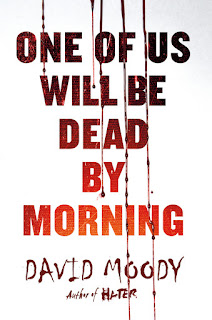
David Moody

https://us.macmillan.com/oneofuswillbedeadbymorning/davidmoody/9781250108425/David Moody first self-published Hater in 2006, and without an agent, succeeded in selling the film rights for the novel to Mark Johnson (producer, Breaking Bad) and Guillermo Del Toro (director, The Shape of Water, Pan’s Labyrinth). His seminal zombie novel Autumn was made into an (admittedly terrible) movie starring Dexter Fletcher and David Carradine. Moody has a unhealthy fascination with the end of the world and likes to write books about ordinary folks going through absolute hell.

Moody's new novel is One of Us Will Be Dead by Morning.

Recently I asked the author about what he was reading. His reply:
I’ve just finished Josh Malerman’s excellent and thought-provoking Bird Box. I’m a sucker for all things apocalyptic. There’s such a glut of end of the world stories about right now (no coincidence, I believe, considering we’re living through such bizarre and unpredictable times), but it’s hard to find stories that bring something new to the genre. Bird Box is such a book. Malerman takes a relatively simple premise and gives it a whole new and completely unnerving spin: people are committing suicide as a result of seeing undefined creatures. The only way you can be sure of surviving this apocalyptic event is to only go outside blindfolded. It’s a simple twist, but it’s also a brilliant one, because in denying his protagonists (and readers) the security of sight, Malerman ramps up the horror a hundred fold.

The book’s currently in production as a movie starring Sandra Bullock and John Malkovich. I for one can’t wait to see how a book which hinges on its characters not being able to see translates to a visual medium.
Visit David Moody's website.

My Book, The Movie: One of Us Will Be Dead by Morning.

--Marshal Zeringue

Saturday, December 23, 2017

Nicholas Montemarano

Nicholas Montemarano is the author of the novels The Book of Why (2013) and A Fine Place (2002) and the short story collection If the Sky Falls (2005).

His new novel is The Senator’s Children.

Recently I asked the author about what he was reading. His reply:
Here’s what I’ve been reading lately: plays, plays, plays, and more plays.

Several times a year I visit one of my favorite bookstores, The Drama Book Shop in New York City, and load up with plays. I see plays too—a recent favorite was Constellations by Nick Payne—but the truth is, I enjoy reading plays even more.

Novelists have much to learn from playwrights about creating and building scenes, showing rather than telling, and writing sharp, surprising dialogue. Some of the most innovative writers working today, in my opinion, are playwrights.

I’ve read many excellent plays recently, but let me mention one.

The play I just finished, which I loved, is This Is Our Youth by Kenneth Lonergan (who also wrote and directed the film Manchester by the Sea). Set in New York City in 1982, the play is about three college-age Upper West Siders who come from privileged but broken families. They’re fixated on drugs, sex, and their fading youth. They’re on the cusp of adulthood, but lost. The entire play is written in the poetry of the everyday, and it’s a thrill to read aloud. As one character says to his best friend: “Plus I’m like providing you with precious memories of your youth, for when you’re fuckin’ old…I’m like a one-man youth culture for you pathetic assholes. You’re gonna remember your youth as like a gray stoned haze punctuated by a series of beatings from your fuckin’ Dad, and like, my jokes. God damn!”
Visit Nicholas Montemarano's website, Facebook page, and Twitter perch.

The Page 69 Test: The Book of Why.

--Marshal Zeringue

Thursday, December 21, 2017

Kathryn Erskine

Kathryn Erskine is the acclaimed author of many distinguished novels for young readers, including Mockingbird, winner of the National Book Award; The Absolute Value of Mike, an Amazon Best Book and ALA Notable Book; and Quaking, an ALA Top Ten Quick Pick for Reluctant Readers.

Erskine's new book is The Incredible Magic of Being.

Recently I asked the author about what she was reading. Her reply:
Salt to the Sea, Ruta Sepetys

This is a masterpiece of a book about a little-known event near the end of World War Two. Refugees fleeing Soviet troops head to the sea, overcrowding the ships supposedly carrying them to safety. Apart from the incredibly well-researched history and storytelling, it’s worth reading simply to examine how Sepetys generates such strong characters and empathy for them (or perhaps, in the case of the Nazi youth, loathing) with such sparse language. It’s an all-nighter.

Long Way Down, Jason Reynolds

Powerful. Stunning. This verse novel will take you no time to read but much time to truly digest. The bulk of it takes place descending in an elevator as a teen considers a life changing decision on the heels of his brother’s murder. It says a lot about who we are as a society and begs the question, What would you do in such a situation?

Straw into Gold, Gary D. Schmidt

“What fills a hand fuller than a skein of gold?” is the question of the Rumpelstiltskin inspired fairy tale turned on its head and spun around like a Rubik’s cube. Like all of Gary Schmidt’s work, he doesn’t shy away from the gritty but his characters create hope in their perseverance, and you root for them on their journey, sometimes smiling, sometimes cringing, until the end, when you realize you’re left with a perfectly uplifting tale to fill your hand.

Alexander Hamilton: Revolutionary, Martha Brockenbrough

I haven’t started this one yet but I can’t wait. It’s not just the subject matter but how much I love her writing, especially epic works like The Game of Love and Death. Martha Brockenbrough is an award winning, bestselling author but even having said that I think she’s underappreciated. She’s whip smart, funny, and has the social conscience we need today to help fight our current backsliding.

Life on Surtsey, Iceland’s Upstart Island, Loree Griffin Burns

I’m loving this research, told in such an appealing style, about a volcanic island born over 50 years ago and now supporting life. It’s as much about the scientists as the land – including where and how to deposit their bodily functions!

This is Just a Test, Wendy Wan-Long Shang and Madelyn Rosenberg

I’m always fascinated that authors can write books together so I’m curious to see how Wendy and Madelyn accomplish this feat. I just started but am engaged by these characters already!
Visit Kathryn Erskine's website.

The Page 69 Test: The Incredible Magic of Being.

--Marshal Zeringue

Tuesday, December 19, 2017

Claire Douglas

Claire Douglas has worked as a journalist for fifteen years, writing features for women’s magazines and newspapers, but she’s dreamed of being a novelist since the age of seven. She finally got her wish after winning Marie Claire’s Debut Novel Award for her first book, The Sisters, which became a bestseller. Her second novel, Local Girl Missing, is now available in the US.

Recently I asked Douglas about what she was reading. Her reply:
I have just finished reading a gothic horror called The Silent Companions by Laura Purcell. I picked the book up because the cover is absolutely stunning – one of the best I have seen – and I loved the sound of the story. It’s set in the 1800s and follows recently widowed Elsie as she heads to her dead husband’s isolated family home. While there, she finds in the attic some life-sized wooden cut-outs of different people; a young girl, a gypsy boy, a washer woman and a cook, called Silent Companions and a diary of a woman who lived in the same house two-hundred years before. As she reads the diary she learns more about these Silent Companions, and her suspicions of them grow. Soon people in the house are dying and Elsie doesn’t understand why. It’s so creepy, full of rich imagery, dark and so compelling. It genuinely is one of the scariest books that I have ever read.

I’m also reading Tom’s Midnight Garden by Philippa Pearce to my children. It’s one of my favourite children’s books. It was written in the 1950s but I think still holds up as one of the best children’s stories ever! It’s about a little boy called Tom who is sent to stay with his aunt and uncle when his brother, Peter gets measles. The aunt and uncle live in a small apartment in, what would have once been, a grand house. Tom is lonely and bored. There is no garden to play in, just a small back yard. But at night, when the grandfather clock in the entrance hall strikes thirteen, he gets up to investigate and finds a door to the most wonderful garden. There, he meets a little girl called Hatty, who is dressed in Victorian clothes. It’s a story about time travel, about loneliness and friendship. It’s such a beautiful book with such a poignant ending that never fails to bring a lump to my throat.
Learn more about Local Girl Missing.

--Marshal Zeringue

Sunday, December 17, 2017

Jessica Brockmole

Jessica Brockmole is the author of At the Edge of Summer, the internationally bestselling Letters from Skye, which was named one of the best books of 2013 by Publishers Weekly, and Something Worth Landing For, a novella featured in Fall of Poppies: Stories of Love and the Great War.

Brockmole's latest novel is Woman Enters Left.

Recently I asked the author about what she was reading. Her reply:
This fall there’s been a lot of nonfiction on my reading stack, some for research, some for pleasure. One that fascinated me was Lizabeth Cohen’s A Consumers' Republic: The Politics of Mass Consumption, about the changing role of the American consumer from the Great Depression to the postwar era, and Virginia Scharff’s Taking the Wheel: Women and the Coming of the Motor Age, which traces the relationship between women and automobiles in the early twentieth century. Although I didn’t read the latter until after my own Woman Enters Left was out there in the world, I recommend it if you want to learn more about intrepid women traveling across the largely unpaved United States, like my Ethel and Florrie in their unsprung Model T.

In fiction, I’ve recently read two by authors I know, Kristina Riggle’s Vivian in Red, about a feisty octogenarian who, after he thinks he sees a ghost, takes us back to his days as a young songwriter when he wrote his one hit Broadway song, and Clarissa Harwood’s Impossible Saints, set amid the fierceness of the suffragist movement in early twentieth-century England. I had the pleasure of doing an event with Kristina this past fall and have one coming up in January with Clarissa. One of the absolute best parts of writing books is getting to meet so many other amazing authors!

Up next: I have Ken Follett’s Column of Fire waiting to dig into on the first snowy day.
Visit Jessica Brockmole's website, and follow her on Facebook and Twitter.

The Page 69 Test: Letters from Skye.

My Book, The Movie: Letters from Skye.

My Book, The Movie: Woman Enters Left.

The Page 69 Test: Woman Enters Left.

--Marshal Zeringue