Saturday, May 13, 2023

D.W. Buffa

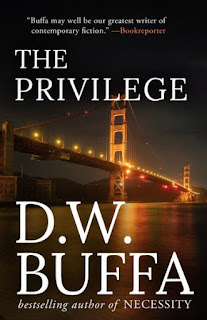
D.W. Buffa's recent novel is The Privilege, the ninth legal thriller involving the defense attorney Joseph Antonelli. The tenth, Lunatic Carnival, is due out soon. He has also published a series that attempts to trace the movement of western thought from ancient Athens, in Helen; the end of the Roman Empire, in Julian's Laughter; the Renaissance, in The Autobiography of Niccolo Machiavelli; and, most recently, America in the twentieth century, in Neumann's Last Concert.

Here is Buffa's take on Jane Austen's Mansfield Park:
The first page of Jane Austen’s novel, Mansfield Park, tells the story:

“About thirty years ago, Miss Maria Ward of Huntingdon, with only seven thousand pounds, had the good luck to captivate Sir Thomas Bertram, of Mansfield Park, in the county of Northampton, and to be thereby raised to the rank of a baronet’s lady, with all the comforts and consequences an handsome house and large income.” Lady Bertram had two sisters, neither of whom was so fortunate, because there “are not so many men of large fortune in the world as there are pretty women to deserve them.”

One of the sisters married a clergyman, Reverend Mr. Norris, “who had scarcely any money at all.” The other sister married a naval officer, Lieutenant Price, “without education, fortune, or connections,” and before they had been married eleven years had nine children. The eldest daughter, Fanny, who is nine, is sent to live with Mrs. Price’s sister, Lady Bertram, at Mansfield Park. Lady Bertram has four children of her own, two sons and two daughters, all of them several years older than Fanny. They think Fanny remarkably stupid, so stupid she does not know the principal rivers in Russia and has never heard of Asia Minor. They, themselves - and this tells something of how different education was then to what it is now - used to repeat in chronological order the kings of England, and the Roman emperors “as low as Severus,” a good deal of ‘Heathen Mythology, and all the Metals, semi-Metals, Planets and distinguished philosophers.” Fanny Price knows nothing, but, as we will discover, is more intelligent, and has better judgment, than anyone else at Mansfield Park.

It is a rule, sometimes understood by politicians, that it is often more difficult to protect yourself from your friends than from your enemies. Jane Austen never had any enemies; she has had too many friends. Nearly everything said about her, certainly everything depicted in the motion pictures based on her novels, have distorted out of all recognition the penetrating intelligence of her remarkable mind. If Mansfield Park is the retelling of the story of Cinderella, it is Cinderella written with the craft and subtlety of Niccolo Machiavelli. Those who now idolize what they think the light comedies of Jane Austen, might wish to consider what Thomas Babington Macaulay, one of the greatest writers of English prose, wrote about her in January of l843:

“Shakespeare has had neither equal nor second. But among writers who…have approached nearest to the manner of the great master, we have no hesitation placing Jane Austen…. She gives us a multitude of characters, all, in a certain sense, commonplace, all such as we meet every day. Yet they are all as perfectly discriminated from each other as if they were the most eccentric of human beings.”

Shakespeare was able to see how a character is formed by a multiplicity of passions and beliefs, all of them, together, checking and balancing each other in a sometimes uneasy combination. Shakespeare’s Shylock, for example, is driven by a desire for money, but he is also driven by a thirst for revenge, and, it is not so often remembered, by loyalty to his religion. Jane Austen has this same ability to see, to understand, and to describe the conflicting feelings and emotions that make someone who, and what, they are. But while Shakespeare had to work within the limitations of the stage, each character defined by what they said and what they did, Jane Austin, with the greater freedom of the novel, could include their private thoughts and feelings. Witness how she describes Mrs. Norris.

Mrs. Norris was the first to suggest that something should be done to help her, and Lady Bertram’s, sister, Mrs. Price, and that taking over the care of one of her many children would be the most helpful thing they could do. Sir Thomas is in complete agreement with this, but after Fanny arrives, is surprised to learn that Mrs. Norris would be unable to “take any share in the personal charge” of the girl. Mrs. Norris, “as far as walking, talking, and contriving reached … was thoroughly benevolent and nobody knew better how to dictate liberality to others; but her love of money was equal to her love of directing, and she knew quite as well how to save her own as to spend that of her friends.” When the Rev. Mr. Norris dies, she “consoled herself for the loss of her husband by considering that she could do very well without him….”

Sir Thomas exercises an almost tyrannical rule over his household. His daughter, Julia, is determined to escape his restrictions. She has attracted Mr. Rushworth, “an inferior young man, as ignorant in business as in books, with opinions in general unformed, and without seeming much aware of it himself.” Mr. Rushworth is stupid, but he is also very rich. Maria, however, is not in love with him; she is in love with Henry Crawford, a young man who has made a career of having women fall in love with him, and thinks nothing of it when he leaves Maria to pursue someone else.

There was only one thing Maria could do, and only someone with the lethal intelligence and rapier wit of Jane Austen could know what it was: “Henry Crawford had destroyed her happiness, but he should not know that he had done it.” She was ready for marriage to Mr. Rushworth, “being prepared for matrimony by an hatred of home, restraint, and tranquillity; by the misery of disappointed affection and contempt of the man she was to marry.” What could possibly go wrong?

Henry Crawford’s sister, Mary Crawford, has in the meantime set her sights on Sir Thomas’s second son, Edmund. The problem is that Edmund wants to become a clergyman. “You really are fit for something better,” she tells him. “Come, do change your mind. It is not too late. Go into the law.” Convinced there is no more important work, Edmund insists that it will “be every where found, that as the clergy are, or are not what they ought to be, so are the rest of the nation.” This, as you can imagine, has no effect on Miss Crawford.

Later, when they are practically engaged, Mary Crawford draws the difference between them with a cruel, ruthless logic which, if it escapes attention, only does so because the author constructs the conversation - the dialogue - in a way that makes the statement of extremes seem the light-hearted expression of an almost commonplace point of view. “A large income,” she informs him, “is the best recipe for happiness I ever heard of.” All Edmund can promise is that he will not be poor. This produces a response that, spoken to someone not in love with her, would have ended all relations. “Be honest and poor, by all means - but I should not envy you; I do not much think I shall even respect you. I have a much greater respect for those who are honest and rich.”

That Edmund, like his father before him, has been “captivated” by beauty, leads him to the kind of allowances he might otherwise never have been willing to make. He confides to Fanny, who has, in secret, been in love with him for as long as she can remember, that Mary “does not think evil, but she speaks it - speaks it in playfulness - and though I know it to be playfulness, it grieves me to the soul.” Fanny has grown up, and though Mrs. Norris, like the wicked step-mother in Cinderella, is always telling her, “Remember, wherever you are, you must be the lowest and last,” she sees more clearly than anyone else the selfish game others are playing, and understands better than anyone the fine nobility of Edmund Bertram’s too forgiving soul. She has grown up into a very attractive young woman, a fact which Henry Crawford is the first to notice. He tells his sister that he has decided “to make Fanny Price fall in love with me.” His sister, to her credit, has a very high regard for Fanny Price, and her brother is made to promise that no harm will come to the girl. He will only make her “feel when I go away that she shall never be happy again.”

But Fanny Price does not fall in love with Henry Crawford; he falls in love with her. His sister tells him, “From my soul, I do not think she would marry you without love, that is, if there is a girl in the world incapable of being influenced by ambition, I can suppose it is her….” She is right: Fanny does not love him, and she refuses to marry him. This astonishes Sir Thomas, and makes Mrs. Norris angry, though more angry “for having received such an offer than for refusing it.” Mrs. Norris “would have grudged such an elevation to one whom she had always been trying to depress.” Lady Bertram, for her part, tells Fanny not just that she has made a mistake, but has failed in her responsibilities: “it is every young woman’s duty to accept such a very unexceptionable offer as this.” To which Jane Austen comments, “This was almost the only rule of conduct, the only piece of advice, which Fanny had ever received from her aunt in the course of eight years and a half.”

After Sir Thomas recovers from his initial shock, he sends Fanny to see her family, the first visit she has made since she left, nearly nine years ago. Fanny regards this as a singularly generous thing to do; Sir Thomas regards it as the best way to show Fanny the mistake she is making. He thinks, correctly, and quite shrewdly, that an extended visit will make her “heartily sick” of the place. The “smallness of the house,” the “noise, disorder, and impropriety,” a mother from whom she “never met with greater kindness…than on the first day of arrival,” make her realize how much she had come to require the “elegance, propriety, regularity, harmony - and perhaps, above all, the peace and tranquillity of Mansfield….” Comparing the two houses, “Fanny was tempted to apply to them Dr. Johnson’s celebrated judgment as to matrimony and celibacy, and say, that though Mansfield Park might have some pains, Portsmouth could have no pleasures.”

Old enough, and mature enough, to make this comparison, Fanny begins to feel less dislike for Henry Crawford, and more belief in the sincerity of his affection. She continues to have feelings for Edmund, feelings which, because they must stay hidden, sharpen her sense of how mistaken he is about Mary Crawford. When he writes to her that Mary is the only woman he could think of marrying and attributes her ideas to the fashionable world, and that it is only “the habits of wealth I fear,” Fanny reacts with scorn. “Her friends leading her astray for years! She is quite as likely to have led them astray. They have all, perhaps, been corrupting one another.” She tells herself this; she cannot tell him.

Any doubt she may have had about Mary Crawford vanish forever when Edmund’s older brother, Tom, who will inherit everything, becomes ill and is in serious danger of dying. Mary writes Fanny: “I would put it to your conscience whether ‘Sir Edmund’ would not do more good with all the Bertram property, than any other possible ‘Sir.’”

While Mary Crawford is imagining the possible demise of Edmund’s brother with all the satisfaction of wealth and power foretold, Henry Crawford, waiting for Fanny to change her mind, discovers that the “temptation of immediate pleasure was too strong for a mind unused to make any sacrifice to right.” He runs off with Fanny’s cousin, Edmund’s sister, the wife, for all of six months, of the rich, stupid, and unfortunate, Mr. Rushworth. And what was Fanny’s reaction? An admirable sadness for Edmund’s now disgraced sister? A sense of betrayal for what Henry Crawford, for whom she had started to think affection might not be impossible, had done? Not a bit of it. She “felt she was, in the greatest danger of being exquisitely happy, while so many were miserable. The evil which brought such good to her! She dread lest she should learn to be insensible of it.”

Mrs. Norris and Mary Crawford both find ways to blame Fanny for what Henry Crawford has done. None of it would have happened if Fanny had accepted him, insists Mrs. Norris. “Why would she not have him?” Mary asks Edmund. “It is all her fault.”

Edmund, finally, realizes what Fanny has known all along, that Mary Crawford lacks all conscience. “Fanny, it was the detection, not the offense which she reprobated.”

In the well-ordered world of Jane Austen, the timing is perfect. She tells us in the last chapter that Edmund stops caring about Miss Crawford, “exactly at the time when it was quite natural that it should be so, and not a week earlier,” and “became as anxious to marry Fanny, as Fanny herself could desire.” She then explains, “Even in the midst of his late infatuation, he had acknowledged Fanny’s mental superiority. What must be his sense of it now, therefore? She was of course only too good for him; but as nobody minds what is too good for them, he was very steadily earnest in his pursuit of the blessing, and it was not possible that encouragement from her should be long wanting.”

If you did not know it was Jane Austen, you might think you had been reading a history of the Medici, that family, full of treachery, learning, and deceit, that brought the Renaissance to Florence and left us with the memory of what it means to be alive.
Visit D.W. Buffa's website.

Third reading: The Great Gatsby

Third reading: Brave New World.

Third reading: Lord Jim.

Third reading: Death in the Afternoon.

Third Reading: Parade's End.

Third Reading: The Idiot.

Third Reading: The Decline and Fall of the Roman Empire.

Third Reading: The Scarlet Letter.

Third Reading: Justine.

Third Reading: Patriotic Gore.

Third reading: Anna Karenina.

Third reading: The Charterhouse of Parma.

Third Reading: Emile.

Third Reading: War and Peace.

Third Reading: The Sorrows of Young Werther.

Third Reading: Bread and Wine.

Third Reading: “The Crisis of the Mind” and A Man Without Qualities.

Third reading: Eugene Onegin.

Third Reading: The Collected Works of Thomas Babington Macaulay.

Third Reading: The Europeans.

Third Reading: The House of Mirth and The Writing of Fiction.

Third Reading: Doctor Faustus.

Third Reading: the reading list of John F. Kennedy.

Third Reading: Jorge Luis Borges.

Third Reading: History of the Peloponnesian War.

--Marshal Zeringue

Tuesday, May 9, 2023

Aaron Hamburger

Aaron Hamburger is the author of a story collection titled The View from Stalin’s Head which was awarded the Rome Prize by the American Academy of Arts and Letters and nominated for a Violet Quill Award. He has also written three novels: Faith for Beginners, nominated for a Lambda Literary Award, Nirvana Is Here, winner of a Bronze Medal from the 2019 Foreword Reviews Indies Book Awards, and Hotel Cuba.

Recently I asked the author about what he was reading. Hamburger's reply:
Currently I’m reading Russian Thinkers by Isaiah Berlin. I was teaching a course on Tom Stoppard’s plays, including The Coast of Utopia, which is about the revolutionary writers and philosophers in the mid-1800s who laid the groundwork for the Russian Revolution years later. Stoppard leaned heavily on Berlin’s book to write his play. Russian Thinkers is not exactly a beach read, but it’s a fascinating portrait of time and place that helped me understand better the conditions that allowed the Russian Revolution to happen years later. One of my favorite parts is the portrait of Vissarion Belinsky, a sickly, socially awkward literary critic who in his short life profoundly influenced the writers and thinkers of his time. Belinsky argues that great art is not propaganda, and should not be engineered to convey some kind of message. “Do not worry about the incarnation of ideas. If you are a poet, your works will contain them without your knowledge—they will be both moral and national if you follow your inspiration freely.” I want to tape this to the forehead of every budding young novelist! Russian Thinkers took on added interest for me because my grandparents (whose story I fictionalized in Hotel Cuba) lived through the Russian Revolution. It’s startling for me to think about how their lives were shaped by the intellectual musings of the Russian intelligentsia a half-century before they were born.
Visit Aaron Hamburger's website.

The Page 69 Test: Hotel Cuba.

My Book, The Movie: Hotel Cuba.

--Marshal Zeringue

Tuesday, May 2, 2023

Brian Klingborg

Brian Klingborg has both a B.A. (University of California, Davis) and an M.A. (Harvard) in East Asian Studies and spent years living and working in Asia. He currently works in early childhood educational publishing and lives in New York City. Klingborg is the author of two non-fiction books on Shaolin kung fu; Kill Devil Falls; and the Lu Fei China mystery series (Thief of Souls, Wild Prey, and The Magistrate.)

Recently I asked the author about what he was reading. Klingborg's reply:
Lately, I’ve been scouring book recommendation lists for thrillers and crime novels written by Asian authors (in translation, of course). I’m currently about halfway through The Plotters, by Un-Su Kim. This book is a slightly meandering tale of an assassin named Reseng who lives in Seoul and works for a broker named Old Racoon. When someone tries to kill Reseng by planting a bomb in his toilet (what a way to go!), he starts down a quixotic and violent rabbit hole.

I’d have to say the jury is out on this one. Kim has a talent for sharply defined characters and interesting scenarios, but he also has a predilection for lengthy digressions that detract from the book’s momentum and tension. To be fair, I haven’t finished it yet, so perhaps all these asides will inform the conclusion in a satisfying way. But regardless, Kim is a talented and unusual writer. I’ll certainly check out his other work.
Visit Brian Klingborg's website.

My Book, The Movie: Wild Prey.

Q&A with Brian Klingborg.

The Page 69 Test: Wild Prey.

--Marshal Zeringue

Friday, April 28, 2023

Andrew Welsh-Huggins

Andrew Welsh-Huggins is the Shamus, Derringer, and International Thriller Writers-award-nominated author of the Andy Hayes Private Eye series, featuring a former Ohio State and Cleveland Browns quarterback turned investigator, and editor of Columbus Noir. His stories have appeared in Alfred Hitchcock Mystery Magazine, Ellery Queen Mystery Magazine, Mystery Magazine, the 2022 anthology Paranoia Blues: Crime Fiction Inspired by the Songs of Paul Simon, and other magazines and anthologies. Kirkus calls his new crime novel, The End of the Road, "A crackerjack crime yarn chockablock with miscreants and a supersonic pace.”

Recently I asked the author about what he was reading. His reply:
The Glassmaker’s Wife, Lee Martin

Martin, a Pulitzer Prize fiction finalist for The Bright Forever, reimagines the 1840s trial of a woman in Illinois accused of fatally poisoning her husband. Martin draws on bare-bone facts of a real murder and subsequent trial to spin straw into gold by creating vivid characters, a compelling sense of place, and a driven plot, all in lyrical prose that at times reads like something actually written in the nineteenth century.

The Echoes, Jess Montgomery

A fascinating, thoughtful, and engaging read, not to mention a masterclass in how to write historical mystery fiction. The latest in Montgomery’s series about female Sheriff Lily Ross set in 1928 Ohio, the book perfectly captures the feel of the era and the rural landscape without hitting you over the head with details of the research that Montgomery obviously did to bring the story to life.

Didn’t Nobody Give A Shit What Happened to Carlotta, James Hannaham

A tour de force of narrative voice. Hannaham recasts Homer’s Odyssey as the tale of Carlotta Mercedes, a Black trans woman released from prison after twenty years in Ithaca in upstate New York and now finding her way through a vastly changed New York City over the weekend of July Fourth, 2015. Carlotta’s first person account of her journey is funny, biting, poignant, raucous, emotional, and so much more. I can’t recommend this book highly enough.
Visit Andrew Welsh-Huggins's website.

My Book, The Movie: An Empty Grave.

Q&A with Andrew Welsh-Huggins.

The Page 69 Test: An Empty Grave.

--Marshal Zeringue

Monday, April 24, 2023

Sarah Strohmeyer

Sarah Strohmeyer is a bestselling and award-winning novelist whose books include The Secrets of Lily Graves, How Zoe Made Her Dreams (Mostly) Come True, Smart Girls Get What They Want, The Cinderella Pact (which became the Lifetime Original Movie Lying to Be Perfect), The Sleeping Beauty Proposal, The Secret Lives of Fortunate Wives, Sweet Love, and the Bubbles mystery series. Her writing has appeared in numerous publications, including the Cleveland Plain Dealer and the Boston Globe. She lives with her family outside Montpelier, Vermont.

Strohmeyer's new novel is We Love to Entertain.

Recently I asked the author about what she was reading. Her reply:
Okay, stay with me here. I’m reading a book about cults called, well, Cults: Inside the World's Most Notorious Groups and Understanding the People Who Joined Them by Max Cutler (who ran a similar podcast) and Kevin Conley. I chose it for research on my next book, but it’s also the April pick for a true-crime online bookclub my daughter roped me into and I enjoy. Lemme tell you, I am riveted.

Came for the Manson Family - who haunted my childhood nightmares - and stayed for Adolfo Constanzo, a “Narcosatanist,” who led a small cult of ruthless followers/lovers. The psychopathic Adolfo made his fortune by hoodwinking superstitious Mexican drug dealers - and the former head of Mexico’s equivalent of the FBI. Blood rituals, flaying, and cauldrons of human body parts are prominent. Plus, the bisexual Adolfo and his inner core of henchpeople were young and gorgeous. No publisher would buy it if this were fiction. It’s that juicy.
Visit Sarah Strohmeyer's website.

The Page 69 Test: This Is My Brain on Boys.

My Book, The Movie: This Is My Brain on Boys.

My Book, The Movie: We Love to Entertain.

--Marshal Zeringue

Saturday, April 22, 2023

D.W. Buffa

D.W. Buffa's recent novel is The Privilege, the ninth legal thriller involving the defense attorney Joseph Antonelli. The tenth, Lunatic Carnival, is due out soon. He has also published a series that attempts to trace the movement of western thought from ancient Athens, in Helen; the end of the Roman Empire, in Julian's Laughter; the Renaissance, in The Autobiography of Niccolo Machiavelli; and, most recently, America in the twentieth century, in Neumann's Last Concert.

Here is Buffa's take on Thucydides’ History of the Peloponnesian War:
Thomas Hobbes, an extremely careful writer, was the first to translate into English Thucydides’ History of the Peloponnesian War. He noted what a careful writer Thucydides had been: The “narrative doth secretly instruct the reader, and more effectually than can possibly be done by precept.” To show that this was not a novel, seventeenth century, interpretation of how careful writers wrote, Hobbes cited the fourth century Roman history of Ammianus Marcellinus: “Marcellinus saith, he was obscure on purpose; that the common people might not understand him. And not unlikely; for a wise man should so write (though in words understood by all men), that wise men only should be able to commend him.” The History of the Peloponnesian War may not be the straightforward account that, on first, or even a second, reading, it might seem to be.

In a line often quoted, if not always understood, Thucydides insists that, “My work is not a piece of writing designed to meet the taste of an immediate public, but was done to last forever.” Thucydides knew from the beginning that the war between Athens and Sparta was the biggest war that had ever taken place, bigger by far than the Trojan War, the war made famous by what Homer wrote, that war that without Homer would have long since been forgotten. Those who claimed to see the future said the war would last three times nine years; it lasted even longer than that.

If the Trojan War began over a woman, the Peloponnesian War had a larger cause. Athens had become a naval power, and, through that power, an empire, which, left unchecked, threatened Sparta’s very existence. As always, Sparta was slow to move. Delegates who had come to Sparta from the city of Megara described the difference between the Athenians and the Spartans in language that left no doubt that what had happened was as much a failure of the Spartan character as it was the limitless ambition of the Athenians:
An Athenian is always an innovator, quick to form a resolution and quick at carrying it out. … If they aim at something and do not get it, they think they have been deprived of what belonged to them already; whereas, if their enterprise is successful, they regard that success as nothing compared to what they will do next. … Of them alone it may be said that they possess a thing as soon as they have begun to desire it, so quickly with them does action follow decision.
The Spartans, on the other hand, are the “only people in Hellas who wait calmly on events…. You alone do nothing in the early stages to prevent an enemy’s expansion; you wait until your enemy has doubled his strength.”

On hearing this, the Spartans were ready to declare war, but King Archidamus counseled delay. Thucydides describes Archidamus as “a man who had a reputation for both intelligence and moderation.” Remembering what Hobbes wrote, that Thucydides “doth secretly instruct the reader,” we notice that Thucydides does not say Archidamus was intelligent and moderate, only that he had that reputation. The Megarian speech about the Spartans and the Athenians is not a report of what was actually said, but what, according to Thucydides, they would have said under the circumstances. The speeches in the History of the Peloponnesian War are speeches Thucydides wrote himself. Thucydides does not provide a report of what was said, or what was said to have been said; he gives the reader a deeper, and therewith a truer, account of what was at issue. A history of the American Civil War which reported that Lincoln gave a very short speech paying tribute to the fallen at Gettysburg would be accurate, and would reveal absolutely nothing at all of how profound, how full of tragic meaning, the Gettysburg Address really was.

At the end of the first year of the war, Pericles gave a speech to honor those who were the first to fall in the war, a speech by which, more than anything else, Athens has been remembered through the centuries. Athens, insists Pericles, is not only “an education to Greece,” but so remarkable that, “Future ages will wonder at us, as the present age wonders at us now.” Everything in Athens is exactly as it should be, moderate and well-balanced. “Our love of what is beautiful does not lead to extravagance; our love of the things of the mind does not make us soft. We regard wealth as something to be properly used; rather than as something to boast about.”

Pericles’ Funeral Oration was given in the winter; summer brought the plague. Thousands died a cruel, gruesome death; those who survived were often disfigured or disabled. For Thucydides, who had it but lived, the suffering “seemed almost beyond the capacity of human nature to endure.” The rules of honor and decency were abandoned; pleasure in all its forms was the only thing most people cared about, “since money and life alike seemed equally ephemeral.” Then, the second year of the war was upon them and the Spartans invaded Attica again. Forced to contend with war and plague at the same time, Pericles gave another speech, a speech in which he explained how Athens could still win the war.

The world, he reminded the Athenians, was divided into two parts, land and sea, and because Athens controlled the sea, she could go anywhere she wanted. Their sea power has given them an empire, and while it may have been wrong to take it, it would be “dangerous to let it go.” Athens might be hated by those over whom she ruled, but, “Hatred does not last for long; and in the brilliance of the present is the glory of the future stored up for ever in the memory of man.” Then he warned them that, if it would be dangerous to let its empire go, it would be fatal to try “to add to her empire during the course of the war.” It was a warning that would go unheeded.

Pericles lost his sons to the plague and then died of it himself. Under Pericles, Athens, according to Thucydides, “was at her greatest.” Because of “his position, his intelligence, and his known integrity,” Pericles “could respect the liberty of the people and at the same time hold them in check.” In Athens, “nominally a democracy, power was really in the hands of the first citizen.”

Everyone now talks about threats to American democracy, but America was never intended to be a democracy. The American Founders constructed a government to protect liberty from what they called majority faction, by which they meant the unlimited power of pure democracy, the democracy of ancient Athens, in which every citizen had an equal voice, and an equal vote, on every matter of war and peace. Generals and admirals were chosen by vote of the assembly, an assembly quick to condemn to death any general or admiral who failed to achieve victory in a battle they thought he should have won. Pericles had been able to lead them, if sometimes only by following where they wanted to go, but no one after Pericles had that same ability. No one except his nephew, Alcibiades; but with Alcibiades the issue was not whether he could control Athens, but whether Athens could control him.

Thucydides never mentions Socrates, but Socrates often mentions Alcibiades whose life he saved in battle, as Alcibiades had once saved his. Alcibiades, as Plato tells us in the Symposium, found it astonishing that, unlike everyone else, Socrates refused to become his lover. Alcibiades loved Socrates, and hated him as well: he was the only man he knew was better than himself. When he first told Socrates that he was going to be the most persuasive speaker in Athens, Socrates told him he would do better to first know what he was talking about. He told him, or rather warned him, that his ambition was too great to stop at Athens, too great to stop before he had conquered not just all of Greece, but all the world. Alcibiades did not disagree. When he convinced the Athenians to launch an expedition against Sicily, he was already planning what, after Sicily, he would conquer next.

The Megarians were right about the Athenians: once they wanted a thing they thought it already theirs. Still at war with Sparta, they launched the largest naval expedition ever undertaken, the city delirious over all the glory, and all the wealth, victory in Sicily would bring. The Athenians loved Alcibiades, but feared the tyrant he could become. When the Hermae, the religious icons representing fertility, which were displayed in front of public buildings, and nearly every private home, were destroyed, Alcibiades was blamed. Recalled to Athens shortly after arriving in Sicily, which meant almost certain death, Alcibiades escaped. Taking refuge with Athen’s enemy, he convinced the Spartans not only to grant him safety, but to let him lead them to victory. The speech in which he did this tells more than the past and present; it tells the future:
“The Athens I love is not the one wronging me now, but that one in which I used to have secure enjoyment of my rights as a citizen. The country that I am attacking does not seem to be mine any longer; it is rather than I am trying to recover a country that has ceased to be mine. And the man who really loves his country is not the one who refuses to attack it when he has been unjustly driven from it, but the man whose desire for it is so strong that he will shrink from nothing in his effort to get back there again.”
And he does get back there again, but before that happens the Sicilian Expedition ends in disaster. All the ships are lost and nearly every member of the expeditionary army is killed or dies in captivity. Pericles was right when he warned the Athenians not to attempt to add to their empire if they wanted to win the war. Or was he? Thucydides never says that Pericles’ advice was sound; he does say that the Sicilian expedition would have succeeded if the Athenians had trusted Alcibiades. The question after the Sicilian expedition was whether Alcibiades could somehow regain that trust.

It was perhaps inevitable that Alcibiades would make powerful enemies among the Spartans. No one was likely to feel overly fond of someone who, after sleeping with the king’s wife, said he did so because he thought that only with a child of his would the Spartans ever know what it was like to have as king someone born to rule. He had fled Athens to save his life; he fled Sparta for the same reason. He could not go back to Athens; he went to Persia instead, where, quite unbelievably, that most immoderate of human beings taught Tissaphernes moderation, a policy of keeping the balance between Sparta and Athens by refusing to give Sparta the help it needed for a final victory. By convincing the Persians to follow his advice, Alcibiades convinced the Athenians that he could persuade the Persians to help them overcome the Spartans. Alcibiades was called back to Athens, not to stand trial for any crime, but to form a new government. For the first time in Thucydides life, the Athenians had a “good regime.” Thucydides, that careful writer, lets us know, without saying so, that Alcibiades, and not Pericles, was the best ruler Athens ever had.

We visit ancient ruins and get some idea of what was there before what was there was left in ruins. We read Homer and have a sense of what Achilles and Odysseus thought worth living and dying for. We read Herodotus and learn how close, not just Athens, but all of Greece, came to being subjected, if not destroyed, by a Persian army under Xerxes so large it took the days of the week to count. But we read Thucydides and suddenly find revealed all the possibilities of war and peace, which are the limits of all the human things. We read the History of the Peloponnesian War and begin to understand, better than we had before, the human condition. Athens, ancient Athens, still lives, not because of what Pericles said or what Alcibiades did, but because of what Thucydides, that careful writer, wrote. Athens, ancient Athens, still lives because the History of the Peloponnesian War is what Thucydides wanted it to be, a possession for all time.
Visit D.W. Buffa's website.

Third reading: The Great Gatsby

Third reading: Brave New World.

Third reading: Lord Jim.

Third reading: Death in the Afternoon.

Third Reading: Parade's End.

Third Reading: The Idiot.

Third Reading: The Decline and Fall of the Roman Empire.

Third Reading: The Scarlet Letter.

Third Reading: Justine.

Third Reading: Patriotic Gore.

Third reading: Anna Karenina.

Third reading: The Charterhouse of Parma.

Third Reading: Emile.

Third Reading: War and Peace.

Third Reading: The Sorrows of Young Werther.

Third Reading: Bread and Wine.

Third Reading: “The Crisis of the Mind” and A Man Without Qualities.

Third reading: Eugene Onegin.

Third Reading: The Collected Works of Thomas Babington Macaulay.

Third Reading: The Europeans.

Third Reading: The House of Mirth and The Writing of Fiction.

Third Reading: Doctor Faustus.

Third Reading: the reading list of John F. Kennedy.

Third Reading: Jorge Luis Borges.

--Marshal Zeringue

Wednesday, April 19, 2023

Patrick Chiles

Patrick Chiles began his writing career with the self-published novels Perigee and Farside, which were acquired by Baen Books in 2016. His subsequent novels, 2020’s Frozen Orbit, 2021’s Frontier, and 2023’s Escape Orbit, have established him as a rising talent in the realm of realistic, near-future science fiction. Having a fascination with practical space travel and a love for Cold War technothrillers, his novels feature plausible technology while leveraging his military and airline experience to create stories with engaging, relatable characters on astonishing adventures: “ordinary people, doing extraordinary things.”

Recently I asked Chiles about what he was reading. His reply:
I’m currently picking my way through a few different books, because I’m ADD like that.

First is Joelle Presby’s The Dabare Snake Launcher, about a project to build the world’s first space elevator in east Africa. Its characters and setting are informed by her childhood in Africa as a child of missionary parents, and her fascination with the local’s talent for building amazing things using rudimentary and/or repurposed materials (which kind of defines “Dabare”). It’s a level of resourcefulness we could learn from. It also includes a healthy dose of African mysticism.

I’m also reading Daniel Suarez’s Critical Mass, the second in a series about a private mining expedition to an asteroid that began with Delta V a few years ago. It hits on a lot of the same subjects I like to write about, namely near-future space exploration and expanding our economic base out into the solar system. It’s always fun to see how other writers treat similar subject matter, and this particular subject is one I don’t see enough of.

Finally, I’ve been picking my way through Terry Virts’s How to Astronaut, a collection of anecdotes about his experiences aboard the space shuttle and the International Space Station. It’s light, fun reading and filled with the kinds of insider details that could be useful novel-fodder in the future. Books like this make background research feel a lot less like actual work.
Visit Patrick Chiles's website.

Coffee with a Canine: Patrick Chiles & Frankie and Beanie.

Q&A with Patrick Chiles.

The Page 69 Test: Escape Orbit.

--Marshal Zeringue

Wednesday, April 12, 2023

Sam Wiebe

Sam Wiebe is the award-winning author of the Wakeland novels, one of the most authentic and acclaimed detective series in Canada, including Invisible Dead (“the definitive Vancouver crime novel”), Cut You Down (“successfully brings Raymond Chandler into the 21st century”), Hell and Gone ("the best crime writer in Canada"), and Sunset and Jericho ("Terminal City’s grittiest, most intelligent, most sensitively observed contemporary detective series").

Wiebe’s other books include Never Going Back, Last of the Independents, and the Vancouver Noir anthology, which he edited.

Wiebe’s work has won the Crime Writers of Canada award and the Kobo Emerging Writers prize, and been shortlisted for the Edgar, Hammett, Shamus, and City of Vancouver book prizes.

Recently I asked the author about what he was reading. Wiebe's reply:
Green River, Running Red by Ann Rule

There’s a moment in Green River, Running Red when Ann Rules relates how she’d unconsciously begun referring to the forty-plus victims of Gary Ridgeway as numbers. Horrified, she wills herself to memorize the names and details of the women—to never forget their humanity. It’s a powerful book, covering a decades-long investigation that Rule herself was connected to.

The Zebra-Striped Hearse by Ross Macdonald

I feel a strong affinity with Ross Macdonald, and not just because we both grew up in Vancouver. His novels are about human nature, justice, mercy, the weight of the past on the present, and the interactions of people with the geography of the west.

The Zebra-Striped Hearse isn’t the best Lew Archer novel—for my money that would be The Underground Man—but it’s a strong example of Macdonald’s strengths as a writer. A running theme of the book is how the young, the old, and the middle aged get along. The group of surfing kids who tool around in the zebra-striped hearse scandalize the people around them, but Archer treats them as equals and they end up helping his investigation.

Questions of age and class are important in Sunset and Jericho, too. Wakeland is caught between the city’s wealthy elite and a group of violent young radicals determined to hold the rich to account. What happens when you have more in common with the killers than your clients? And what do we owe the next generation? Macdonald was there first, and is one of the best.
Visit Sam Wiebe's website.

My Book, The Movie: Invisible Dead.

The Page 69 Test: Invisible Dead.

The Page 69 Test: Cut You Down.

Q&A with Sam Wiebe.

The Page 69 Test: Hell and Gone.

My Book, The Movie: Hell and Gone.

My Book, The Movie: Sunset and Jericho.

--Marshal Zeringue

Saturday, April 8, 2023

Monica Wesolowska

Monica Wesolowska is the author of the memoir Holding Silvan: A Brief Life which was named a "Best Book of 2013” by The Boston Globe and Library Journal. Her children’s picture books are Leo + Lea (with illustrations by Kenard Pak) and Elbert in the Air (with illustrations by Jerome Pumphrey). Her essays and short stories have appeared in many other venues including The New York Times. For over fifteen years, she’s taught creative writing at UC Berkeley Extension, Stanford Continuing Studies, Left Margin Lit and elsewhere around the Bay Area as well as working one-on-one as an independent editor. A graduate of Reed College and a former fellow at the Fine Arts Work Center, she lives in her hometown of Berkeley, California.

Recently I asked Wesolowska about what she was reading. Her reply:
My Strange Shrinking Parents by Zeno Sworder

Not just for children, this incredible new picture book leapt from a bookstore shelf into my arms. The allegory in it is unforgettable. It begins: “It goes without saying that all children believe their parents to be strange. Mine were more unusual than most.” We soon learn why. After migrating from far-off lands (beautifully illustrated with the parents emerging from a blue-and-white china pattern) these parents have had to pay for the upkeep of their child with their height. An inch here. An inch there. As the parents shrink, the boy grows. Although there are benefits to having shrinking parents (such as more room to dance together in the kitchen!) it’s also painfully embarrassing. Incredibly, the book does not resolve this dilemma by simply undoing their shrinking. Towards the end, there is a wordless page, just cherry blossoms against a sky in the same rich-yet-muted blue of the whole story. Each time I read the book, I feel invited to pause there and ponder the cycles of life and the depths of love.
Visit Monica Wesolowska's website.

--Marshal Zeringue

Tuesday, April 4, 2023

Margaret Verble

Margaret Verble is an enrolled citizen of the Cherokee Nation and a member of a large Cherokee family that has, through generations, made many contributions to the tribe’s history and survival. Although many of her family have remained in Oklahoma to this day, and some still own and farm the land on which two of her books are set, Verble was raised in Nashville, Tennessee, and currently lives in Lexington, Kentucky.

Her first novel, Maud's Line, was a Finalist for the Pulitzer Prize for Fiction in 2016. Her second novel, Cherokee America, was listed by the New York Times as one of the 100 Notable Books of the Year for 2019 and won the Spur Award for Best Western. It is set in 1875 in the Arkansas River bottoms of the old Cherokee Nation West and is a prequel to Maud's Line. The books are linked both by their setting and by four characters who are young in Cherokee America and elders in Maud's Line.

When Two Feathers Fell from the Sky is set in 1926 in the old Nashville Glendale Park Zoo. It was chosen by Booklist as one of the 10 Best Adult Novels of 2021.

Verble's latest novel is Stealing. Recently I asked the author about what she was reading. Verble's reply:
I like to consider myself a connoisseur of books. A person one could turn to for advice about what to read. Someone with enough discernment to divide the wheat from the chaff. But I’m beginning to believe that’s just crap. I’ve been disappointed in nearly everything I’ve picked out to read lately. Rather than diss those authors, I’ll mention a couple of books I read a while back and did enjoy quite a bit:

Lucy by the Sea: Elizabeth Strout is a fabulous writer. She’s so skillful that she can draw readers into caring about characters who are deeply flawed, or jaggedly scarred, or just not particularly likeable. And she can write a compelling book without including a murder, or a suicide, or some awful accident. That’s real talent, and I love everything she writes.

The Extraordinary Life of an Ordinary Man: A Memoir by Paul Newman. There was nothing literary about this choice. I bought the book because, well, Mr. Newman was a serious hunk and I’m not yet dead. I thought it’d be “fluffier” than it turned out to be. It’s quite an interesting character study. And an enjoyable read. Also, the pictures are appealing.
Visit Margaret Verble's website.

Q&A with Margaret Verble.

--Marshal Zeringue