Saturday, October 30, 2010

Elliott Sawyer

Elliott Sawyer was an officer in the 101st Airborne Division. He saw action as a combat patrol leader in Iraq in 2005 and 2006 and during a second deployment in Afghanistan in 2008 and 2009. He was awarded the Bronze Star Medal and an Army Commendation Medal. Now, back in the United States, he commands a training company of up to 240 soldiers. He and his wife live in Elgin, Oklahoma. The Severance is his first novel.

Earlier this month I asked him what he was reading. His reply:
What do I read? Whatever I can get my hands on. One of the best parts about being in the Military is that people from all over the country send boxes upon boxes of their used books to bases around the world. This is especially true when you’re deployed to Iraq or Afghanistan. Publishers also send cases of excess brand new books. In fact, when I was last deployed, I once made a “fort” out of the piles of unread Stuart Woods paperbacks (In case you’re wondering, they were mostly copies of Two Dollar Bill and The Prince of Beverly Hills. As of the time of this writing I have actually only read one of these. I will leave it to you to guess which one.) But, for me it was mostly the used books I read. I mean the really worn out looking ones. The way I figure it if a book looks like it’s been read a bunch of times then it must have been pretty good. Here are some of the ones I really enjoyed that influenced me while I was writing my first book, The Severance.

The Running Man by Richard Bachman, uh, I mean Steven King. Whatever, the book is great. The story combines two of things I like in my fiction: A dystopian future full of crime and violence and an anti-hero up against the world trying to beat the odds. I liked The Running Man so much that in early versions of my book, The Severance, I tried to include scenes where my main character would be interrupted while reading it (These scenes died in editing, I mourn the loss.) The book’s main character, Ben Richards, was a major inspiration for me when I was crafting my story’s protagonist. Jake Roberts. Richards has a certain amorality and pragmatism that I really liked. You can’t exactly call him a “hero” by any stretch. He kills cops, blows up buildings, takes hostages and, for the most part, just doesn’t care. And yet you root for him the whole way. I love this. But like any good rebel without a cause he had to die in the end. If you’re only seen the Arnold Schwarzenegger film adaptation you’re really missing out.

The Hunter by Richard Stark (or Donald E. Westlake if you want to be technical.) Some might call the Stark novels “pulp” or “low brow” fiction, but I’d call those people “lame.” The quality of this book speaks for itself. It was adapted into three major motion pictures, spawned 23 subsequent books, and adapted into a graphic novel. The book features another classic anti-hero, Parker, who is hell bent on revenge for being betrayed. Parker has almost no likeable qualities whatsoever except that he is totally dedicated to his task (which is wrecking house on his enemies’ faces.) He doesn’t have a tough guy attitude because he is a tough guy. For Parker it's not an act it’s a fact. I really appreciated this books snappy dialogue, which I have tried to emulate.

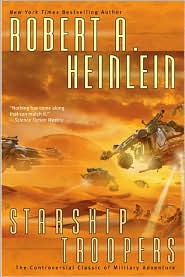
Starship Troopers by Robert A. Heinlein. Humans in powered battle suits merc’n the crap out of big spider aliens. Stop. Nothing else needs to be said. This is the greatest book of all time. Space ships and flame throwers, what’s not to like? For some folks, a lot. This is one of the more controversial books I’ve ever read, and that’s probably why I like it so much. You could write for days about all the different themes presented in this book. Politics, Gender Roles, Militarism, they’re all in there. The aspect that I like most about this book is that Heinlein seems to blend these themes together so smoothly. Heinlein devotes a large portion of his book describing the Terran Federation’s fascist style government and political process but he transitions to it so smoothly that you don’t even know you’re knee deep in his manifesto (which I don’t agree with) until it hits your belt buckle. And, in case I forgot to mention, it features people killing spiders with ray guns (spiders creep me out.)

While I’ve always had an affinity for fiction I’ve been told that you can’t write good fiction without reading some non-fiction. For The Severance I read Tiger Force: A True Story of Men and War and The Bear Went Over the Mountain: Soviet Combat Tactics In Afghanistan for research to widen my base of knowledge beyond my own perspective. Tiger Force follows a platoon of 101st Airborne Division soldiers on their tour of duty in Vietnam through their greatest triumphs and alleged atrocities. It was a great help in building a platoon dynamic in my story. The Bear Went Over the Mountain is a classic book in military circles around the world. It reads about as interesting as stereo instructions (it was commissioned by the Soviet Army) but no other book describes battles in the same kind of detail. Terrain, Enemy Forces, Friendly Task Organization... I won’t bore you with the military jargon but it's all in there. Battles are more than what’s in front of a soldier’s muzzle and if you want to write a good battle you need to know all the moving pieces.
Visit Elliott Sawyer's website.

--Marshal Zeringue

Thursday, October 28, 2010

Miles Corwin

Miles Corwin, a former crime reporter for the Los Angeles Times, is the author of three nonfiction books: The Killing Season, a national bestseller; And Still We Rise, the winner of the PEN West award for nonfiction and a Los Angeles Times Best Book of the Year; and Homicide Special, a Los Angeles Times bestseller.

Kind of Blue, his first novel, debuts in November.

I recently asked him what he was reading. His reply:
I just finished T. Jefferson Parker’s Iron River.

I enjoyed it for a number of reasons. A lot of mysteries are clipped and laconic, more like movie treatments than novels. Iron River was different. The descriptions of the desert landscapes were very evocative, and the characters were well drawn and fully formed. The subplot was compelling and convincing. And while many mystery writers are content to adhere to the basic outlines of a murder investigation, Parker grappled with an important societal issue – you can read the book to find out what it is – without being didactic or slowing down the plot.

I like to alternate crime fiction with nonfiction. After reading Iron River, I read Agent Zigzag by Ben MacIntyre, a book about a fascinating World War II spy. After reading a book like this I always feel intimidated. The things real people say and do are often so interesting and unexpected and improbable and compelling, I wonder how can I ever make up characters that can compete.
Visit Miles Corwin's website.

--Marshal Zeringue

Tuesday, October 26, 2010

Elizabeth Anderson

Elizabeth Anderson is the John Rawls Collegiate Professor of Philosophy and Women's Studies at the University of Michigan, Ann Arbor. Her books include Value in Ethics and Economics and the newly released The Imperative of Integration.

A couple of weeks ago I asked her what she was reading. Her reply:
I've been reading around lately in the history of egalitarianism. I'm interested not only in the history of egalitarian ideas, but in the history of the practice of equality. In that area Geoff Eley's Forging Democracy: The History of the Left in Europe, 1850-2000 is an amazing eye-opener. Eley narrates a history dripping with irony, inconsistency, and missed opportunities. Socialist movements in Europe started out with a strong agenda of feminism and sexual liberation. However, he documents how time and again, the Left put women's interests on the back burner in the name of advancing (male) workers' liberation first. When socialist or communist parties came close to or actually acquired power, they swiftly moved to shore up male dominance and adopted sexually conservative ideologies.

Women's issues were not the only ones drawing out incipient conservative tendencies in Left political parties. The German Social Democratic Party officially adhered to a Marxist ideology long past its expiration date. Yet, when the opportunity for a real workers' revolution arose in the wake of Germany's collapse in World War I, with workers taking to the streets and ready to seize power, the SDP, which had been suddenly handed control of the state, sent the army out to crush the revolt. Why? Orthodox Marxist theory said the time for revolution would not be ripe until capitalism was completely developed, but there were still economically backward areas in Germany. So Germany would have to wait--even though Lenin had already shown how revolution can succeed in a far more backward country. Ironically, the SDP's Marxist orthodoxy helped make them counter-revolutionaries! In this case, unlike the case with its treatment of feminism, we can be grateful for the SDP's conservatism: as we know from subsequent history, and as Eley shows, communist revolutions have not turned out so well for the people whose liberation the communists promised. Of course, there were other causes of the SDP's caution: it had long since discarded anarchist revolutionary practice and committed itself institutionally to parliamentary democratic procedures. Eley does a wonderful job explaining the sources of divergence among rival leftist movements, as well as the profound role of the Left in shaping democracy in Europe.
Read an excerpt from Elizabeth Anderson's The Imperative of Integration, and learn more about the book from the Princeton University Press.

--Marshal Zeringue

Sunday, October 24, 2010

Steven Saylor

Steven Saylor is the author of the acclaimed Roma Sub Rosa series of historical mysteries featuring Gordianus the Finder as well as the international bestseller Roma.

His new book is Empire: The Novel of Imperial Rome.

Earlier this month I asked him what he was reading. His reply:
Most of my reading these days is devoted to primary sources for Roman history—everything from the chronicles of Livy to the plays of Seneca to the satires of Lucian. But I also love to read purely for escape, and in that regard I am strangely addicted to the novels of the Italian archaeologist, historical novelist, and thriller writer Valerio Massimo Manfredi.

Strangely, I say, because VMM has got to be one of the most uneven writers around. His historical novels about the Ancient World range from quite fine (The Last Legion, Tyrant, The Talisman of Troy, The Lost Army) to so-so (The Ides of March) to embarrassingly bad (Empire of Dragons).

(I have so far avoided reading the books for which VMM is best known, a trilogy of novels about Alexander the Great which were big bestsellers across Europe; VMM is so oblivious of the male-male sexuality of the ancient Greeks that I am not eager to compare his Alexander to the Alexander of Mary Renault.)

Along with historical novels, VMM also writes “thrillers”—at least they are marketed as thrillers, but the author is so blithely unfettered by genre rules and reader expectations that these books are actually unclassifiable. Like popcorn, I find them addictive and enjoyable, but ultimately unsatisfying; since VMM is willing to pull any old rabbit out of the hat (including ridiculous supernatural explanations), it hardly matters what happens in these potboilers. The Oracle is harebrained but quite atmospheric, and the breathless plotting of Pharaoh kept me turning the pages, but The Tower is a leading contender for Worst Novel Ever Written. If you don't believe me, read it yourself.

Part of the problem may lie in the translations of Christine Feddersen Manfredi. (VMM's wife? Sister-in-law? Daughter-in-law? Oddly, his book jacket bios never explain their relationship.) I'm pretty sure English is not her first language; some of the books contain repeated and obvious malapropisms of the sort no native speaker would commit. (There is editorial oversight at fault here; VMM's UK and US publishers should have caught these problems and fixed them.) Her work, too, is uneven, veering from poetic to clunky (sometimes in the same paragraph), but I think, in general, the English prose in VMM's books has gotten better over the years.

So where does the VMM thriller I’m reading now, The Ancient Curse, fit into all of this? The book was first published in Italian (as Chimaira) back in 2001 (immediately after the Alexander trilogy), but has only now been translated into English. Set in present-day Italy, the plot revolves around a strange archaeological find from Etruscan times; more than VMM's other thrillers, this one really draws on his experience as an archaeologist, which is a definite plus. The nature of the story is supernatural from the outset, so there are no bizarre left-turns along the way. And the language is sometimes quite fine, spare but evocative, with some eerie scenes that remind me of certain uncanny moments in David Lynch movies. I have to say I am enjoying every page.

So, I would rate this as the best of VMM's thrillers. (I think there is one more yet to be translated into English, his first novel from 1985, Palladion). Don't expect air-tight plotting, but do expect vivid characters, a brooding atmosphere, authentic archaeological details, and a pretty good yarn.
Visit Steven Saylor's website and Facebook page.

--Marshal Zeringue

Friday, October 22, 2010

Eve Marie Mont

Eve Marie Mont is the author of Free to a Good Home, her debut novel about a woman coming to terms with past disappointments and forging a bright new future--man and dog included.

A couple of weeks ago I asked her what she was reading. Her reply:
Right now, I’m juggling two books, going back and forth between them depending on my mood. One is Kate Morton’s The Forgotten Garden. I’ve never read any of Morton’s other books, even though they gets raves, but I’m thoroughly immersing myself in this multi-layered novel about family secrets and identity. The story, which spans a century, focuses on a little girl placed aboard a ship sailing from England to Australia. When she arrives in Australia, however, she has no idea who she is or where she came from. Adopted by the harbormaster and his wife who name her Nell, the girl grows up happy and well cared for until her father tells her the truth. This sets in motion a search to find her true identity, a mystery that will echo across the years, culminating in her granddaughter Cassandra’s inheritance of a mysterious cottage with a forgotten garden. The book is thick—over 500 pages—so it has an epic feel, but it also has that transportive quality I look for in a good read. Rich in atmosphere and characterization, the book reminds me of other Gothic tales like Daphne DuMaurier’s Rebecca and Diane Setterfield’s The Thirteenth Tale. I look forward to finding out how Nell’s story will resolve itself.

The other book I’m reading now is Mary Alice Monroe’s Time is a River, which focuses on Mia Landon, a woman reeling from her recent bout with breast cancer as well as the dissolution of her marriage. She retreats to a cottage in the mountains, owned by fly-fishing instructor Belle Carson, and slowly learns of the grace and validation to be gained through the meditative sport. She also uncovers the journal of Belle’s grandmother, Kate Watson, a legendary fly fisherwoman once mired in scandal when she was accused of killing her husband. Through the resolute voice of Kate, Mia is able to find the strength and inspiration to reinvent her life. I am only a third of the way through this one, but the lyrical language and quirky small town characters are making this an enjoyable, escapist read.
Read an excerpt from Free to a Good Home, and visit Eve Mont's website and blog.

--Marshal Zeringue

Thursday, October 21, 2010

Paul Grossman

Paul Grossman has been a freelance journalist for many years with published articles in major magazines such as Vanity Fair and Details. He had a highly successful Actor’s Equity reading of his first stage play, The Pariah, at the Center for Jewish History in Manhattan—a drama about Hannah Arendt and the Adolf Eichmann war-crimes trial, which is currently in the hands of the Perry Street Theater Company for production development. Grossman is also a long time teacher of writing and literature at Hunter College.

His new novel is The Sleepwalkers.

Recently I asked him what he was reading. His reply:
I’m just finishing a very powerful Dutch novel from the Second World War called Comedy in a Minor Key. Although written by a German Jew who spent those years in hiding, it’s told from the point of view of the Dutch couple who keep such a man in their care. The result is most intimate, psychologically raw exploration I’ve ever encountered of what it must have felt like to have a Jewish refugee hidden in your home at the height of the Nazi Holocaust.
Visit Paul Grossman's website.

--Marshal Zeringue

Tuesday, October 19, 2010

Mary Anna Evans

Mary Anna Evans is the author of the award-winning Faye Longchamp archaeological mysteries: Artifacts, Relics, Effigies, Findings, and Floodgates. Her new novel, the sixth in the series, is Strangers.

Earlier this month I asked her what sh was reading. Her reply:
I'm sure I'm not the first writer to bemoan the fact that, though I write books because I love to read them, I find that writing my novels cuts deeply into time I might spend reading. And when I do read, it's frequently nonfiction that's related to the topic of my work-in-progress.

Since I write mysteries about an archaeologist and I am neither an archaeologist nor a historian, I set aside about a month at the beginning of each new project to bone up on the history and material culture of the area where the book is to be set. I call this activity "reading for a living."

I scour my own library, which includes tomes like The Encyclopedia of Southern Culture and the WPA guides to Florida, Mississippi, and New Orleans. I poke through the public library for material, getting some of the more esoteric stuff by interlibrary loan. (I believe it took four libraries to satisfy my insatiable need for information on tin-glazed medieval Islamic ceramic lustreware. Who would have thought that information would be so hard to get? It wasn't even on the internet. What's up with that?)

Despite its dearth of information on tin-glazed medieval Islamic ceramic lustreware, I crawl all over the internet, following my nose as I look for background material on my topic. At this point in the process, I don't care of the information is scholarly or pop culture schlock or even unsubstantiated rumor. I can sort out the truth later, but schlock and rumor are part of the human condition, so they have their place in fiction. Or so it seems to me.

For my new release, Strangers, I found an online English translation of a journal kept by the priest accompanying the Spaniards who founded St. Augustine in 1565, Father Francisco Lopez de Mendoza Grajales. His descriptions of hurricanes and lost ships and massacres and first contact with Native Americans were simply indelible. Because I don't like to muck around in the lives of real people, my depiction of Father Francisco's actions is very close to his own, but I also created a fictional priest to tell the story I wanted to write.

My Father Domingo sees the same massacres and epidemics that the real Father Francisco did, but they affect him differently. Father Domingo wakes up the morning after the massacre at the Matanzas River and he just walks away. He goes native, ministering to the Timucuan Indians as they pass into extinction. And, in the end, he strikes back in the only way a man trained in peace can manage.

Inevitably, I buy more books for my groaning shelves. For my current work-in-progress, Plunder, I bought a book that I think has one of the best titles ever: X Marks the Spot: The Archaeology of Piracy. After reading it, I'll never again watch Johnny Depp pilot the Black Pearl in The Pirates of the Caribbean in quite the same way.

But I write fiction because it's what I like to read, so I squeeze reading it into the scraps of time left me by my work and my family responsibilities. This is why it has taken me an astonishingly long time to read a book that I'm really enjoying: Light in August by William Faulkner.

As a seventh-generation Mississippian and an Ole Miss graduate, it's fairly inexcusable that I'd never read Faulkner beyond a few short stories in high school. I chose Light in August for two excellent reasons: It was already in my overstuffed library and I thought the blurb on the back looked interesting. Imagine how surprised I was to find myself immersed in a beautifully written and artfully nuanced work of...crime fiction.

No, it's not a mystery, as the publishing industry currently defines it. I don't really even like to mention a genre category in the same paragraph as William Faulkner, for fear that someone reading this might think that I can't tell the difference between pop culture schlock and timeless art. My point is that, as I've read it, I've spent a good bit of time trying to pinpoint the differences between the two, because it can only help my own work. And also because the question is interesting.

Faulkner's use of the English language is, of course, far more sophisticated than that in modern crime fiction. (And in everything else...) His ability to give a clean and clear look at a character's heart in a sentence or a page (or a page-long sentence) can make me stop reading so I can think a bit. Having grown up in Mississippi, I know that his descriptions of the countryside and the social interactions and the psychological intricacies of a small-town church service are pitch-perfect.

I'm nearly finished with the book and, unless Faulkner is going to pull a fast one on me, he hasn't been shy about letting us know whodunit...because finding out who did the murder is not the point. The spreading ripples of that murder's impact and the sordid history that brought the killer to the act of murder is the point. And the writer's obvious joy in manipulating time and space as he unfolds his story is pretty damn fine to read, as well.

Maybe some foolish mystery editor would reject Light in August if it were submitted today, because the killer isn't hidden from view, but that editor would be wrong. I actually don't think my editor would reject it. I think she'd just see it as a different way to explore the concept of justice, which is what I think mystery fiction is all about.

A friend told me that Faulkner's Sanctuary is even more like a mystery than Light in August. I think it'll be next on my reading list. Right after I plow through this stack of books about shipwrecks and how to salvage treasure from the bottom of the ocean...
Learn more about the author and her work at Mary Anna Evans' website.

The Page 69 Test: Floodgates.

--Marshal Zeringue

Sunday, October 17, 2010

Darin Strauss

Darin Strauss is the international bestselling author of the New York Times Notable books Chang and Eng and The Real McCoy, and the national bestseller More Than It Hurts You. Also a screenwriter, he is adapting Chang and Eng with Gary Oldman, for Disney. The recipient of a 2006 Guggenheim Fellowship in fiction writing, he is a Clinical Associate Professor at NYU's creative writing program.

His new book is Half a Life.

Recently I asked him what he as reading. His reply:
I re-read two stories that go well together. Babel's "My First Fee" and VS Pritchett's "The Diver." In Babel's story, the narrator -- a virginal would-be writer -- convinces an old hooker to give him a freebie for an interesting reason: he improvises, telling her his first story. "My First Fee" was written in the 1920's. And a few years later, Pritchett wrote "The Diver" -- virginal would-be writer convinces an older woman to sleep with him; he does so by telling his first story. I've never seen the Babel and the Pritchett compared. But VSP had to know "My First Fee." Pritchett read and reviewed Babel. The reason I now read them both is -- they're both great, and for all the surface similarities, they are quite different stories. It shows how one can be healthily influenced , but still remain oneself -- not an imitator.

I'm in a duel-op mode, I guess. Also reading Updike's Marry Me with Tom Perotta's Little Children. Two stories of suburban infidelity. Updike is a world-class noticer; the prose is lovely, but the plot sags. Perotta's book is a perfectly-constructed, reader-loving machine. If you could combine the two novels, you'd have the greatest infidelity novel of all time. And that's what a writer should be: a cuisinart, pureeing your favorite ingredients to make your own stew.
Visit Darin Strauss's website.

The Page 99 Test: Half a Life.

--Marshal Zeringue

Friday, October 15, 2010

Reed Farrel Coleman

Called a hard-boiled poet by NPR's Maureen Corrigan, Reed Farrel Coleman is the former executive vice president of Mystery Writers of America. He has published twelve novels—two under his pen name Tony Spinosa—in three series, and one stand-alone with award-winning Irish author Ken Bruen. His books have been translated into seven languages.

Coleman is a three-time winner of the Shamus Award for Best Detective Novel of the Year. He has also received the Barry and Anthony Awards, and has been twice nominated for the Edgar® Award. His new novel is Innocent Monster, the 6th Moe Prager novel.

Last month I asked him what he was reading. His reply:
Gone ‘Til November by Wallace Stroby

A very much under-appreciated writer, Stroby delivers a powerful novel in the form of a dual narrative. Although I haven’t gotten far enough into the book to know for sure, it seems the two main characters—an African-American hit man from New Jersey and a white, female sheriff’s deputy from south Florida—are on a collision course. I doubt the end is going to be pretty or turn out very well for one of them. But no matter how it turns out, I’m enjoying Stroby’s sparse yet vivid prose and the evocation of two very different settings and situations. It’s a story told at street level and rightfully so, because behind the façade, that’s really where we all live.
Visit Reed Farrel Coleman's website.

Reed Farrel Coleman's Moe Prager Mystery Series, the movie.

The Page 69 Test: Innocent Monster.

--Marshal Zeringue

Wednesday, October 13, 2010

Todd Ritter

Todd Ritter is the author of Death Notice, his debut mystery featuring small-town police chief Kat Campbell. Although he now lives in suburban New Jersey, he was born and raised in rural Pennsylvania, where he encountered way too many snakes.

Earlier this month I asked him what he was reading. His reply:
I am terrified of snakes. I don’t discriminate between shape, size, color and killing capability. I’m scared of all of them. A few years ago, a baby garter snake sitting by the door held me hostage in the men’s room at the Great Swamp National Wildlife Refuge in northern New Jersey. That’s how much they freak me out.

Knowing this, it would stand to reason that I shouldn’t be reading Awakening by S.J. Bolton, which is about an English village infested with snakes. Very early in the book, Bolton describes a venomous snake lying peacefully on top of a sleeping baby. That alone should have made me drop the book and run screaming.

But Awakening is about far more than snakes. In fact, snakes aren’t really the villain here. And Bolton sets a furious pace that never lags. So I keep reading, even when she drags the heroine, animal expert Clara Benning, into a house that contains dozens of serpents slithering among the drapes, chairs and bedspreads. Sure, it makes me squeal, squirm and check under the bed for rogue taipans and adders, but it’s too late to stop reading. Awakening has its hooks (or, to use a hoary pun, fangs) in me.
Learn more about Death Notice and its author at Todd Ritters' website.

--Marshal Zeringue