Thursday, November 8, 2012

Max Glaskin

Max Glaskin is an award-winning science and technology journalist with a special interest in cycling. He has contributed to a vast range of publications, including New Scientist, Reader’s Digest, and the Times (London).

His new book is Cycling Science: How Rider and Machine Work Together.

Last month I asked Glaskin what he was reading. His reply:
Three weeks ago I put down The Sea by John Banville. I was glad to have finished it because at times I had feared I never would. It happens often for me. Of all the books I've ever started to read, I reckon that I've never reached the end of about half of them. (Maybe you feel the same about blog entries and this is as far as you'll go.) Then I feel a certain inadequacy. Increasingly I think that the problem is not in the books I pick up but in me.

I'd first started The Sea several years ago. It was a gift and I hadn't been involved in its choice. I gave up within 80 pages and gave it up to our second-hand bookshop, in exchange for the price of a coffee in the excellent café opposite, where I read the ephemeral sports section of the newspaper.

Then, this September, the book group to which I belong, chose The Sea. Actually, it was the member of the book group who always chooses novels with an Irish setting and which I have repeatedly failed to finish, who had made the choice. My heart sank. Already I was feeling inadequate and I hadn't even started reading it again. Fortunately my inner self-help manual kicked in and on page 101 it says that the only way to deal with the condition of serial book-quitter is to finish it.

Having traded my copy and spent the money on caffeine, I was reluctant to buy a brand new copy. It had been an award-winner and a best-seller so I walked into town and called in at every charity shop which sells second-hand books. The fourth one, Oxfam, had a perfectly good copy for a knock-down price.

Then I made the time to read it. The sports pages of the newspaper were left unopened. The TV sulked alone. I fought through the first 80 pages and then began to be surprised by the odd sentences here and there that John Banville had sprinkled with glitter. His focus on detail became startling and no longer a drag. It was to be read slowly to enjoy his new ways of describing the oft-overlooked.

He came to the end of his story and so did I. I enjoyed it and I hope that he'd enjoy Cycling Science.
Visit Max Glaskin's website, and follow Cycling Science on Twitter and Facebook.

--Marshal Zeringue

Wednesday, November 7, 2012

Jehanne Dubrow

Jehanne Dubrow is the author of four poetry collections, including most recently Red Army Red and Stateside (Northwestern UP, 2012 and 2010). Her first book, The Hardship Post (2009), won the Three Candles Press Open Book Award, and her second collection From the Fever-World, won the Washington Writers' Publishing House Poetry Competition (2009). Finishing Line Press published her chapbook, The Promised Bride, in 2007.

Her poetry, creative nonfiction, and book reviews have appeared in journals such as Southern Review, The New Republic, Poetry, Ploughshares, The Hudson Review, The New England Review, West Branch, Gulf Coast, Blackbird, Copper Nickel, Prairie Schooner, as well as on Poetry Daily and Verse Daily.

Recently I asked Dubrow what she was reading. Her reply:
The last time I wrote for the “Writers Read” blog, I was working on my fourth book, Red Army Red, a collection of poems about my childhood and adolescence in Cold War-era Poland; at the time, my reading list was full of books on the subject of Communism and the Iron Curtain. Now, I’m in the middle of drafting The Arranged Marriage, a book of prose poems that mythologizes my mother’s Jewish-Latina upbringing in Honduras, El Salvador, and southern Florida. Because I usually work in traditional forms like the sonnet or the villanelle, this new project has led me to study up on the history and craft of prose poetry.

Michel Delville’s The American Prose Poem has served as a great introduction. The book covers the development and establishment of the form within American poetics, including the influence of the avant-garde, the role of Modernism, and the connection between prose poetry and flash fiction.

The Rose Metal Press Field Guide to Prose Poetry: Contemporary Poets in Discussion and Practice, edited by Gary L. McDowell and F. Daniel Rzicznek, brings together contemporary prose poems with brief, self-reflective essays by the poets. I am a huge fan of writers writing about their own processes (such essays are like “Inside the Actor’s Studio” but for poets). In one of the chapters, poet Ray Gonzalez explains that “[t]ruth in prose poetry forces me to maintain the paragraph in a poetic atmosphere, while I attempt to break out of its boundaries.” Many of the writers included in this anthology examine the blocky shape of the prose poem, attempting to understand how these boxes of text can look the same on the page while creating tremendously diverse narratives, voices, and pictures of the world.

In addition to rereading Baudelaire’s iconic book of prose poems, Paris Spleen, as well as examples by Gertrude Stein, Allen Tate, Robert Hass, Charles Simic, Nin Andrews, and Sabrina Orah Mark, I’ve been spending a lot of hours with Allison Benis White’s collection Self-Portrait with Crayon. This book uses paintings and other pieces by Edgar Degas to speak about childhood, a mother who abandons her child, and the absence created by such maternal absence.

I love to work on several book manuscripts concurrently, moving back and forth between them in order maintain a fresh perspective and to avoid boredom. Right now, I’m writing what I call “meditative close readings” of poems by Philip Larkin. This project tries to make sense of how the writers whose words we love become an intimate part of our daily lives. So, I’ve been reading and rereading Larkin’s The Complete Poems, edited by Archie Burnett. This new edition brings together all sorts of poems and scribbles by Larkin that I’ve never read before, but it also offer useful critical commentary. I don’t intend my essays to function primarily as scholarly analyses of Larkin, but it’s important to study a scholar’s perspective of Larkin nonetheless.

Finally, I’ve been reading a book by my former poetry professor, Stanley Plumly. Posthumous Keats: A Personal Biography serves as one kind of model for what I hope to accomplish with Philip Larkin. Plumly’s study of the life of Keats is not only thoughtful and tremendously well-researched (Plumly spent twenty years working on this project) but it is also, as the title reminds us, a personal engagement with a fellow poet. So much of what poets do involves conversation, argument, debate, and communion with previous generations of poets. A poet doesn’t die, if we carry his words with us—in our pockets, in our mouths, in our memories.
Visit Jehanne Dubrow's website and blog.

Writers Read: Jehanne Dubrow (April 2010).

--Marshal Zeringue

Tuesday, November 6, 2012

Jon Wiener

Jon Wiener is a contributing editor to The Nation magazine and teaches 20th century US history at the University of California – Irvine. He sued the FBI for their files on John Lennon — the story is told in his book Gimme Some Truth: The John Lennon FBI Files and at the website www.LennonFBIfiles.com. The case went all the way to the Supreme Court before most of the outstanding issues were settled in 1997.

Wiener's latest book is How We Forgot the Cold War: A Historical Journey across America.

A few weeks ago I asked the author about what he was reading.  His reply.
I’m still thinking about how we remember the Cold War. The new book by Kristen Iversen, Full Body Burden: Growing Up in the Nuclear Shadow of Rocky Flats, is an unforgettable work that brings together the personal and the political in the story of a little-known disaster at a plutonium factory west of Denver.

One of the highlights of my history grad seminar is Emily Rosenberg’s book A Date Which Will Live. It shows how the memory of Pearl Harbor has changed over the decades: in the seventies, fear of Japanese economic power led to talk about “an economic Pearl Harbor,” and of course 9/11 was “the Pearl Harbor of the 21st century.” Most amazing, on the tenth anniversary of Pearl Harbor, Dec. 7, 1951, there were no public ceremonies of remembrance at all – because we needed Japan’s support in our war in Korea.

I’m also reading Erika Doss’s Memorial Mania: Public Feeling in America, which looks at just how feverish and intense our culture of commemoration has become. Kirk Savage’s Monument Wars uncovers the shift in Washington DC from heroic statues to spaces of experience, especially in Washington, D.C. It's also a gorgeously illustrated and produced book. And I’ve been re-reading Nixonland by Rick Perlstein–vivid, intense, thick description of politics in my youth.
Visit Jon Wiener's website.

--Marshal Zeringue
Sunday, November 4, 2012

Gretchen McNeil

Gretchen McNeil is a former coloratura soprano and was the voice of Mary on G4's Code Monkeys, and she currently sings with the L.A.-based circus troupe Cirque Berzerk. She is a founding member of vlog group the YARebels—where she can be seen as "Monday"—and is an active member of the Enchanted Inkpot, a group blog of YA and middle-grade fantasy writers. Her latest novel is Ten.

Last month I asked her what she was reading. Her reply:
Since it's Halloween, and I'm about to start writing a new horror pitch after the holidays, I'm rereading some of my favorite scary stories for "inspiration." Here are my two favorites...

The Turn of the Screw by Henry James. I love a good ghost story (even though James himself insisted this novella isn't actually about ghosts...whatever), and this turn of the century tale of a governess with possibly supernatural charges is one of the best. Kids can be creepy, and Miles and Flora take that to a whole new level. You've got possession, murder, lust, revenge - all tied up in two very disturbed children. This novella is drippingly gothic, and James spins the setting and tension so tightly, the reader is practically in a frenzy to find out what happens.

Hell House by Richard Matheson. Haunted house books are, by far, my favorite scary read. And Matheson, better known for another horror classic I am Legend, delivers the best, scariest, freakiest, creepiest, down right horrifying haunted house novel ever. Belasco House is the epitome of a haunted house, what all others should aspire to, as much of a character as the four fools who have to spend the night there. It's simultaneously scream-inducing and gory, page-turning and horrid. Like watching a train wreck - you literally cannot put this book down, even though you'll want to.
Visit Gretchen McNeil's website.

--Marshal Zeringue

Saturday, November 3, 2012

Adele Griffin

Adele Griffin is a two time National Book Award Finalist and the author of some of our most haunting and unforgettable young adult novels.

Her latest novel is All You Never Wanted.

Last month I asked Griffin what she was reading.  Her reply:
I've got a book of poems I just finished, called Spit Back a Boy, by Iain Haley Pollock. I got to meet Iain a few weeks ago, just knew his work would be thoughtful-- it is. And my friend has me hooked reading the first volume of journals of Virginia Woolf-- this isn't really a book you dive into and forget about the world. I keep the book in the kitchen, it's a tea and read style book. But I can feel her life in quiet moments, in who she meets and what she has for tea....

I am finishing Unbreak My Heart by my friend Melissa Walker, this is a lovely summer getting-over-a-romance story, set on a sailboat, I love Melissa's wry lighthearted style in this book. And I'm about to start the David Foster Wallace biography, Every Love Story Is a Ghost Story, on several people's recommendation. And by the end of the month, I hope I've read May We Be Forgiven by AM Homes and Ask the Passengers by A.S. King. Finally, I need to finish Quiet: The Power of Introverts by Susan Cain. It's so insightful, but I read it slowly, in pieces, and then give myself time to think about it. That's what we introverts do.
Visit Adele Griffin’s website and Facebook page.

Read--Coffee with a Canine: Adele Griffin and Edith.

Writers Read: Adele Griffin (June 2011).

--Marshal Zeringue

Thursday, November 1, 2012

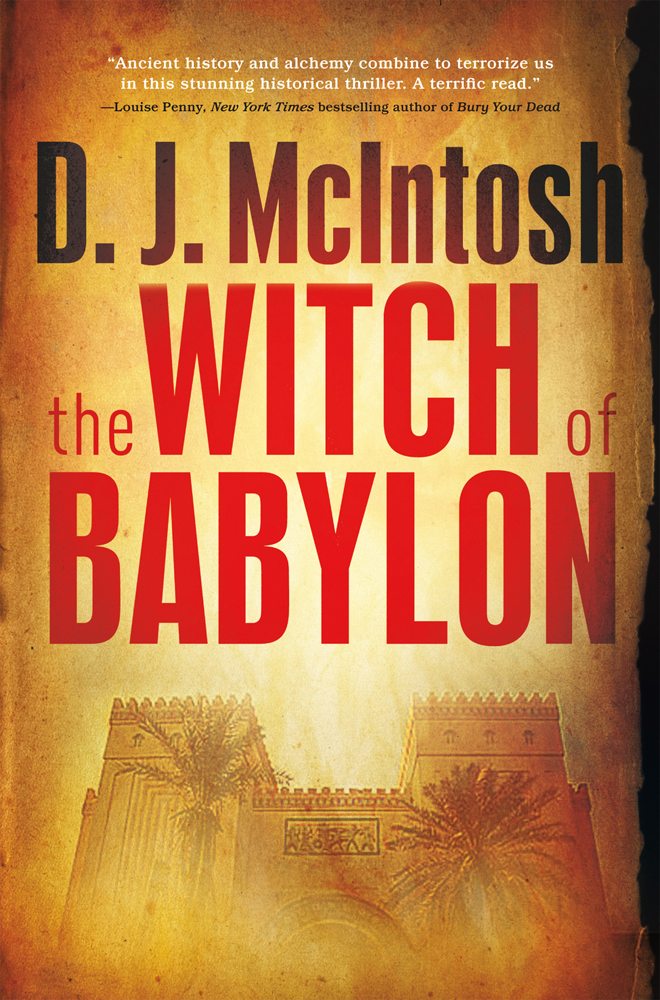
D.J. McIntosh

D. J. McIntosh’s The Witch of Babylon has been sold in nineteen countries, was short-listed for the Crime Writers Association Debut Dagger Award, and won a Crime Writers of Canada Arthur Ellis Award for best unpublished novel.

Last month I asked McIntosh what she was reading.  Her reply:
Because my second novel turns on the hunt for a rare 17th century book, I’ve turned to a book I first read some time ago written by John Dunning, an author who’s considered a master of the bibliophile mystery. He has a huge following and with good reason. Dunning’s ‘hero’ is Cliff Janeway, a book dealer and ex-cop. I always found this an unlikely combination but Dunning brings Janeway convincingly alive. In The Bookman’s Promise, Janeway takes pity on an elderly woman who claims her family is the rightful owner of a valuable first edition collection of works by the adventurer and historian, Sir Richard Burton. In the best tradition of quest novels, Janeway searches for both the collection and Burton’s mysterious handwritten journal that reveals a hidden secret - the spark that lit the American Civil War. I think history is often best illuminated through novels and Dunning’s book is proof of this. He held me enthralled all the way through.

Almost all my non-fiction reading is research for my novels and it’s why I picked up The House of Wisdom by Jonathan Lyons. The story of several Christian scholars who travelled to the Near East in the Middle Ages, the book documents how Arabic culture and learning transformed western thought. These ideas ultimately fuelled the Renaissance. Far from a staid historical account, this book had me ‘turning the pages’ as the saying goes, as though it was a thriller.

For a pure, engrossing, nail biting, experience I loved Michael Koryta’s The Ridge. I read a lot of suspense fiction and find many can be predictable but Koryta’s writing is superb. He takes a stock suspense character – the hard bitten sheriff with a vulnerable side – and turns him into a memorable figure. The sheriff has fallen in love with a woman who’s now in jail for shooting him. As a big cat preserve is established in isolated eastern Kentucky, people strangely escape what should be certain death. This is just for openers and Koryta’s magic is to make us believe every word.
Visit D.J. McIntosh's website, Facebook page, and Twitter perch.
The Page 69 Test: The Witch of Babylon.

--Marshal Zeringue

Wednesday, October 31, 2012

Paula Bomer

Paula Bomer is the author of Nine Months (Soho Press) and Baby & Other Stories (Word Riot Press). She is also the publisher and editor of Sententia Books.

Earlier this month I asked Bomer what she was reading. Her reply:
Right now I am reading The Man Who Loved Children by the Australian writer, Christina Stead. I'm a huge fan of Jonathan Franzen and while reading his latest collection of excellent essays, Farther Away, I came across an essay on The Man Who Loved Children. I'm not letting myself read the Franzen essay until I finish the novel, 527 pages of very small type, dense writing. Frankly, I'm finding it challenging but that's not necessarily a bad thing. It's also deeply, darkly depressing, from the beginning onward. There are flashes of humor, but only flashes. In fact, when starting the book I thought "where can this go?" because it starts with the Pollit family already completely miserable. As it turns out, things can get worse and that's what seems to be happening.

Another book I'm reading is the forthcoming couplet of novellas, Could You Be With Her Now, by the amazing indie writer, Jen Michalski. Each novella is startling with bravery and a mastery of language and pacing. Also, they couldn't be more different, which is no small feat- to have such range. I can't wait for more of the world to know about Jen Michalski thanks to Dzanc Books, who will be publishing it very soon.
Read more about Nine Months, and visit Paula Bomer's blog.

--Marshal Zeringue

Tuesday, October 30, 2012

Judith Rock

Judith Rock has written on dance, art, and theology for many journals, and has been artist-in-residence and taught and lectured at colleges, seminaries and conferences across the United States and abroad. The Rhetoric of Death, her first novel, was a 2011 Barry Award nominee.

Rock's latest novel is A Plague of Lies.

Recently I asked the author what she was reading. Her reply:
When I'm working on a book--just now I'm writing the 4th book in the Charles du Luc historical mystery series--I'm more likely to read nonfiction than fiction. I do most of my reading-for-fun before I go to sleep, and by the end of a writing day, I often don't want to cope with another story... But there are exceptions, and lately I've been reading Christopher Fowler's Peculiar Crimes Unit series and loving it! It's so different from my own stuff and so fascinating, that it's a perfect change of scene. I love the British sense of humor, and also Fowler's wonderful use of language and the arcane and intricate side-issues he lets Arthur Bryant lead the reader--and the often equally astonished Peculiar Crimes Unit--into. Of course, the other reason I love the series is that Bryant is a fount of arcane London history.

As for nonfiction, I mostly read history. Rarely battles and kings history, more often buttons and soup pots and how did they cope with fleas history. I read 17th century history for research as I write. But for fun at the end of the day, I'm more likely to enjoy medieval buttons and fleas. I just finished Margaret Wade Labarge's Mistress, Maids, and Men: Baronial Life in the 13th Century, based on Eleanor de Montfort's household accounts. With wonderful tidbits like the names of her couriers, including Gobithasti.
Visit Judith Rock's website.

The Page 69 Test: A Plague of Lies.

--Marshal Zeringue

Sunday, October 28, 2012

David Handler

David Handler’s first book in the Berger and Mitry series, The Cold Blue Blood, was a Dilys Award finalist and BookSense Top Ten pick. Handler is also the author of eight novels about the witty and dapper celebrity ghostwriter Stewart Hoag and his faithful, neurotic basset hound, Lulu, including Edgar and American Mystery Award winner The Man Who Would Be F. Scott Fitzgerald.

Handler's latest novel in the Berger and Mitry series is The Snow White Christmas Cookie.

A few weeks ago I asked the author what he was reading.  His reply:
Don’t laugh, okay? I’m currently reading a children’s book. Or I should say re-reading one. My girlfriend Diana and I were talking recently about the books we’d read as little kids that made a lasting impression on us. Naturally, since the grown-up me has resorted to a life of crime fiction, I immediately mentioned the Hardy Boys. I loved Frank and Joe Hardy when I was a kid. But I was also a huge fan of Freddy the Pig, a nimble and intrepid detective who solved an assortment of barnyard crimes large and small on Mr. Bean’s farm. Freddy’s partner in detection was Mrs. Wiggins the Cow. And his best friend was Jinx the Cat. I remember the Freddy books as being witty and cleverly plotted. And yet whenever I mention my fond memories of them to friends I’m always met with blank stares. Some of them even think I’m pulling their leg. They refuse to believe that there was ever a pig detective, particularly a nimble and intrepid one.

Not so Diana, who was a children’s librarian when she first got out of college. She not only remembered the Freddy series by a gifted writer named Walter R. Brooks, who wrote for The New Yorker, but she discovered that the books are actually back in print after decades of oblivion. And so, to my delight, I can report that I am currently re-reading a landmark work of crime fiction called Freddy the Detective, complete with the original illustrations by Kurt Wiese. Freddy the Detective was originally published way back in 1932, but you wouldn’t know it. Like all classic literature it remains fresh and timeless. It’s also as wry and hilarious as I remembered. Sarcasm. There’s actual sarcasm. I can’t tell you how much fun I’m having re-reading it.

Fans of my Berger-Mitry and Hoagy mysteries often ask me to name the writers who have influenced my work. They’re also curious about where on earth I got the idea for Hoagy’s sidekick, Lulu, who happens to be a basset hound. I always mention Ross Thomas and Donald Westlake as being huge influences on me. I never mention the name Walter R. Brooks. But from now on I promise I will. Because he was there from the very beginning. And so was Freddy.
Visit David Handler's website and blog.

Writers Read: David Handler (October 2011).

--Marshal Zeringue

Friday, October 26, 2012

Barbara Mariconda

Barbara Mariconda is the author of over thirty books for children and teachers; her latest, The Voyage of Lucy P. Simmons, is a middle grade historical fantasy novel, the first in a trilogy published by Harpercollins. She is co-founder of Empowering Writers.

Earlier this month I asked Mariconda about what she was reading. Her reply:
I always have a pile of books beside my bathtub, spend the last hour of every evening up to my chin in warm water, reading. Relaxing. Sometimes, if the book is just okay, I’ll nod off - in fact, you can identify the less riveting books on my shelves by the curled, rumpled pages of titles that have taken a dip in the suds after putting me to sleep.

Two books that have stayed high and dry and kept me awake much later than they should have are Body and Soul by Frank Conroy and Falling Upward: A Spirituality for the Two Halves of Life by Richard Rohr. The first, a novel, written back in the 90’s, the latter, a prophetic reflection on what spiritual maturity means, and the richness that comes with it.

I picked up Body and Soul at a small independent book store in Chapel Hill, N.C. at the recommendation of a helpful, well-read book seller. It’s the story of concert pianist Claude Rawlings, set just after World War II. The story begins with five year old Claude, lonely and isolated, living in NYC with his mother, whose attitude toward the boy is one of not-so-benign neglect. Spending most of his days alone in a basement apartment, Claude becomes fascinated with the rhythm of footsteps on the sidewalk above, the sounds of the building and surrounding neighborhood, a radio that provides company, and an old white studio piano jammed in the back room. This alienated, lonely child develops an extraordinary sense of the power of sounds, and music becomes a vehicle for him to grow beyond the walls that hold him prisoner.

As a pianist myself, what fascinated me was the way Conroy explored the ability of music to nurture the soul and elevate the spirit, and the relationships between artistry, the science of acoustics, music theory, and technical aptitude, while drawing analogies between all of this and the complexities of life. To be honest, I enjoyed the musical aspects of this novel more than the plot, which follows Rawlings into adulthood, still, the musical elements were enough to keep me awake in the tub.

Falling Upward is a must for anyone pushing fifty who’s ever asked, “What’s it all about?” Rohr, a Franciscan priest, is, I believe, a prophetic voice, offering insight and hope. He discusses the tasks of the first half of life – to strive, excel, compete, attain - to define ourselves as successful in terms of societal values, building a secure container that will hold the often difficult second half of life realities. Failure, illness, loss - these seemingly tragic events are actually necessary vehicles for spiritual growth and emotional maturity. What I love about Rohr is his compelling insights into the way of the middle – the often uncomfortable place between the poles of opposites, of black and white, right and wrong – the place where compassion and inclusiveness are born. His writing pushes us beyond religious dogma and the grade-school faith that does not serve us well when life becomes difficult, and toward a richer, wiser, more complex, and ultimately more satisfying mature spirituality in the second half of life. It’s a book to read several times, to savor, to contemplate, in the tub, or out!
Visit Barbara Mariconda's website.

Read--Coffee with a Canine: Barbara Mariconda and Little Man.

--Marshal Zeringue