Thursday, April 25, 2019

David Quantick

David Quantick is an author, television writer and radio broadcaster. As well as All My Colors, he wrote the surreal thriller The Mule (“the Da Vinci Code with better grammar” – The Independent) and the comic scifi novel Sparks (“excellent” – Neil Gaiman). He also wrote the critically-acclaimed TV drama Snodgrass, currently being developed into a feature film, and Dickens In Rome, a new play for Northern Stage.

Quantick has won several broadcast awards, including an Emmy as part of the writing team on Veep.

Recently I asked the author about what he was reading. Quantick's reply:
I’m in a random selection of books right now. I bought Rex Warner’s The Aerodrome, which is a Penguin paperback from the 1930s and is a kind of parable about the rise of fascism (I have a slightly dubious obsession with Nazi counterfactuals like The Man In The High Castle and, in a different vein, Norman Spinrad’s astonishing, hilarious The Iron Dream). It’s quite eccentric and not at all manly, which I like.

I just finished David Stubbs’ Mars by 1980, a history of electronic music from Stockhausen to the Aphex Twin, which means that everything I read is now soundtracks by bleeps and clanks and makes my life a lot more interesting, like I am being pursued by faulty robots.

And I have just finished It, by Stephen King, which is not only one of the best King novels - being both a perfect evocation of lost youth and also totally scary – but also, I realised, a continuation of the kind of story invented by E Nesbit, taken on by Enid Blyton, carried on by the Scooby-Doo stories, and beautifully pastiched in Meddling Kids by Edgar Cantero. It has inspired me.
Visit David Quantick's website.

The Page 69 Test: All My Colors.

--Marshal Zeringue

Wednesday, April 24, 2019

Heather Gudenkauf

Heather Gudenkauf is the Edgar Award nominated, New York Times and USA Today bestselling author of The Weight of Silence, These Things Hidden and Not A Sound.

Her new novel, Before She Was Found, is a gripping thriller about three young girlfriends, a dark obsession and a chilling crime that shakes up a quiet Iowa town.

Recently I asked Gudenkauf about what she was reading. Her reply:
Right now I’m reading an advanced reading copy of The Nanny by Gilly MacMillan. This atmospheric thriller follows Jo as she returns to her childhood home and tries to rebuild a relationship with her estranged mother. After a skull is found in the lake behind the house, Jo is forced to face the confront the truth the mysterious disappearance of her beloved nanny decades earlier. The Nanny has everything I’m looking for in a thriller: unreliable narrators, family secrets and plenty of suspense.
Visit Heather Gudenkauf's website.

Coffee with a Canine: Heather Gudenkauf and Maxine.

Coffee with a Canine: Heather Gudenkauf & Lolo.

--Marshal Zeringue

Monday, April 22, 2019

Michael Moreci

Michael Moreci is the creator of numerous original comics series and has written and collaborated on multiple established properties.

His debut novel, Black Star Renegades, draws inspiration from the space operatics of Star Wars and the swagger of Guardians of the Galaxy. It is a galaxy-hopping adventure that blasts its way from seedy spacer bars to sacred temples guarded by strange creatures--all with a cast of misfit characters charged with saving the world.

Moreci's new book is We Are Mayhem (Black Star Renegades, Volume 2).

Recently I asked the author about what he was reading. His reply:
Oftentimes, I find myself reading for research and inspiration purposes. Don't get me wrong, I'm reading stuff I love because I'm writing--for the most part--stuff I love. But it's still connected to work; I love fully immersing myself in my writing projects, and that means reading books that correspond.

That said, my current bookshelf, as always, is a mix of novels and comics. I just finished reading The Chronoliths by Robert Charles Wilson, which was terrific. Just--outstanding. I love Wilson in general (Spin is out of this world), but this book was especially remarkable. It hit a chord with me because it dealt with ideas that I'm always wrestling with--of free will, destiny, and existence in general. My comic series, Wasted Space, touches on this a bit, but it'll be getting more into it in coming issues. The book itself follows a set of characters whose lives are impacted by a strange global phenomenon: the appearances of monolithic structures across the world--they appear seemingly out of nowhere--that all, in one way or another, memorialize a future event or a mysterious future leader. The story essentially asks the question "Are we the agents of our own futures, or are we heading to a predetermined destination?" It's a very challenging question to ask, but Wilson, as always, handles it with remarkable intelligence and humanity.

I'm also reading Descender, by Jeff Lemire and Dustin Nyguen, which is sort of like Spielberg's/Kubrick's A.I. blended with an Amblin heart. It's a story of a young android boy and how he may--or may not--be the key to unlocking an apocalyptic event and a robot uprising. It deals heavily in humanity and why we are who we are, and it's executed wonderfully. I also recently read Tim Daniel's Fissure, which was great, as well as The Few, from Sean Lewis and Hayden Sherman. Oh! And Copra from Michel Fiffe was out of this world--it's like Suicide Squad on LSD.

I'm about to switch gears a bit, away from writing sci-fi and into writing horror, and for that, I'm starting to read Michael Talbot's The Bog (and for anyone who wants the best paperback horror, you must subscribe to Valancourt's Paperbacks From Hell series; trust me), as well as a reread of Joe Hill's Locke and Key, which is a favorite of mine.

I'm certain I'll be starting something new soon enough! Always writing, always reading...
Visit Michael Moreci's website.

Coffee with a Canine: Michael Moreci & Charlie.

--Marshal Zeringue

Saturday, April 20, 2019

M.G. Wheaton

Born in Texas, M.G. Wheaton worked in a computer factory before getting his start as a writer for such movie magazines as Total Film, Fangoria, Shivers, SFX and several others. After leaving journalism, Wheaton worked as a writer for video games, comic books, and movies, including writing scripts for New Line, Sony, Universal, Miramax, HBO, A&E, Syfy, Legende, Disney Channel, and others while working with filmmakers such as Sam Raimi, Michael Bay, Steven Soderbergh, George Tillman, Gavin O'Connor, Janusz Kaminski, and Clark Johnson.

Wheaton's new novel is Emily Eternal.

Recently I asked the author about what he was reading. His reply:
Right now, I’m reading about five books at once: one on audio, two on the Kindle, and two physical books which is about average for me depending on if I’m in the car, working out, or in a theater somewhere waiting for the curtain to rise.

On Kindle, I’m reading Ahmed Saadawi’s novel, Frankenstein in Baghdad, and Tony Healey’s The Singles, a collection of short stories and novellas. Frankenstein in Baghdad takes place during the US occupation of Iraq and focuses on the aftermath of a sectarian bombing. One of the nameless people blown to bits is reassembled by a junk dealer but before long, heads out into the city again with revenge on his mind. Told from several different points-of-view, it’s dark and absurd and kind of amazing. I have no idea where it’s going, but I can’t put it down.

Similarly, Healey’s collection of shorts is equally addictive. Healey is an excellent crime writer, best known for his Harper and Lane novels, but his recent and twisty Not For Us is my favorite. The Singles is like if a pulp magazine like Black Mask or Weird Tales showed up in the modern day and was filled with crime and adventure stories of every stripe. So far, I’ve read one detective story, one jungle caper, and a twisty, Twilight Zone-type murder tale. Hilariously, I caught someone reading the detective story over my shoulder waiting at the post office and she seemed as engrossed as I was.

On audio, I’m listening to investigative reporter, Jane Mayer’s book Dark Money: The Hidden History of the Billionaires Behind the Rise of the Radical Right, which is so hard to recommend as every chapter is more infuriating than the last, hilariously enough. It concerns the billionaires behind right-wing politics, just this parade of huge money donors like the Koch Brothers, John M. Olin, Richard Mellon Scaife, etc., who create these non-profit foundations to evade taxes then use them as lobbying firms to push for, say, environmental deregulation. In case after case, Mayer lays out how these men became extremely wealthy by breaking the rules, such as the sheer number of times the Kochs have been called out for everything from lying about how much benzene they were polluting the air with in Texas to running a nationwide scheme of cheating their business partners out of oil revenue by using faulty gauges and covering up spills. When caught, each and every one of these billionaires chooses not to clean up their businesses but instead to funnel hundreds of millions into right-wing think tanks and university programs in hopes of bringing about widespread de-regulation of environmental and tax laws in Washington that is then supported by judges they’ve sponsored. The book is basically an incendiary prequel to a lot of what’s happening in American politics right now.

As for physical books, I’m a big Little Free Library person and recently traded for Edith Wharton’s The Age of Innocence and Mary Renault’s The Persian Boy, which I’d never heard of but sounded interesting. From the very first page, the Wharton is exquisite, describing Newland Archer’s evening at the opera when he, and everyone around him, first spies the beautiful Countess Olenska in a neighboring box. I’ve only ever read The House of Mirth, so it’s wonderful to devour such beautiful prose.

The Renault, it turns out, is a semi-romantic, imagined life of Bagoas, a Persian eunuch who first served in the court of King Darius III, then with Alexander the Great after his army clashed with Darius’s troops, eventually becoming a lover to each. I’ve read some Alexander stories here and there such as Steven Pressfield’s novel, The Virtues of War, as well as various chunks of Arrian’s histories of Alexander, but this is very different, much more emotional and much more attuned to the very human frailties of its characters. Renault, herself emigrated from the UK to South Africa to live openly with her partner, Julie Mullard, writes of Alexander’s relationship with both Bagoas and his more historically prominent lover Hephaestion in romantic terms absent in those other works while still retelling the epic story of Alexander’s unification of the Greek and Persian worlds.
Visit Mark Wheaton's website.

--Marshal Zeringue

Thursday, April 18, 2019

Katy Loutzenhiser

Katy Loutzenhiser grew up in Cambridge, Massachusetts, dabbling in many art forms and watching age-inappropriate movies. After graduating from Bowdoin College, she found an unlikely home in the Chicago comedy scene and regularly sang improvised musicals in public. These days she writes YA books in Brooklyn, where she lives with her husband. She is probably eating a burrito right now.

Loutzenhiser's new novel is If You're Out There.

Recently I asked the author about what she was reading. Her reply:
Though my own work doesn't quite fall under the "rom-com" category (my debut, If You're Out There, can best be described as a friendship-themed mystery/comedy with a dash of romance), my reading is heavy on the light and fluffy. A recent favorite was the debut YA novel Hot Dog Girl by Jennifer Dugan (out April 30). It follows a girl's romantic trials and tribulations during her summer job dressed as a hot dog. Honestly, the story had me at hot dog, and it did not disappoint! I also just finished the audiobook for One Day In December by Josie Silver. A Reese Witherspoon pick with exceedingly charming British narrators, the sample all but guaranteed the book would weasel its way into my heart, which it totally did. When I'm in the thick of writing, nothing helps me unwind quite like a fun, clever love story.
Visit Katy Loutzenhiser's website.

My Book, The Movie: If You're Out There.

--Marshal Zeringue

Tuesday, April 16, 2019

Rodrigo Rey Rosa

Rodrigo Rey Rosa was born in Guatemala in 1958. He immigrated to New York in 1980, and in 1982 he moved to Morocco. American expatriate writer Paul Bowles, with whom Rey Rosa had been corresponding, translated his first three books into English. Rey Rosa has based many of his writings and stories on legends and myths indigenous to Latin America and North Africa. Of his many works, seven have been translated into English: The Beggar’s Knife, Dust on Her Tongue, The Pelcari Project, The Good Cripple, The African Shore, Severina, and now Chaos, A Fable.

Recently I asked Rey Rosa about what he was reading. His reply:
When I write fiction—as I am doing now—my reading tends to be more scattered than usual. My general rule is not to read fiction when I’m writing. I read poetry, art history, newspapers and magazines, books on philosophy, anthropology, jurisprudence, but no fiction at all. If I were to read fiction, I’d probably look for something by John Le CarrĂ© that I haven’t read. Or Henry James or Patricia Highsmith. But so far this year, I can honestly say that I haven’t read a single page of fiction. The last novel I started (and abandoned on December 31, 2018) was South Wind by Norman Douglas. I hope to finish reading it someday.

In recent months I’ve read essays by Giorgio Agamben on the art of desecration. Also: Creation and Anarchy: The Work of Art and the Religion of Capitalism. Even in the parts I don’t pretend to understand, Agamben seems to me always brilliant. Also, Reflections on Fieldwork in Morocco by Paul Rabinow. The long hallucinatory poem “The Crystal” by Conrad Aiken. Several books by Ernst Gombrich: Art and Illusion; Meditations on a Hobby Horse; The Preference for the Primitive... The mild regret of not having read Gombrich much when I was younger. But I still, especially when I’m writing fiction, learn something.
Learn more about Chaos, A Fable.

--Marshal Zeringue

Sunday, April 14, 2019

Robert Dugoni

Robert Dugoni is the critically acclaimed New York Times, #1 Wall Street Journal and #1 Amazon best selling author of The Tracy Crosswhite series, My Sister’s Grave, Her Final Breath, In the Clearing, and The Trapped Girl.

Dugoni's new novel is The Eighth Sister.

Recently I asked the author about what he was reading. His reply:
I just returned from Norway and my publisher gave me Hunger by Nobel Prize winner Knut Hamsun. It was a fabulous character sketch of a starving man trying to survive on the streets of Oslo, and having just been there, made quite an impression on me. I finished that novel and started on an unpublished manuscript by one of my students, Oscar Lalo. Oscar is French, living in Geneva, Switzerland and has written a literary novel called Marie. It is stunning in so many respects. I had to ask for the rest of the novel and I’m enjoying it immensely.
Visit Robert Dugoni's website and Facebook page.

My Book, The Movie: The Eighth Sister.

--Marshal Zeringue

Friday, April 12, 2019

Dan Stout

Dan Stout lives in Columbus, Ohio, where he writes about fever dreams and half-glimpsed shapes in the shadows. His prize-winning fiction draws on his travels throughout Europe, Asia, and the Pacific Rim, as well as an employment history spanning everything from subpoena server to assistant well driller.

Stout's new novel is Titanshade.

Recently I asked the author about what he was reading. Stout's reply:
One of the great advantages of having a book released is that you suddenly find yourself with tons of great reading material! I’m incredibly lucky to have a stack of debut novels and ARCs on my bookshelves, and I’m working my way through them.

I just finished reading Katherine Forbes Riley’s The Bobcat, a beautifully constructed tale about trauma, sickness, and healing. Riley avoids all the tropes and minefields of this kind of story, and she has an unerring ability to always find the perfect word or turn of phrase. It’s really fantastic work. It releases in June, and I was lucky enough to get my hands on an advance copy.

Another recent sneak peek was A.G. Carpenter’s A Fistful of Dust. This book is an absolute gem. A weird western tale of betrayal and revenge in a sci-fi setting, Carpenter’s prose practically leaps off the page and grabs you by the throat. She’s immensely talented, and I expect that this will get a lot of buzz when it releases later this year.

I’m also getting ready to dive into Edgar Cantero’s novella, There's a Giant Trapdoor Spider Under Your Bed. I was introduced to Cantero’s work when I read Meddling Kids, and I can’t wait to tear into this one.
Visit Dan Stout's website.

My Book, The Movie: Titanshade.

--Marshal Zeringue

Wednesday, April 10, 2019

Lorna Landvik

Lorna Landvik's novels include the bestselling Patty Jane’s House of Curl, Angry Housewives Eating Bon Bons, Oh My Stars, Best to Laugh, and Once in a Blue Moon Lodge. She has performed stand-up and improvisational comedy around the country and is a public speaker, playwright, and actor most recently in the one-woman, all-improvised show Party in the Rec Room. She lives in Minneapolis.

Landvik's new novel is Chronicles of a Radical Hag (with Recipes).

Recently I asked the author about what she was reading. Her reply:
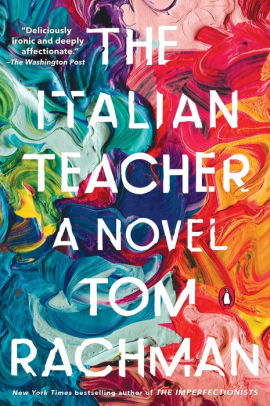
I have about twenty pages left of The Italian Teacher by Tom Rachman and I can’t wait to get to them. In fact later tonight, I will, in the tub. That’s my treat to myself, along with a glass of Malbec and foaming epsom salts. His novel, The Imperfectionists was a big, full read and so I was excited to dive into his latest. Rachman’s like a wily and agile shortstop who covers all the bases (character, setting, plot), bringing us the story of a famous painter and his son. Bear Bavinsky is the larger-than-life artist who marries and breeds as easily as he uncaps a tube of paint, and Pinch is his first son, who idolizes his father, even as he experiences the drama and cruelty Bear wreaks. Everything takes you in — the people, their endearing/maddening foibles, insights into the art world, the wide-ranging locales (Roma! London, Toronto! the south of France!). It’s a book that makes you feel and think, beautifully written with grace notes of humor.

Waiting for the Punch by Marc Maron is another book I’ve been reading/lolling around in. In it, comic, podcaster Maron asks questions of people — mostly comics, some politicians, radio hosts, producers — and their answers are illuminating, funny, sad, scary and hopeful. It’s like a reference book for people trying to figure out how to get through life.
Visit Lorna Landvik's website.

My Book, The Movie: Chronicles of a Radical Hag (with Recipes).

--Marshal Zeringue

Monday, April 8, 2019

H. S. Cross

H. S. Cross was raised in the waspy suburbs of Detroit, attending co-ed day schools, doing children’s theater, sailing, riding bikes, collecting Garfield paraphernalia, and afraid to kiss boys. It therefore follows that she has written two novels set in the 1920s and 30s at an austere English boarding school for boys, Wilberforce and the newly released Grievous.

Recently I asked the author about what she was reading. Her reply:
I co-lead a book group that focuses on classics, so a decent portion of my reading is driven by the need to evaluate future selections or re-read the book we are about to discuss. Right now, I’m finishing up Shakespeare’s The Winter’s Tale for our meeting this week. I’m not sure whether I’ve actually read the play before, but I first encountered it as a teenager in a production at the Public Theater that left me in tears of awe at the ending. I’m finding it a difficult read, and my mind is occupied thinking about how I would direct Leontes in the first half. In anticipation of next month’s meeting, I’m also reading Tolstoy’s The Death of Ivan Ilych; it’s one of those greats I am only now getting to, and it feels apt for Lent.

On the subject of Lent, I have two books on the go in the theology pile. Gerhard Forde’s On Being a Theologian of the Cross offers reflections on Luther’s Heidelberg Disputation and makes an argument for a theology of the cross over and against a theology of glory. It’s over my head in many places, but despite the seemingly arcane nature of Forde’s inquiry, his argument sheds light on something I find problematic in many churches today, namely their need to make scripture, doctrine, and God pleasing, even flattering, to the human ego; Luther’s argument points towards a more robust, and for us countercultural, approach to thinking about God. Equally vigorous but less esoteric is Fleming Rutledge’s Three Hours, a slim volume of sermons she preached for Good Friday in 2018. Rutledge, one of the most formidable living theologians and a woman of considerable charisma, writes with clarity, humor, compassion, and orthodoxy on the seven last words of Christ. I was not able to see her preach these in person, but people who were there are still talking about it.

As for contemporary fiction, I recently got around to reading Kazuo Ishiguro’s The Buried Giant, his so-called fantasy set in an imagined post-Arthur Britain. It’s unsettling, and he’s doing something difficult with love, memory, trauma, and history. I thought the reviews missed the point of this delicate, underwritten work.

Another haunting quasi-fantasy I loved was Lian Hearn’s The Tale of Shikanoko, set in a world reminiscent of medieval Japan. It was released in four volumes over eight months, and receiving those paperbacks one-by-one rekindled for me the pleasure and excitement of childhood book orders. Reading Hearn makes me feel less strange because, like me, she is a woman writing chiefly about men in a culture alien to her own; she creates an entire world, one more brutal, beautiful, and honor-filled than might be expected from a nice lady from Australia.

I’ve also recently enjoyed Eve Tushnet’s debut, Amends, a kooky yet penetrating send-up of reality TV and therapeutic culture (the conceit is a reality show being filmed in a recovery clinic full of zany people). In its absurdity, it makes some serious points about the difficulties and possibilities of making amends.

My for-fun, in-the-bathtub book right now is Cheryl Lu-Lien Tan’s Sarong Party Girls. This novel is set in Singapore, and its narrator speaks at times in “Singlish”, a Singaporean patois, which provides a fun lens for this Austen-esque let’s-find-husbands-before-it’s-too-late story.
Visit H. S. Cross's website.

--Marshal Zeringue