Wednesday, June 21, 2023

Rachel Cochran

Rachel Cochran was raised in Texas and received her PHD in English from the University of Nebraska-Lincoln. She currently teaches literature and creative writing at UNL and is also an assistant editor of Machete, an imprint of Ohio State University Press. Her short stories and essays have appeared or are forthcoming in The Rumpus, The Masters Review, and have won the Mari Sandoz/Prairie Schooner fiction award, and the New Ohio Review's nonfiction contest.

Cochran's debut novel is The Gulf.

Recently I asked the author about what she was reading. Cochran's reply:
I adore books about obsessive friendships, particularly friendships formed in adolescence. In my life–and in my novel, The Gulfadolescence is a strange, stormy time, one in which attractions and repulsions are overpowering and occasionally deeply intermixed. Novels that can paint this complicated dynamic in convincing ways utterly absorb me.

One such novel I recently read and adored is Margaret Atwood’s Cat’s Eye, recommended to me by a close friend. I’ll admit, at first I was skeptical: the synopsis, which tells you that the novel is about an artist who returns to her hometown in adulthood and thinks about her childhood, seems to admit that not much happens in the story, plot-wise, and usually that’s a sticking point for me. But in Cat’s Eye, the happening is deeply embedded in the language itself–and ultimately the mind of the narrator–as she turns these gut-wrenching, white-hot memories over and over, handling them and gazing into them much like she used to do with the cat’s eye marble named in the title.

Two much more recent examples are Rebecca Makkai’s I Have Some Questions for You and Polly Stewart’s The Good Ones. Both of these are crime novels, murder mysteries of a sort, in which adult women look back on an old crime in which the victim was someone they knew–though the word “friend” is a troubled, tricky term in both cases, a complication that leads both protagonists to feel tortured over their own obsessions. A similar theme appears in Katie Gutierrez’s More Than You’ll Ever Know, in which a true crime writer seeks to understand–and ultimately build a friendship with–a female bigamist whose crime culminated in the death of one of her husbands at the hands of the other.

Other forms of obsession are also a dominant theme in the other books I’ve recently loved. In Elaine Hsieh Chou’s gripping, funny, and deeply strange Disorientation, the protagonist’s obsession with coming up with an acceptable dissertation topic takes her on one of those classic- thriller rabbit-hole journeys of discovery that has the power to undermine her entire reality–though where the book goes from there is nothing you’ll be able to expect. Fernanda Melchor’s Hurricane Season is about a community’s obsessive fixation on–and ultimately hatred of–the Witch, whose body is discovered in a canal in the novel’s opening lines; the truth of what happened to her is teased out of the tempestuous obsessions of the novel’s various narrators.

If (as I learned in my first fiction workshop) desire creates action, then perhaps obsession creates extremity. Since there’s usually an element of both positive and negative charge to obsession, it also allows for my favorite narrative dynamic of all time: messy protagonists.
Visit Rachel Cochran's website.

--Marshal Zeringue

Friday, June 16, 2023

Christina Lynch

Christina Lynch’s picaresque journey includes chapters in Chicago and at Harvard, where she was an editor on the Harvard Lampoon. She was the Milan correspondent for W magazine and Women’s Wear Daily, and disappeared for four years in Tuscany. In L.A. she was on the writing staff of Unhappily Ever After; Encore, Encore; The Dead Zone, and Wildfire. She now lives in the foothills of the Sierra Nevada. She is the co-author of two novels under the pen name Magnus Flyte. She teaches at College of the Sequoias. The Italian Party is her debut novel.

Lynch's new novel is Sally Brady’s Italian Adventure.

Recently I asked the author about what she was reading. Lynch's reply:
I have a large personal library, and always have an eclectic mix of reading material strewn over the bed and surrounding tabletops to suit varying moods and energy levels. The other night I stupidly left Mussolini’s Daughter by the indefatigable Caroline Moorehead on a low shelf and then found it partially shredded by my 11-month-old puppy. You can imagine the angry shrieking. Moorehead is a go-to source of research for my historical fiction projects, the latest of which is set in Venice in 1926. Apparently Jack the supermutt also finds her work delectable!

I’m a sucker for those emails from New York Review Books about the new editions of older works they’re publishing, and on impulse I bought A Private Affair by Beppe Fenoglio, about an Italian Resistance fighter in WWII. I’m not that far into it, but I’m loving that the main character is more concerned with jealousy over a love affair than the German occupation—it feels so real to me, and reflective of how people really behave in wartime, not the glossy poster version of history. Fenoglio was in the Resistance himself, so the details are wonderful.

The most entertaining slice of the stack on my night table is a pair of comic collections by Norman Thelwell, Pony Panorama and Pony Cavalcade, that feature tiny furry equines wreaking havoc on the humans around them. When I’ve had a long day grading essays and can’t bear to read another word, it’s Thelwell time.

I’m embarrassed to say I’m finally reading Braiding Sweetgrass by Robin Wall Kimmerer, about our relationship with the natural world. Better late than never! I’m reading it slowly because it’s the kind of book where you read one page and then lie there thinking about it for a while. Though the ground squirrels strain my patience, I try to live in harmony with the insects, plants and animals here in the foothills of the Sierra Nevada. A few years back I even nursed a tarantula back to health over several months—and he never ate any of my books... Puppies!
Visit Christina Lynch's website.

My Book, The Movie: Sally Brady's Italian Adventure.

--Marshal Zeringue

Monday, June 12, 2023

Alex Marwood

Alex Marwood is the pseudonym of a former journalist who has worked extensively in the British press. She is the author of the word-of-mouth sensation The Wicked Girls, which won the Edgar Award for Best Paperback Original; The Killer Next Door, which won a Macavity Award for Best Mystery Novel; The Darkest Secret; and The Poison Garden. Her novels have been short-listed for numerous crime writing awards and been optioned for the screen. She lives in south London.

Marwood's new novel is The Island of Lost Girls.

Recently I asked the author about what she was reading. Her reply:
I’m settling in to writing my next book, which means that my reading habits are taking on their writing pattern. Though I consume books in the manner of someone who fears that all the books will suddenly vanish from the face of the earth, I find it very difficult to read fiction while I’m writing, so my knowledge of contemporary fiction can be quite patchy.

There are a number of reasons for this: I’m always nervous that my focus, which is bad at the best of times, will be drawn away from the subject I’m trying to tackle by the ideas in other people’s novels. If the book is bad, I feel a gnawing sort of rage at the waste of my time, and if it’s good, I fill with melancholic self-criticism and a conviction that my own powers are lacking. So I generally stick, with the odd exception, to non-fic in this period. And obviously, that reading will often be related to the book I’m writing. You might, from the first two books on this list, get a hint of where I’m going with my work in progress. The working title is Boomers, though no doubt there will be reasons to change that by the time it’s published!

Days of Rage – Bryan Burrough

An deep-dive overview of America’s underground terror movements in the early years of the 1970s, this is a mad, broad sweep through a bit of history that seems to have fallen out of many people’s awareness. This study of how the civil rights movements of the 1960s metastasised in the minds of a subset of its followers is superb in every way: jaw-dropping statistics (a bomb a day going off in the States between 1970 and 1974!), beautiful pen-and-ink portraits of how the belief that one is well-intended can transmogrify into a ruthless belief that anyone who doesn’t agree with one is fair game, and moments of shout-out-loud laughter. Honestly, I’m in awe – and its relevance to the current world is hard to ignore.

The Baader-Meinhoff Complex – Stefan Aust

The Baader-Meinhoff gang, otherwise know as the Red Army Faction, was Europe’s equivalent of the Weather Underground. This book takes a literary, rather poetical stance to its subject matter; it’s dense and demanding, and fascinating, and less of a single-sitting read then Burrough’s book. I’m currently reading about the time when the BM went to Palestine to train with the PLO, and the culture clash between the rather solemn Muslims that made up the PLO and this raggedy band of naked-sunbathing German radicals is both sad and hilarious.

Killing for Company – Brian Masters

I have two nesting rituals as I go down into writing mode: I build a piece of flatpack furniture (it was a garden shed this time), and I read this book. Masters’s psych-heavy biography of the British serial killer Dennis Nilsen is a classic, changed the face of the true-crime genre and was the starting-point from which my novel The Killer Next Door grew. I also sometimes read Gordon Burn’s extraordinarily brilliant biog of the folie a deux between Fred And Rose West, Happy Like Murderers, but it’s so disturbing, in a truly visceral way, that I can’t always face it.

The Siege of Mecca - Yaroslav Trofimov

An account of another major incident that seems to have barely registered – partly as a result of severe censorship - on many people’s awareness. In 1979, hundreds of hardline Islamist gunmen descended on Islam’s holiest shrine at the height of the Haj, holding many thousands of pilgrims hostage. This tale of how it happened, and how the Grand Mosque was eventually relieved with the secret help of foreign special forces (non-Muslims are not allowed to enter Mecca), reads like a Boy’s Own adventure and is unputdownable.

None of This Is True – Lisa Jewell

Of course there are exceptions even I will make to my no-fiction rule, and anything Lisa Jewell writes will immediately leap to the top of the pile. Lisa’s an old friend, from the days when we were both categorised under the rather patronising “chick-lit” label, and watching her come over fully to the dark side, and do it so dazzingly well, has been an utter joy. Her Barbara Vine-ish psych thriller The Family Upstairs is one of my all-time favourite books, but dare I say that this gorgeous story of a celebrity podcaster and the stalker who gradually invades her life is even better?
Visit Alex Marwood's website.

The Page 69 Test: The Island of Lost Girls.

--Marshal Zeringue

Thursday, June 8, 2023

Eva Gates

Vicki Delany is one of Canada’s most prolific and varied crime writers and a national bestseller in the U.S. She has written more than forty-five books: clever cozies to Gothic thrillers to gritty police procedurals, to historical fiction and novellas for adult literacy. She is currently writing four cozy mystery series: the Catskill Summer Resort mysteries for Penguin Random House, the Tea by the Sea mysteries for Kensington, the Sherlock Holmes Bookshop series for Crooked Lane Books, and the Lighthouse Library series (as Eva Gates) for Crooked Lane.

Delany is a past president of the Crime Writers of Canada and co-founder and organizer of the Women Killing It Crime Writing Festival. Her work has been nominated for the Derringer, the Bony Blithe, the Ontario Library Association Golden Oak, and the Arthur Ellis Awards. Delany is the recipient of the 2019 Derrick Murdoch Award for contributions to Canadian crime writing. She lives in Prince Edward County, Ontario.

The latest Eva Gates's Lighthouse Library mystery is Death Knells and Wedding Bells.

Recently I asked Delany about what she was reading. Her reply:
I rarely have two books on the go at one time. I’m more of a straight-forward, linear reader. One book, beginning to end, and then pick up the next.

But right now I am reading two. One of my daughters invited me to her book club recently when I was visiting. The book the club was reading is When Women Ruled the World by Kara Cooney. I hadn’t read the book but I enjoyed the discussion and found the topic interesting enough to want to find out more. It’s an account of six queens of ancient Egypt, who ruled their countries and empires and with full power, despite living in an otherwise patriarchal society. In my opinion, the book should be more accurately titled When A Woman Ruled the World, as these women might have had absolute power but those rights and powers did not extend to other women. The societies remained as patriarchal as ever. I’m not far into the book, but I am hoping to find out a lot more about the queens themselves and the society they lived in. The book can be hard to plow through in some places. The names for one thing are hard to get your head around and keep straight!

In a break from non-fiction tomes dealing with gender politics I’m reading Never Coming Home by Hannah Mary McKinnon and enjoying it enormously. This is not a whodunit. We know from the get-go, who did what, why, and how. The story is told completely from the POV of the villain, and I normally wouldn’t care for that, but McKinnon handles her protagonist with sensitivity that never veers on us wanting to be on his side. He has enough humanity that we can, for a brief moment, feel sorry for him. But ultimately he’s a baddy and we know it. The tension lies in watching his clever plan come apart and waiting for him to get his comeuppance, which I certainly hope is what all this is leading to. Great book with marvellous plotting.

I’m a gigantic fan of Kate Morton, and have been since her first book, The House at Riverton. One of my favourite books of the last several years is her The Secret Keeper. Her new book is Homecoming. This book is set in Australia rather than her usual England. It’s not the best, by far, of her books, but still a good book that alternates between a mass murder of almost an entire family in Australia in 1959 and the present day of one of the descendants of a survivor. The plot stumbles at times and the big reveal is way too easy to spot from a long way away but the writing is truly beautiful. Worth a visit to Australia.
Follow Eva Gates on Twitter and visit Vicki Delany's website.

The Page 69 Test: Death By Beach Read.

The Page 69 Test: Death Knells and Wedding Bells.

--Marshal Zeringue

Tuesday, June 6, 2023

D.W. Buffa

D.W. Buffa's new novel is Lunatic Carnival, the tenth legal thriller involving the defense attorney Joseph Antonelli. He has also published a series that attempts to trace the movement of western thought from ancient Athens, in Helen; the end of the Roman Empire, in Julian's Laughter; the Renaissance, in The Autobiography of Niccolo Machiavelli; and, most recently, America in the twentieth century, in Neumann's Last Concert.

Here is Buffa's take on Leonardo Sciascia's To Each His Own:
In 1891, when my grandfather was a young boy living in New Orleans, a mob broke into the jail, beat to death some of the eleven Italians held there, most of them Sicilians, and then hung the rest. It was the largest lynching in the history of the United States. Both the New York Times and Teddy Roosevelt thought that, on the whole, it was a rather good thing. Someone had to teach Sicilians the consequences of criminality. That several of those killed had just been acquitted by a jury of the murder of the New Orleans chief of police proved only that, if justice were to be done, the mob had to do it.

A dozen or so years later, my grandfather, by then a young man with a young wife and child, warned that he was about to be arrested for a crime which he may, or may not, have committed, left New Orleans and made his way to San Francisco. Thanks to Prohibition and his own ingenuity he cornered the market on illegal liquor and became one of the wealthiest and most powerful men in the city. The local police, for reasons of their own, never gave him any trouble; the federal agents who arrested him had similar motives. He was given a choice: prison or his money, and with a Sicilian’s sense of honor, he gave them his money and in that way protected the family name. It was a decision that some of his grandchildren have sometimes regretted.

Some years ago, on my first visit to Sicily, a distant cousin, a prominent physician in Palermo, suggested I change hotels and stay at the luxurious Villa Igiea, where we were having a drink. Though the desk clerk assured me they had nothing available with a view over the marina and the sea, the hotel where I was staying was small and noisy and the next day I decided the view did not matter. As I was checking in, I mentioned to the clerk that I had been told there was nothing with a view. He started to nod, then looked at my last name, and became, suddenly, marvelously polite and attentive.

“It happens that we do,” he remarked, with a quick, nervous smile. “It’s one of the best rooms we have.”

Which meant I probably could not afford it. “How much more will it cost?” I asked, with lying indifference.

He shrugged it off as an irrelevancy. “There is no extra charge.”

My cousin who had been, when he first graduated from medical school - and even now this seems too good to be true - the only doctor in the town of Corleone, thought it both funny and tragic.

“Everyone in Sicily has seen The Godfather. He probably thought you were the head of one of the American families.”

I almost regretted that I was not. Almost, until I remembered that what Hollywood had so dramatically glorified as an organization that at least sometimes tried to mete out justice to those who deserved it, was in the eyes of every decent person in Sicily the source of nothing but evil. It was something no one had ever had to tell Leonardo Sciascia, one of Sicily’s greatest writers.

Born in 1921, the year before Mussolini marched on Rome, Sciascia grew up under fascism, but because he lived in Sicily, which for more than two thousand years had been almost always occupied by some foreign power, neither he, nor many others, believed what they were told by the government, or for that matter, by anyone else. Unlike many other Sicilian writers and artists, Sciascia stayed in Sicily and even, for a brief period, served on the city council of Palermo, where nothing was ever done or discussed, and where “everything is bought and sold, preferably twice over.” It is this absence of all public spirit that informs much of what Leonardo Sciascia writes, especially his short novel, To Each His Own, a detective story which is not a detective story at all. It is much more than that. It begins with an anonymous two sentence death threat sent to the town pharmacist:

“This letter is your death sentence. To avenge what you have done, you will die.”

The letter, like everything else that happens, is discussed among the pharmacists’ friends when they gather together, the way they do nearly every day. Dr. Roscio, a physician; Rosello, the lawyer; Professor Laurana; Pecorilla, the notary; and Don Luigi Corvaia try to imagine who could have sent it. Don Luigi does not exclude even those present as capable of doing this. In a single sentence, Leonardo Sciascia reveals the Sicilian character: “In a word, Don Luigi, bred in the ways of mistrust, suspicion, and malice, was prepared to attribute to each man as much spitefulness as his own mind easily distilled.”

No one, especially the pharmacist himself, Dr. Manno, can think of anything he might have done that would explain why he might be subject to a threat. A week later, on August 23, 1964, while out hunting with Dr. Roscio, the two of them are murdered.

Professor Laurana becomes interested in the crime when he discovers that the anonymous death threat had been made with letters cut from the Osservatore Romano, a paper with only two subscribers in town. One of them, Dean Rosello, the highest ranking Church official in the area, the uncle of Dr. Roscio’s widow, is devoted to his niece who had “lived in his home until the day of her marriage.” The deanery, a great house owned by the Church, had been the home, twenty years earlier, of two married brothers and their families, including the dean’s nephew, Rosello the lawyer.

Paolo Laurana, a professor of Italian and history who spends summers “with his literary criticism, which was published in magazines that no one in the town read,” is not very intelligent, but honest and meticulous, with “a secret vanity and arrogance.” Almost forty, he was a “victim of his mother’s jealous and possessive love.” This, it should be noted, was not a unique situation. D. H. Lawrence once met an old woman in a Sicilian church and asked her why the tortured figure of Jesus was always shown in such awful detail. The old woman replied: “Because he was unkind to his mother.”

After learning that anyone could have picked up copies of a discarded paper, Laurana would not have thought about the crime again had he not, quite by chance, met in a restaurant in Palermo someone he had known in college, a Communist, who is now a national deputy. He tells him that Roscio had come to Rome to see him shortly before his death, “To ask whether I would be willing to denounce on the floor of Parliament and in our Party papers and at Party meetings a prominent person in your town. Someone, he said, who held the whole province in the palm of his hand, who made men and unmade them, stole, bribed, swindled….”

Laurana has come to Palermo to see Roscio’s father, a famous eye specialist who is now ninety years old and almost totally blind. He asks Laurana about his daughter-in-law, the widow of his murdered son. She is “very beautiful, isn’t she?” When Laurana agrees, the old man qualifies the description. “Or perhaps simply very much a woman…. The kind that when I was young used to be called bed-worthy.” Beautiful or not, he does not care much for his daughter-in-law or her family. He dismisses them with the remark that in the course of his very long life he has never met, not even once, a real Catholic.

When Laurana returns home and tells Rosello the lawyer what he has learned, Rosello insists that Roscio “must have said something to his wife.” They go to see her. Roscio had told his friend in Rome that he had documents to support his allegations. Rosello asks his cousin if they might glance through her husband’s papers. They search his study but find nothing. It all seems confusing to the widow. Everyone knows her husband was killed because he had the misfortune to be with the pharmacist, who had received the death threat. “The pharmacist was the false target,” Laurana explains. He was “the screen.” The widow is “stunned, devastated,” and Laurana reproaches “himself for having upset her with a hypothesis of his that, in point of fact, he did not consider totally improbable.”

All Laurana knows is that there is someone, a “prominent person who bribes, swindles, steals,” who may have had Roscio and the pharmacist murdered. “Who comes to mind?” he asks the rector of Sant’Anna, who knows everyone in town, brags about his own corruption, and despises the Dean. “Rosello, the lawyer,” the rector replies without hesitation. Rosello is involved in everything. If “someone were to tell me the white-slave traffic is in his hands, I would believe it without an oath.”

Laurana still does not believe it, but then, one evening, he listens to a discussion at a local club and Don Luigi, who, as we have seen, believes everyone capable of everything, remarks, “Who knows whether the widow of Dr. Roscio will remarry.” She “is so young and, let’s say it frankly, so beautiful, that a man feels a kind of, I don’t know, it hurts a man to think that she just remain closed in forever with her grief and her mourning.” But, someone objects, she has a young daughter, which would make some think twice about marrying her. “About a woman like that?” exclaims Don Luigi with derision. “Who wouldn’t go after her without a second thought, hook, line and sinker?” The discussion turns to who might be eligible and Don Luigi is not lost for an answer. “When the lady decides to marry, she’s got a husband ready and waiting right in the family.” Her cousin, Rosello the lawyer.

This provides a possible motive for the crime, and removes the doubt Laurana has had about the guilt of Rosello. But he does not go to the authorities, not because he has not yet got conclusive proof, but out of pride, a pride peculiar to Sicilians, the result, explains Sciascia, of “the centuries of contempt that an oppressed people, an eternally vanquished people, had heaped on the law and all those who were its instruments….”

Accompanying his mother to the cemetery, Laurana finds Roscio’s widow, Signora Luisa, “in elegant mourning, kneeling in prayer on a velvet cushion” in front of her husband’s tomb. When they say goodbye, it seemed to him that when she shook his hand, “she held it for one meaningful moment and that there was a gleam of imploring understanding in her eyes. He imagined that her cousin, her lover, might have told her everything, and that therefore she was urging him to remain silent. He was deeply disturbed, for that confirmed her complicity.” And then Sciascia adds something that puts everything in a new, and for Professor Laurana, a far more interesting, perspective. When Luisa gets up, she exposes “a further whiteness of thigh above her tightly drawn stockings.”

A few days later, Laurana finds her on the bus he is taking. Sitting next to her, she “aroused in him a painful, physically painful, desire,” a desire that immediately becomes more intense when he remembers the crime, “the passion, the betrayal, the cold perfidy with which it had been planned; evil had become incarnate, had been obscurely, splendidly transformed into sex.” But then she tells him something that changes everything. She has found her husband’s diary in which he wrote about someone “whom he doesn’t name,” but, she is certain, is “my cousin.” She is on her way to get the proof. She thinks she knows where her husband kept it. Laurana asks if she would really be willing to take action against her cousin. “And why not?” she asks. “If the death of my husband….But I need your help.” They agree to meet the next evening at a cafe around seven. They get off the bus and he watches her walk away, “a marvelous, innocent, courageous creature. He was near to tears.”

They were to meet at the cafe at seven, but she does not come. Laurana begins to imagine her dead, killed in an accident, or perhaps murdered because of what she has discovered. At 9:20, he leaves for his train. At the station square, a car stops and someone he recognizes offers him a ride. Laurana is never seen again. His body is “lying under a heavy pit of lime, in an abandoned sulfur mine,” miles from town.

A year later, on September 8, the first anniversary of Dr. Roscio’s death just the month before, Dean Rosello opens his home for the feast day of Mary the Child. He announces the “betrothal of his nephew the lawyer and his niece Luisa.” He explains how it all came about. “Could my poor niece - young as she - be left with a child, to spend the rest of her life alone? And, on the other hand… how to find her a good husband… one who would have the goodness of heart, the charity, to consider the child as his own?” His nephew - Rosello the lawyer - decided “to take this step out of justice and compassion.”

Don Luigi has an explanation of his own, one he is careful to share only outside in the garden with the town notary who has also learned the truth, that the affair between the cousins had started when they were still in college, at the Dean’s house, and then, after her marriage, was continued in her husband’s house; that Roscio had caught Rosello and his wife together, and had told the Dean that if he did not send Rosello away and make sure he never came back, he would turn over certain documents that would send Rosello to prison. The Dean, having been told that his niece had betrayed her husband by sleeping with the Dean’s nephew, told his nephew and then kept secret the murders that followed. Not for the first time, and not for the last, the Church and the Mafia had been conspirators in crime, a crime that Don Luigi, and who knows how many others, learned about and said nothing. In Sicily, knowing everything and saying nothing was a way of life. At least until Leonardo Sciascia started writing the truth, something my grandfather had known all along.
Visit D.W. Buffa's website.

Third reading: The Great Gatsby

Third reading: Brave New World.

Third reading: Lord Jim.

Third reading: Death in the Afternoon.

Third Reading: Parade's End.

Third Reading: The Idiot.

Third Reading: The Decline and Fall of the Roman Empire.

Third Reading: The Scarlet Letter.

Third Reading: Justine.

Third Reading: Patriotic Gore.

Third reading: Anna Karenina.

Third reading: The Charterhouse of Parma.

Third Reading: Emile.

Third Reading: War and Peace.

Third Reading: The Sorrows of Young Werther.

Third Reading: Bread and Wine.

Third Reading: “The Crisis of the Mind” and A Man Without Qualities.

Third reading: Eugene Onegin.

Third Reading: The Collected Works of Thomas Babington Macaulay.

Third Reading: The Europeans.

Third Reading: The House of Mirth and The Writing of Fiction.

Third Reading: Doctor Faustus.

Third Reading: the reading list of John F. Kennedy.

Third Reading: Jorge Luis Borges.

Third Reading: History of the Peloponnesian War.

Third Reading: Mansfield Park.

--Marshal Zeringue

Thursday, June 1, 2023

Mary Anna Evans

Mary Anna Evans is an award-winning author, a writing professor, and she holds degrees in physics and engineering, a background that, as it turns out, is ideal for writing her new series, the Justine Byrne series. Set in WWII-era New Orleans, the first book, The Physicists’ Daughter, introduces Justine Byrne, whom Mary Anna describes as “a little bit Rosie-the-Riveter and a little bit Bletchley Park codebreaker.” When Justine, the daughter of two physicists who taught her things girls weren’t expected to know in 1944, realizes that her boss isn’t telling her the truth about the work she does in her factory job, she draws on the legacy of her unconventional upbringing to keep her division running and protect her coworkers, her country, and herself from a war that is suddenly very close to home. The second book, The Traitor Beside Her, is out early this month.

Recently I asked Evans about what she was reading. Her reply:
My career, when viewed uncharitably, could be said to sprawl a bit. I write novels. I write stories. I write essays. I teach college students to write in a multitude of fictional genres, with a focus on mysteries and thrillers, but I teach nonfiction writing, too. My academic work focuses on crime fiction and Agatha Christie, but I weigh in from time to time on writing pedagogy. There’s a joke to be made here about being a jack of all trades but a mistress of none, but there’s a common theme in all the aspects of my career. I work with words. I write them, to be sure, but all writers begin as readers, and I believe we must continue to read if we are to develop in our art.

Thus, I can say in absolute truth that I read for a living. Nothing would have made twelve-year-old me happier than to look into the future and see this.

So what am I reading now?

Well, I’m slated to teach thriller writing this fall, and I’m excited about a new-to-me author, David Heska Wanbli Weiden. I discovered him earlier this year, when reading The Best American Mystery and Suspense 2022. I was taken by his story “Turning Heart,” which prompted me to buy his acclaimed 2020 novel Winter Counts with the idea that it might be a good text for my thriller class. When The Best Mystery and Suspense 2023 comes out this fall, I will be reading that, because it will be an excellent text for the mystery class I’ll teach in the spring and because, as my experience with Weiden shows, short story anthologies are such a good way to find new authors to read. Also, I have a copy of Lucy Worsley’s new biography of Agatha Christie, Agatha Christie: An Elusive Woman that I’m dying to pick up, because it has the potential to add depth to the book I’m writing about Christie’s portrayal of women and justice. Also, it will be useful when I next teach mystery writing.

This double-dipping (or triple-dipping!)—reading a book that I’m sure I’ll love, but justifying the time taken from other tasks by saying, “It’s for work!”—can cut both ways. My daughter has recently taken me to task for making everything about work, challenging me to read something completely for fun. I’m going to do more of that, but there’s a price to pay for the privilege of reading for a living. The price is that I’m not always in control of what I need to read next.

Work like mine naturally expands to fill the time allotted, but when I next have time to read for unadulterated fun, I’m going to finish N.K. Jemisin’s The City We Became. I was a few chapters into it when other responsibilities pulled me away, but it is a brilliant and thoughtful tour de force, and I will get back to it. And I will be reading more books for no other reason than sheer pleasure, because my daughter told me to do that, but also because, while life is too short to read all the books I want to read, it’s long enough to make a good, healthy dent in them.
Visit Mary Anna Evans' website.

The Page 69 Test: Floodgates.

The Page 69 Test: Strangers.

My Book, The Movie: Strangers.

The Page 69 Test: Plunder.

The Page 69 Test: Rituals.

Q&A with Mary Anna Evans.

My Book, The Movie: The Physicists' Daughter.

The Page 69 Test: The Physicists' Daughter.

--Marshal Zeringue

Tuesday, May 30, 2023

Adam Mitzner

Adam Mitzner is the acclaimed Amazon Charts bestselling author of Dead Certain, Never Goodbye, and The Best Friend in the Broden Legal series as well as the stand-alone thrillers A Matter of Will, A Conflict of Interest, A Case of Redemption, Losing Faith, The Girl from Home, and The Perfect Marriage. A practicing attorney in a Manhattan law firm, he and his family live in New York City.

Mitzner's new novel is Love Betrayal Murder.

Recently I asked the author about what he was reading. Mitzner's reply:
I recently returned from vacation and devoured Julia Bartz’s The Writing Retreat, which struck me as a cross between Steven King’s Misery and Donna Tartt’s A Secret History, which are two of my favorites. A must read if you enjoy writing and having the bejeezus scared out of you.

Megan Abbott is one of the few authors that I love so much that I calendar when her next book comes out. Luckily for me, that was this week. I’m saving Beware the Woman for the weekend, though, because I know that if I start on publication date, I’ll be done the next day.
Visit Adam Mitzner's website.

The Page 69 Test: A Conflict of Interest.

My Book, The Movie: A Conflict of Interest.

The Page 69 Test: A Case of Redemption.

My Book, The Movie: A Case of Redemption.

The Page 69 Test: Losing Faith.

My Book, The Movie: Losing Faith.

The Page 69 Test: A Matter of Will.

My Book, the Movie: A Matter of Will.

My Book, The Movie: The Perfect Marriage.

The Page 69 Test: The Perfect Marriage.

Q&A with Adam Mitzner.

--Marshal Zeringue

Saturday, May 20, 2023

Tanis Rideout

Tanis Rideout’s internationally acclaimed first novel, Above All Things, was a national bestseller, named to numerous best books of the year lists, and published in several languages around the world. It was awarded the Premio ITAS del Libro di Montagna and was longlisted for the International IMPAC Dublin Literary Award. Her new novel is The Sea Between Two Shores. She is also the author of the poetry collection Arguments with the Lake, and, in 2006, she was named the “Poet Laureate for Lake Ontario” by the environmental advocacy group Lake Ontario Waterkeeper. Born in Belgium, she grew up in Bermuda and in Kingston, Ontario, and now lives in Los Angeles.

Recently I asked Rideout about what she was reading. Her reply:
I tend to have a number of books on the go at any one time. Generally speaking there is a novel, a poetry collection, a research book or two, something visual and a cookbook all piled around me at any one time.

Here’s what’s on the go at the moment:

I Have Some Questions for You by Rebecca Makkai – I got this as a birthday gift from another writer, and am so far loving the prep school setting, the narrator, the questions the book is asking. I’ve been trying to read a lot for plot recently and this one is definitely meeting that mark.

Goldenrod by Maggie Smith – Poetry makes me slow down. I start my mornings with poems, trying to read one or two in those early moments before the coffee kicks in. Smith’s poems often focus on the small extraordinariness of the everyday. It makes me long to gaze out the window, to revel in the small shape of a leaf, the colour of its green.

A couple of research things: Slenderman by Kathleen Hale; and Abortion Rites by Marvin Olasky. I read pretty widely for research. I had a writing mentor when I did my MFA tell me that there is a point in the writing process where you start to read everything through the lens of your work. There’s something magical about finally reaching that point. Slenderman is about a horrific crime and Abortion Rites is about the history of abortion in America. I’ve picked them up for specific reasons but am also hoping to be surprised by them.

Tenements, Towers and Trash – an Unconventional Illustrated History of New York City by Julia Wertz – I started learning how to sketch recently and as result, I’ve become particularly interested in books that have drawings of buildings, everyday objects and cityscapes. This book has all of that and more.

Pizza – The Ultimate Cookbook by Barbara Caracciolo – I’ve gotten really into pizza and this book offers pizza and focaccia recipes from all across Italy – detailing differences, and preferences. The dough has yet to let me down and the Pizza Bianca recipe is fantastic.
Visit Tanis Rideout's website.

My Book, The Movie: Above All Things.

--Marshal Zeringue

Sunday, May 14, 2023

Verlin Darrow

Verlin Darrow is currently a psychotherapist who lives with his psychotherapist wife in the woods near the Monterey Bay in northern California. They diagnose each other as necessary. Darrow is a former professional volleyball player (in Italy), unsuccessful country-western singer/songwriter, import store owner, and assistant guru in a small, benign spiritual organization. Before bowing to the need for higher education, a much younger Darrow ran a punch press in a sheetmetal factory, drove a taxi, worked as a night janitor, shoveled asphalt on a road crew, and installed wood flooring. He missed being blown up by Mt. St. Helens by ten minutes, survived the 1985 Mexico City earthquake (8 on the Richter scale), and (so far) has successfully weathered his own internal disasters.

Darrow's new novel is Murder for Liar.

Recently I asked the author about what he was reading. His reply:
Lately, I've been revisiting a few of my favorite authors, both because I've forgotten some of their work enough to enjoy them again, and because some have continued to turn out novels I haven't read yet. In Donald E. Westlake's case, I'm discovering a trove of early work using various pen names. He was far too prolific for his publisher.

Others include Jonathan Carroll, Thomas Perry, Thomas Berger, and Elmore Leonard. I highly recommend these authors to anyone who hasn't tried them, each for a different reason. Westlake combines character-based humor with twisty crime plots in which everything always seems to go wrong for the main characters. Carroll is definitely in the literature category, with evocative, rich writing, and fantastic elements, which I like. Thomas Perry's more recent novels keep me in suspense all the way through. Thomas Berger's books are haunting and disturbing, although the events in them are almost always ordinary, but twisted. And Elmore Leonard is a master at making you like characters with questionable morals. Also, his books make me laugh.

I find all of these authors inspirational, and they serve as positive role models as I attempt to emulate what these maestros have accomplished. Also, their work helps me feel okay about writing outside the box of a given genre--including elements that might not ordinarily be included--and stretching to posit how someone would respond to extraordinary events I've never directly experienced. Indirectly, I've run into a lot of unusual circumstances since I've been a psychotherapist for decades, but translating these into a book is challenging.
Visit Verlin Darrow's website.

--Marshal Zeringue

Saturday, May 13, 2023

D.W. Buffa

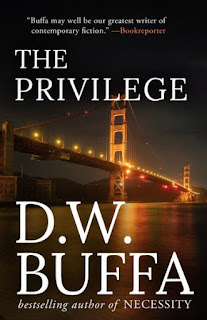
D.W. Buffa's recent novel is The Privilege, the ninth legal thriller involving the defense attorney Joseph Antonelli. The tenth, Lunatic Carnival, is due out soon. He has also published a series that attempts to trace the movement of western thought from ancient Athens, in Helen; the end of the Roman Empire, in Julian's Laughter; the Renaissance, in The Autobiography of Niccolo Machiavelli; and, most recently, America in the twentieth century, in Neumann's Last Concert.

Here is Buffa's take on Jane Austen's Mansfield Park:
The first page of Jane Austen’s novel, Mansfield Park, tells the story:

“About thirty years ago, Miss Maria Ward of Huntingdon, with only seven thousand pounds, had the good luck to captivate Sir Thomas Bertram, of Mansfield Park, in the county of Northampton, and to be thereby raised to the rank of a baronet’s lady, with all the comforts and consequences an handsome house and large income.” Lady Bertram had two sisters, neither of whom was so fortunate, because there “are not so many men of large fortune in the world as there are pretty women to deserve them.”

One of the sisters married a clergyman, Reverend Mr. Norris, “who had scarcely any money at all.” The other sister married a naval officer, Lieutenant Price, “without education, fortune, or connections,” and before they had been married eleven years had nine children. The eldest daughter, Fanny, who is nine, is sent to live with Mrs. Price’s sister, Lady Bertram, at Mansfield Park. Lady Bertram has four children of her own, two sons and two daughters, all of them several years older than Fanny. They think Fanny remarkably stupid, so stupid she does not know the principal rivers in Russia and has never heard of Asia Minor. They, themselves - and this tells something of how different education was then to what it is now - used to repeat in chronological order the kings of England, and the Roman emperors “as low as Severus,” a good deal of ‘Heathen Mythology, and all the Metals, semi-Metals, Planets and distinguished philosophers.” Fanny Price knows nothing, but, as we will discover, is more intelligent, and has better judgment, than anyone else at Mansfield Park.

It is a rule, sometimes understood by politicians, that it is often more difficult to protect yourself from your friends than from your enemies. Jane Austen never had any enemies; she has had too many friends. Nearly everything said about her, certainly everything depicted in the motion pictures based on her novels, have distorted out of all recognition the penetrating intelligence of her remarkable mind. If Mansfield Park is the retelling of the story of Cinderella, it is Cinderella written with the craft and subtlety of Niccolo Machiavelli. Those who now idolize what they think the light comedies of Jane Austen, might wish to consider what Thomas Babington Macaulay, one of the greatest writers of English prose, wrote about her in January of l843:

“Shakespeare has had neither equal nor second. But among writers who…have approached nearest to the manner of the great master, we have no hesitation placing Jane Austen…. She gives us a multitude of characters, all, in a certain sense, commonplace, all such as we meet every day. Yet they are all as perfectly discriminated from each other as if they were the most eccentric of human beings.”

Shakespeare was able to see how a character is formed by a multiplicity of passions and beliefs, all of them, together, checking and balancing each other in a sometimes uneasy combination. Shakespeare’s Shylock, for example, is driven by a desire for money, but he is also driven by a thirst for revenge, and, it is not so often remembered, by loyalty to his religion. Jane Austen has this same ability to see, to understand, and to describe the conflicting feelings and emotions that make someone who, and what, they are. But while Shakespeare had to work within the limitations of the stage, each character defined by what they said and what they did, Jane Austin, with the greater freedom of the novel, could include their private thoughts and feelings. Witness how she describes Mrs. Norris.

Mrs. Norris was the first to suggest that something should be done to help her, and Lady Bertram’s, sister, Mrs. Price, and that taking over the care of one of her many children would be the most helpful thing they could do. Sir Thomas is in complete agreement with this, but after Fanny arrives, is surprised to learn that Mrs. Norris would be unable to “take any share in the personal charge” of the girl. Mrs. Norris, “as far as walking, talking, and contriving reached … was thoroughly benevolent and nobody knew better how to dictate liberality to others; but her love of money was equal to her love of directing, and she knew quite as well how to save her own as to spend that of her friends.” When the Rev. Mr. Norris dies, she “consoled herself for the loss of her husband by considering that she could do very well without him….”

Sir Thomas exercises an almost tyrannical rule over his household. His daughter, Julia, is determined to escape his restrictions. She has attracted Mr. Rushworth, “an inferior young man, as ignorant in business as in books, with opinions in general unformed, and without seeming much aware of it himself.” Mr. Rushworth is stupid, but he is also very rich. Maria, however, is not in love with him; she is in love with Henry Crawford, a young man who has made a career of having women fall in love with him, and thinks nothing of it when he leaves Maria to pursue someone else.

There was only one thing Maria could do, and only someone with the lethal intelligence and rapier wit of Jane Austen could know what it was: “Henry Crawford had destroyed her happiness, but he should not know that he had done it.” She was ready for marriage to Mr. Rushworth, “being prepared for matrimony by an hatred of home, restraint, and tranquillity; by the misery of disappointed affection and contempt of the man she was to marry.” What could possibly go wrong?

Henry Crawford’s sister, Mary Crawford, has in the meantime set her sights on Sir Thomas’s second son, Edmund. The problem is that Edmund wants to become a clergyman. “You really are fit for something better,” she tells him. “Come, do change your mind. It is not too late. Go into the law.” Convinced there is no more important work, Edmund insists that it will “be every where found, that as the clergy are, or are not what they ought to be, so are the rest of the nation.” This, as you can imagine, has no effect on Miss Crawford.

Later, when they are practically engaged, Mary Crawford draws the difference between them with a cruel, ruthless logic which, if it escapes attention, only does so because the author constructs the conversation - the dialogue - in a way that makes the statement of extremes seem the light-hearted expression of an almost commonplace point of view. “A large income,” she informs him, “is the best recipe for happiness I ever heard of.” All Edmund can promise is that he will not be poor. This produces a response that, spoken to someone not in love with her, would have ended all relations. “Be honest and poor, by all means - but I should not envy you; I do not much think I shall even respect you. I have a much greater respect for those who are honest and rich.”

That Edmund, like his father before him, has been “captivated” by beauty, leads him to the kind of allowances he might otherwise never have been willing to make. He confides to Fanny, who has, in secret, been in love with him for as long as she can remember, that Mary “does not think evil, but she speaks it - speaks it in playfulness - and though I know it to be playfulness, it grieves me to the soul.” Fanny has grown up, and though Mrs. Norris, like the wicked step-mother in Cinderella, is always telling her, “Remember, wherever you are, you must be the lowest and last,” she sees more clearly than anyone else the selfish game others are playing, and understands better than anyone the fine nobility of Edmund Bertram’s too forgiving soul. She has grown up into a very attractive young woman, a fact which Henry Crawford is the first to notice. He tells his sister that he has decided “to make Fanny Price fall in love with me.” His sister, to her credit, has a very high regard for Fanny Price, and her brother is made to promise that no harm will come to the girl. He will only make her “feel when I go away that she shall never be happy again.”

But Fanny Price does not fall in love with Henry Crawford; he falls in love with her. His sister tells him, “From my soul, I do not think she would marry you without love, that is, if there is a girl in the world incapable of being influenced by ambition, I can suppose it is her….” She is right: Fanny does not love him, and she refuses to marry him. This astonishes Sir Thomas, and makes Mrs. Norris angry, though more angry “for having received such an offer than for refusing it.” Mrs. Norris “would have grudged such an elevation to one whom she had always been trying to depress.” Lady Bertram, for her part, tells Fanny not just that she has made a mistake, but has failed in her responsibilities: “it is every young woman’s duty to accept such a very unexceptionable offer as this.” To which Jane Austen comments, “This was almost the only rule of conduct, the only piece of advice, which Fanny had ever received from her aunt in the course of eight years and a half.”

After Sir Thomas recovers from his initial shock, he sends Fanny to see her family, the first visit she has made since she left, nearly nine years ago. Fanny regards this as a singularly generous thing to do; Sir Thomas regards it as the best way to show Fanny the mistake she is making. He thinks, correctly, and quite shrewdly, that an extended visit will make her “heartily sick” of the place. The “smallness of the house,” the “noise, disorder, and impropriety,” a mother from whom she “never met with greater kindness…than on the first day of arrival,” make her realize how much she had come to require the “elegance, propriety, regularity, harmony - and perhaps, above all, the peace and tranquillity of Mansfield….” Comparing the two houses, “Fanny was tempted to apply to them Dr. Johnson’s celebrated judgment as to matrimony and celibacy, and say, that though Mansfield Park might have some pains, Portsmouth could have no pleasures.”

Old enough, and mature enough, to make this comparison, Fanny begins to feel less dislike for Henry Crawford, and more belief in the sincerity of his affection. She continues to have feelings for Edmund, feelings which, because they must stay hidden, sharpen her sense of how mistaken he is about Mary Crawford. When he writes to her that Mary is the only woman he could think of marrying and attributes her ideas to the fashionable world, and that it is only “the habits of wealth I fear,” Fanny reacts with scorn. “Her friends leading her astray for years! She is quite as likely to have led them astray. They have all, perhaps, been corrupting one another.” She tells herself this; she cannot tell him.

Any doubt she may have had about Mary Crawford vanish forever when Edmund’s older brother, Tom, who will inherit everything, becomes ill and is in serious danger of dying. Mary writes Fanny: “I would put it to your conscience whether ‘Sir Edmund’ would not do more good with all the Bertram property, than any other possible ‘Sir.’”

While Mary Crawford is imagining the possible demise of Edmund’s brother with all the satisfaction of wealth and power foretold, Henry Crawford, waiting for Fanny to change her mind, discovers that the “temptation of immediate pleasure was too strong for a mind unused to make any sacrifice to right.” He runs off with Fanny’s cousin, Edmund’s sister, the wife, for all of six months, of the rich, stupid, and unfortunate, Mr. Rushworth. And what was Fanny’s reaction? An admirable sadness for Edmund’s now disgraced sister? A sense of betrayal for what Henry Crawford, for whom she had started to think affection might not be impossible, had done? Not a bit of it. She “felt she was, in the greatest danger of being exquisitely happy, while so many were miserable. The evil which brought such good to her! She dread lest she should learn to be insensible of it.”

Mrs. Norris and Mary Crawford both find ways to blame Fanny for what Henry Crawford has done. None of it would have happened if Fanny had accepted him, insists Mrs. Norris. “Why would she not have him?” Mary asks Edmund. “It is all her fault.”

Edmund, finally, realizes what Fanny has known all along, that Mary Crawford lacks all conscience. “Fanny, it was the detection, not the offense which she reprobated.”

In the well-ordered world of Jane Austen, the timing is perfect. She tells us in the last chapter that Edmund stops caring about Miss Crawford, “exactly at the time when it was quite natural that it should be so, and not a week earlier,” and “became as anxious to marry Fanny, as Fanny herself could desire.” She then explains, “Even in the midst of his late infatuation, he had acknowledged Fanny’s mental superiority. What must be his sense of it now, therefore? She was of course only too good for him; but as nobody minds what is too good for them, he was very steadily earnest in his pursuit of the blessing, and it was not possible that encouragement from her should be long wanting.”

If you did not know it was Jane Austen, you might think you had been reading a history of the Medici, that family, full of treachery, learning, and deceit, that brought the Renaissance to Florence and left us with the memory of what it means to be alive.
Visit D.W. Buffa's website.

Third reading: The Great Gatsby

Third reading: Brave New World.

Third reading: Lord Jim.

Third reading: Death in the Afternoon.

Third Reading: Parade's End.

Third Reading: The Idiot.

Third Reading: The Decline and Fall of the Roman Empire.

Third Reading: The Scarlet Letter.

Third Reading: Justine.

Third Reading: Patriotic Gore.

Third reading: Anna Karenina.

Third reading: The Charterhouse of Parma.

Third Reading: Emile.

Third Reading: War and Peace.

Third Reading: The Sorrows of Young Werther.

Third Reading: Bread and Wine.

Third Reading: “The Crisis of the Mind” and A Man Without Qualities.

Third reading: Eugene Onegin.

Third Reading: The Collected Works of Thomas Babington Macaulay.

Third Reading: The Europeans.

Third Reading: The House of Mirth and The Writing of Fiction.

Third Reading: Doctor Faustus.

Third Reading: the reading list of John F. Kennedy.

Third Reading: Jorge Luis Borges.

Third Reading: History of the Peloponnesian War.

--Marshal Zeringue