Saturday, September 30, 2023

John Keyse-Walker

John Keyse-Walker practiced law for 30 years, representing business and individual clients, educational institutions and government entities. He is an avid salt- and freshwater angler, a tennis player, kayaker and an accomplished cook. He lives in Ohio and Florida with his wife.

Sun, Sand, Murder, the first book in Keyse-Walker's Teddy Creque mystery series, won the Minotaur Books/Mystery Writers of America First Crime Novel Award. It was followed by Beach, Breeze, Bloodshed and Palms, Paradise, Poison. The newest Teddy Creque mystery is Reefs, Royals, Reckonings.

Recently I asked Keyse-Walker about what he was reading. His reply:
There always seem to be three books on my radar screen at any one time - one I have recently finished, one I am in the midst of and one waiting patiently on deck. Here they are:

Recently finished — Lonesome Dove by Larry McMurtry. I’d put off reading this masterpiece for years because of its daunting length (over 800 pages). That was a mistake. This is the quintessential Western Novel and should be on everyone’s reading list. Its exploration of the cowboy life is riveting, brutal, beautiful and almost poetic in quality. I decided to defeat the length by reading it in small bites when I was traveling on airplanes. It took over a year but it was a testament to the quality of the writing and the story that whenever the next flight came, I was able to pick the book up and be immediately engaged again.

In the midst of — Beartown by Fredrik Backman. This book explores life in a small Scandinavian forest town obsessed with its junior hockey team but it could as easily be about a Texas town and high school football or an Indiana county and its boys basketball team. Backman has the small town feel down pat and then throws a violent act into the mix, disrupting lives and the hopes that the town had. Out of the disruption, though, new strengths emerge for some of the characters. This is supposed to be a book about a town and a game but it is really about people and how they react when turmoil visits.

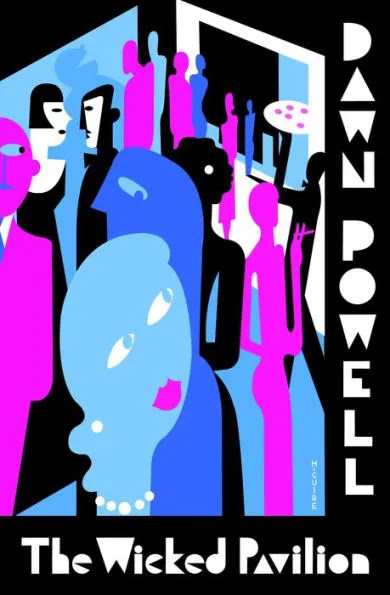
On deck — The Wicked Pavilion by Dawn Powell. Dawn Powell was a friend of Ernest Hemingway, John Dos Passos and E.E. Cummings. I had not heard of her, despite the famous company she kept. She is known for her acid-toughed prose and sharp wit. Hemingway called her his favorite living American writer. The Wicked Pavilion in the book is the Cafe Julian, a place to see and be seen, fall into and out of love, cadge money and puncture the reputations of others, which if her contemporaries are to be believed, Powell does better than anybody. It sounds like wicked fun.
Visit John Keyse-Walker's website.

My Book, The Movie: Sun, Sand, Murder.

My Book, The Movie: Beach, Breeze, Bloodshed.

The Page 69 Test: Palms, Paradise, Poison.

Q&A with John Keyse-Walker.

The Page 69 Test: Bert and Mamie Take a Cruise.

--Marshal Zeringue

Monday, September 25, 2023

D.W. Buffa

D.W. Buffa's new novel is Lunatic Carnival, the tenth legal thriller involving the defense attorney Joseph Antonelli. He has also published a series that attempts to trace the movement of western thought from ancient Athens, in Helen; the end of the Roman Empire, in Julian's Laughter; the Renaissance, in The Autobiography of Niccolo Machiavelli; and, most recently, America in the twentieth century, in Neumann's Last Concert.

Here is Buffa's take on The Letters of T.E. Lawrence:
On August 2, 1909, T. E. Lawrence, five days before his twenty-first birthday, wrote a letter to his mother in which he told her that he had “left Beyrout not long after the beginning of July, and walked straight to Sidon (30 miles or so),” and that “everywhere one finds remains of splendid Roman roads and houses and public buildings, and Galilee was the most Romanized province of Palestine.” This letter, more than 4500 handwritten words in length, is one of 583 letters included in The Letters of T. E. Lawrence, published in 1938. The first letter, also to his mother, was written August 4, 1906; the last, to Henry Williams, was written May 13, 1935, a few days before his death. Forty-six of the letters were written to his publisher, Edward Garnett; fourteen to E. M. Forster, the author of Passage To India, who became one of Lawrence’s close friends; nine to Bernard Shaw, who thought Seven Pillars of Wisdom a very great book; and seven to Robert Graves, whose book, Goodbye To All That, is essential to understanding what the First World War did to those who fought it.

Ten letters were written to John Buchan, an English writer and diplomat, who was convinced that Lawrence’s letters “will rank as high as any of his books, because they show nearly all the facets of his character.” Buchan, who knew everyone of importance, and considered Lawrence “the only man of genius I have ever known,” understood him, perhaps, better than anyone had. When he met him in 1920, “his whole being was in grave disequilibrium. You cannot in any case be nine times wounded, five times in an air crash, have many bouts of fever and dysentery, and finally at the age of twenty-nine take Damascus at the head of an Arab army, without living pretty near the edge of your strength.”

The letters Lawrence wrote read like a novel: everything he does, everything that happens to him, everything he tries, everything he learns, all follow in the ordered sequence of a well-told story; everything , from the very beginning to the very last letter, leading to a conclusion that seems not just appropriate, but inevitable. The twenty year old who decides to write, “a comparison of the castles built by the Crusaders in Syria and Palestine with those of Western Europe;” the twenty year old who, as he wrote on September 22, 1909, had walked more than 1100 miles and seen all but one of “37 out of the 50 odd castles” that “were on my proposed route,” and, in part of the journey, had been “the first European visitor;” the twenty year old who did this was, at the beginning of the war, the only Englishman who knew what the Syrian desert, was like.

In the autumn of 1914, he wrote to a friend about putting together, for the British command in Cairo, a complete map of Sinai. The map was eighteen feet by eighteen feet. “Some of it was accurate, and the rest I invented.” That was not all Lawrence invented. Toward the end of December, he wrote about the situation in Cairo: “There wasn’t an Intelligence Department, it seemed, and they thought all was well without it: - till it dawned on them that nobody in Egypt knew about Syria…so they changed their minds about sending us flying as a good riddance - and set us to collect intelligence instead.” Three months later - March 22, 1915 - he had formulated the strategy of the Arab Revolt he would lead: he will “roll up Syria by way of the Hejaz in the name of the Sherif,” and then “rush right up to Damascus, and biff the French out of all hope of Syria. It is a big game, and at last one worth playing.”

There was not time to write many letters during the war, but those he wrote, and what he wrote in the Arab Bulletin that was circulated among British officials, add a new, and different, light on what happened, than what he wrote in Seven Pillars of Wisdom. When Akaba was taken, after what was thought an impossible journey to the sea coast city from across the desert, he writes that Auda, the leader of one of the most warlike Arab tribes, “had a narrow escape, since two bullets smashed his glasses, one pierced his revolver holster, three struck his sheathed sword, and his horse was killed under him. He was wildly pleased with the whole affair.”Lawrence was less pleased with what had happened to him. In a letter written from Akaba on September 24, 1917, he expressed the hope that “when the nightmare ends…I will wake up and become alive again. This killing and killing of Turks is horrible when you charge in at the finish and find them all over the place in bits, and still alive many of them, and know that you have done hundreds in the same way and must do hundreds more if you can.”

Lawrence may have regretted what he had to do; he never doubted that he had to do it. There were rules in war, but God help the Turks if the rules were broken. With cruel honesty, Lawrence recounted what happened after the Turks took the village of Tapas and raped all the women they could catch. Sherif Bey, the Turkish commander, ordered all the inhabitants killed, including two small children and forty women, one of whom had been forced down on a bayonet. One of the sheiks who rode with Lawrence was so enraged by this, that he “galloped at full speed into the midsts of the retiring column and fell, himself and his mare, riddled with machine gun bullets, among their lance points.” With Auda’s encouragement, Lawrence ordered “No prisoners!”

Despite the order, two hundred fifty Turks were taken alive. “Later, however, they found one of our men with a fractured thigh who had been afterwards pinned to the ground by two mortal thrusts with German bayonets. Then we turned our Hotchkiss on the prisoners and made an end of them, they saying nothing.” Lawrence does not apologize for this. To those who criticized the Arabs for what they had done, he answered that “they had not entered Tura or Tapas, or watched the Turks swing their wounded by the hands and feet into a burning railway truck, as had been the lot of the Arab army at Jerdun.” With all he had seen and done, it is no great wonder that when the war was finally over, he would sit at his mother’s table in the morning and, without moving at all, stare straight ahead for hours.

After the war, Lawrence was determined to do two things: make certain the Arabs would get what they had been promised and to write a true account of the Arab Revolt. The settlement of the Arab situation, which took place during 1921 and 1922, a settlement made by Winston Churchill, “in which I shared, honorably fulfils the whole of the promises we made to the Arabs, in so far as the so-called British sphere, are concerned,” he wrote in a letter of October 1929. “If we had done this in 1919 we could have been proud of ourselves.” The true account he wanted to write, Seven Pillars of Wisdom, took four years, years in which, “I gave it all my nights and days till I was nearly blind and mad.” He didn’t think it good enough to publish, but he wrote to Bernard Shaw that, “I’m shamed forever if I am the sole chronicler of an event, and fail to chronicle it: and yet unless what I’ve written can be made better I’ll burn it.” If Shaw reads it, and comes to the same conclusion, “you will give me courage to strike the match.”

Shaw read it, thought it one of the greatest things ever written, and, among his other suggestions, advised him to eliminate the introduction because it was likely to give offense to some of those still living. This was unfortunate. It removed, among other things, the following:

“Those who dream by night in the dusty recesses of their minds wake in the day to find that all was vanity: but the dreamers of the day are dangerous men, for they may act their dreams with open eyes, and make it possible. This I did. I meant to make a new nation, to restore to the world a lost influence, to give twenty million of Semites the foundation on which to build an inspired dream-place of their national thoughts.” He had at least made a start: “I have fitted these people for the new commonwealth in which the dominant races will forge their brute achievements, and white and red and yellow and brown and black will stand up together without side-glances in the service of the world.”

Lawrence continued to consider Seven Pillars a failure, a “hopeless failure partly because my aim was so high.” Everyone else, not just Bernard Shaw, everyone of intelligence and experience, thought it a remarkable achievement, better, by far, than what most other writers had done. Comparisons, however, had no relevance for Lawrence: “Better perhaps than some, than many, almost - but I do not care for relatives, for matching myself against my kind. There is an ideal standard somewhere and only that matters: and I cannot find it.” He tried. He was always reading what others wrote, reading with an eye to how something was done, how a writer achieved an effect other writers could not. In a letter to the publisher F.N. Doubleday, he wrote one of the most insightful things ever written about Joseph Conrad:
“You know, publishing Conrad must be a rare pleasure. He’s absolutely the most haunting thing in prose that ever was. I wish I knew how every paragraph he writes (Do you notice they are all paragraphs: he seldom writes a single sentence?) goes on sounding in waves like the note of a tenor bell, after it stops. It’s not built on the rhythm of ordinary prose, but as something existing only in his head, and as he can never say what it is he wants to say, all his things end in a kind of hunger, a suggestion of something he can’t say or do or think. So his books always look bigger than they are.”
In another letter, written that same year, he explains that, “prose depends on a music in one’s head which involuntarily chooses and balances the possible words to keep tune with the thought.” Music like this is not given to everyone. “Half the books I pick up, now a days,” he wrote in l931, “seem to have no raison d’ĂȘtre: one does not feel that the writer would have burst if he had not got it out. And that discourages me, for I would like my work, if any, to feel like that.”

Lawrence wrote with a fountain pen, and not with a typewriter, because it was impossible “to think…direct on to the instrument Now, with a pen I can hold my fancy in leash and write what my mind dictates or approves.” He had the same disregard for the modern obsession with historical documents: “The documents are liars. No man ever yet tried to write down the entire truth of any action in which he has been engaged All narrative is parti pris. And to prefer an ancient written statement to the guiding of your own instinct through the maze of related facts, is to encounter either banality or unreadableness. We know too much, and use too little knowledge.”

Lawrence had, from the very beginning, wanted to make a new nation, and so he led the Arab Revolt, and then wrote about it so the story would be told and become a reminder that great things could still be done. But he wanted more than that; he wanted, finally, to understand his own moral standing. He had been so much at liberty to decide what he, and all the others involved in the Arab Revolt, should do, he was not sure if what he had done had been morally justified. By “putting all the troubles and dilemmas on paper, I hoped to work out my path again and satisfy myself how wrong, or how right, I had been.” Seven Pillars, he concluded, was “the self-argument of a man who couldn’t then see straight: and who now thinks that perhaps it did not matter: that seeing straight is only an illusion. We do these things in sheer vapidity of mind, not deliberately, not consciously even. To make out that we were reasoned cool minds, ruling our courses and contemporaries, is a vanity. Things happen, and we do our best to keep in the saddle.”

Lawrence despised fame, and despised himself for sometimes liking that he had become famous. It was, for him, no way to live, with journalists showing up all hours of the day and night wherever he happened to be. He had refused to take any money from Seven Pillars, or any of its abridgments, donating the money to those injured in the war. He talked Alexander Korda out of making a movie about Lawrence of Arabia. He sought, and found, escape in the anonymity of a private volunteer in the Royal Air Force, serving under a different name. He tried to explain this to Bernard Shaw:
I just can’t help it. You see, I’m all smash inside: and I don’t want to look prosperous or be prosperous, while I know that. And on the easy level with the other fellows in the R.A.F. I feel safe: and often I forget that I’ve ever been different…. It would be so easy and so restful just to let sanity go and drop into the dark, but that can’t happen while I work and meet simple-hearted people all day long. However, if you don’t see it, I can’t explain it.
Lawrence, famous around the world as Lawrence of Arabia, could have made a fortune writing, or giving lectures, about himself, but lived instead in the privacy of his air force work and the privacy of his mind, writing the kind of letters we have now, in our hurry to tell everyone in ten short words everything we know, forgotten how to write. Of these years in which he avoided the fame and the money and the celebrity everyone else prized, he wrote: “My last ten years have been the best of my life.”
Visit D.W. Buffa's website.

Third reading: The Great Gatsby. 

Third reading: Brave New World.

Third reading: Lord Jim.

Third reading: Death in the Afternoon.

Third Reading: Parade's End.

Third Reading: The Idiot.

Third Reading: The Decline and Fall of the Roman Empire.

Third Reading: The Scarlet Letter.

Third Reading: Justine.

Third Reading: Patriotic Gore.

Third reading: Anna Karenina.

Third reading: The Charterhouse of Parma.

Third Reading: Emile.

Third Reading: War and Peace.

Third Reading: The Sorrows of Young Werther.

Third Reading: Bread and Wine.

Third Reading: “The Crisis of the Mind” and A Man Without Qualities.

Third reading: Eugene Onegin.

Third Reading: The Collected Works of Thomas Babington Macaulay.

Third Reading: The Europeans.

Third Reading: The House of Mirth and The Writing of Fiction.

Third Reading: Doctor Faustus.

Third Reading: the reading list of John F. Kennedy.

Third Reading: Jorge Luis Borges.

Third Reading: History of the Peloponnesian War.

Third Reading: Mansfield Park.

Third Reading: To Each His Own.

Third Reading: A Passage To India.

Third Reading: Seven Pillars of Wisdom.

--Marshal Zeringue

Friday, September 22, 2023

Linda L. Richards

Linda L. Richards is the award-winning author of over one dozen books. The founder and publisher of January Magazine and a contributing editor to the crime fiction blog The Rap Sheet, she is best known for her strong female protagonists in the thriller genre. Richards is from Vancouver, Canada and currently makes her home in Phoenix, Arizona.

Her latest novel is Dead West.

Recently I asked Richards about what she was reading. Her reply:
Right now I am reading The Hours Before Dawn by Celia Fremlin. I have not read this book before, and yet it gives me the feeling of getting back to my roots as a crime fictionist. I’ll tell you why. The Edgar-Award winning novel came out in 1958. It has the slow burn and languorous pace of a Patricia Highsmith novel, where you find yourself with your heart in your throat and you can’t even imagine how it got there.

In The Hours Before Dawn, an overworked and undervalued young mom takes in a boarder who soon appears to be not quite what she seems. This is proto suspense thriller done to perfection. I can’t wait to see where this one goes.

Fremlin was the author of 16 novels, many of them, as British author Lucy Lethbridge has said, “centering round the home as the harbour of a particularly horrible, intimate, terror.”
Visit Linda L. Richards's website.

My Book, The Movie: Endings.

The Page 69 Test: Endings.

Q&A with Linda L. Richards.

The Page 69 Test: Exit Strategy.

The Page 69 Test: Dead West.

--Marshal Zeringue

Sunday, September 17, 2023

Clay McLeod Chapman

Clay McLeod Chapman writes novels, comic books, and children's books, as well as for film and TV. He is the author of the horror novels The Remaking, Whisper Down the Lane, and Ghost Eaters. He also co-wrote Quiet Part Loud, a horror podcast produced by Jordan Peele's Monkeypaw for Spotify.

Chapman's new novel is What Kind of Mother.

Recently I asked the author about what he was reading. His reply:
I just finished the one-two punch of Josh Malerman’s Spin a Black Yarn and Ronald Malfi’s They Lurk. I would wholeheartedly recommend a double bill of these books back-to-back.

First off, they’re both novella collections, so you’re getting bite-sized Malermans and Malfis.

Yum!

But most of all, I feel like you’re seeing these two authors—authors who I admire and aspire to emulate—at their most playful. These two are masters of modern horror. Let there be no doubt: They have staked their claim at the top of Mount Monstrosity. They are living legends.

Reading Malerman’s “Half the House is Haunted” is a masterclass in nightmare inception. He plants an idea in your head—my head—and it just won’t leave me be. I’m still thinking about it.

Reading Malfi’s “The Stranger” is nihilistic comedy at its blackest. The horror is in how far he goes, the depths that he descends, and how there’s something so cosmically awful about it all, that you just can’t help but laugh. Cackle, actually. It’s madness at its pitchest and I loved it.

Other choice cuts—for me—are Malerman’s “Argyle” and Malfi’s “Skullybelly,” but really, any one of these novellas is a meal in of themselves. There’s so much to love here. You feel the authors having fun, positing these nightmarish notions and then simply going to town.

So grab yourself a copy of both and have yourself a Malerman/Malfi sandwich! Yummy in the tummy!
Visit Clay McLeod Chapman's website.

My Book, The Movie: The Remaking.

The Page 69 Test: The Remaking.

My Book, The Movie: Whisper Down the Lane.

Q&A with Clay McLeod Chapman.

The Page 69 Test: Whisper Down the Lane.

The Page 69 Test: What Kind of Mother.

--Marshal Zeringue

Monday, September 11, 2023

Chris Nickson

Chris Nickson is the author of eleven Tom Harper mysteries, eight highly acclaimed novels in the Richard Nottingham series, and five Simon Westow mysteries. He is also a well-known music journalist. He lives in his beloved Leeds.

Nickson's newest book is Rusted Souls, the final book in the Tom Harper series.

Recently I asked the author about what he was reading. Nickson's reply:
Although born and raised in Britain, and now back living there, I spent three decades in the US. As a music journalist I was very aware of Britpop in the 90s, and reviewed a fair bit of it. But I didn't have the story in a British context. Reading Daniel Rachel's Don't Look Back In Anger, which covers the entire Cool Britannia period of the 90s, along with Animal House by James Brown, the story of his magazine, Loaded, and Dylan Jones's Faster Than A Cannonball: 1995 And All That (which covers more than just that year) gives me a full picture of a time I never experienced over here directly. Honestly, I'm not sure I missed much. Not research, just curiosity

There's also fiction. Patrick O'Brian's Blue At The Mizzen takes me back into the world of Jack Aubrey and Stephen Maturin, such perfectly drawn characters that it's always like a visit with old friends. In a Little Free Library yesterday I found Jay McInerney's debut Bright Lights, Big City, which made such an impact in the mid 80s. I read and loved it back then, but would something so much of the period hold up? I've barely begun it, but so far the answer is yes: much of the writing is as good as I recall.
Visit Chris Nickson's website.

The Page 69 Test: Rusted Souls.

--Marshal Zeringue

Thursday, September 7, 2023

Kathleen Rooney

Kathleen Rooney is a founding editor of Rose Metal Press, a nonprofit publisher of literary work in hybrid genres, as well as a founding member of Poems While You Wait, a team of poets and their typewriters who compose commissioned poetry on demand. She teaches in the English Department at DePaul University, and her recent books include the national best-seller Lillian Boxfish Takes a Walk (2017) and the novel Cher Ami and Major Whittlesey (2020). Where Are the Snows, her latest poetry collection, was chosen by Kazim Ali for the X.J. Kennedy Prize and published by Texas Review Press in Fall 2022.

Rooney's new novel is From Dust to Stardust.

Recently I asked the author about what she was reading. Her reply:
Back in January, I asked my friend Cassandra Gillig—who always has the best book recommendations—if she had read any books lately that I absolutely must know about, and she recommended Jill Johnston’s The Disintegration of a Critic.

Released by Sternberg Press in 2019, it’s a collection of 30 pieces that Johnston—feminist, cultural critic, and lesbian icon—first published in her weekly Village Voice column between 1960 and 1974. Cassandra described the texts as being “all so messy & fun” and said that they “frequently veer into a terrain of almost too off-topic before getting back on track in a way nothing else could.” Now that I’ve finally gotten around to reading the essays, I couldn’t have said it better myself.

Every page is full of goofy wordplay and poetic lyricism and astute political observations and clear-eyed cultural commentary, like when she writes “Life is a raincheck to oblivion” or explains that:
It is not easy to see. Outside the theatre, living as we do, most of us see very little with our eyes wide open. In action the eye absorbs space forms to function; in repose the eye becomes a facial decoration as sight turns inward. And our training is such that when we do look for non-functional reasons, it is usually at something huge and spectacular, like cathedrals or sunsets. And even then it is rare to see more than a general outline. Or to see more and still enter. That is the crucial transition, from seeing to entering. Not only crucial but mysterious so I won’t say any more except to note that I think that most people who go to dance concerts don't see very well, not even dancers, sometimes especially dancers, and most often critics, who must attend special classes in becoming blind.
Johnston gets the reader to see and to enter. And Cassandra never misses.
Visit Kathleen Rooney's website.

The Page 99 Test: Live Nude Girl.

The Page 99 Test: For You, for You I Am Trilling These Songs.

My Book, The Movie: For You, for You I Am Trilling These Songs.

My Book, The Movie: Lillian Boxfish Takes a Walk.

The Page 69 Test: Cher Ami and Major Whittlesey.

My Book, The Movie: Cher Ami and Major Whittlesey.

The Page 69 Test: Where Are the Snows.

The Page 69 Test: From Dust to Stardust.

My Book, The Movie: From Dust to Stardust.

Q&A with Kathleen Rooney.

--Marshal Zeringue

Sunday, September 3, 2023

Sung J. Woo

Sung J. Woo’s short stories and essays have appeared in The New York Times, PEN/Guernica, and Vox. He has written four novels, Deep Roots (2023), Skin Deep (2020), Love Love (2015), and Everything Asian (2009), which won the 2010 Asian Pacific American Librarians Association Literature Award. In 2022, his Modern Love essay from The New York Times was adapted by Amazon Studios for episodic television. A graduate of Cornell University with an MFA from New York University, he lives in Washington, New Jersey.

Recently I asked Woo about what he was reading. His reply:
The book I'm "reading" right now is Robert A. Caro's The Path to Power, The Years of Lyndon Johnson, Volume 1. I'm wrapping quotes around the word "reading" because I'm listening to the book on audiobook, or more accurately, book on tape that's been converted over to mp3s (what a convoluted world we live in!). They really are conversions, as I'm told over and over again that the book is continued on the other side of the cassette or on the next cassette.

Previous to this aural undertaking, I listened to all 66 hours of The Power Broker, Caro's first book about Robert Moses. It took me about six months to get through it, and what I'll never forget is the weird feeling I got near the end, when Moses' power was waning and I was filled with sadness. Looking back, I believe it was a kind of Stockholm Syndrome. Let me explain: Moses was not a great guy. In fact, even though he did amazing things for the state of New York, building countless bridges and highways in record time, he was also a terrible racist and a power-mongering monster. And yet, when I saw him getting older and slowly losing his grip on the city and its surroundings, I couldn't help but feel sorry for him. All credit to Caro for painting such a nuanced, complicated portrait of a man.

I've just started listening to the first LBJ book (2 hours into a 36 hours), and it's every bit as riveting already as The Power Broker. I love how Caro goes all the way, way back to LBJ's roots, to the land itself, the deceptive Hill Country of Texas. No wonder that growing up, LBJ's nickname was Bull -- not because of the steer, but of bullshit. What a tangled web he wove into the fabric of America and the world.
Visit Sung J. Woo's website.

The Page 69 Test: Everything Asian.

My Book, The Movie: Skin Deep.

Q&A with Sung J. Woo.

The Page 69 Test: Skin Deep.

My Book, The Movie: Deep Roots.

The Page 69 Test: Deep Roots.

--Marshal Zeringue

Saturday, August 26, 2023

Jerome Charyn

Jerome Charyn is the author of more than fifty works of fiction and nonfiction, including Ravage & Son; Sergeant Salinger; Cesare: A Novel of War-Torn Berlin; In the Shadow of King Saul: Essays on Silence and Song; Jerzy: A Novel; and A Loaded Gun: Emily Dickinson for the 21st Century. Among other honors, his work has been longlisted for the Mark Twain American Voice in Literature Award and PEN Award for Biography, shortlisted for the Phi Beta Kappa Christian Gauss Award, and selected as a finalist for the Firecracker Award and PEN/Faulkner Award for Fiction. Charyn has also been named a Commander of Arts and Letters by the French Minister of Culture and received a Guggenheim Fellowship and the Rosenthal Family Foundation Award for Fiction from the American Academy of Arts and Letters. He lives in New York.

Recently I asked Charyn about what he was reading. His reply:
I am currently reading a biography of Ludwig Wittgenstein by Ray Monk. I intend to write a story about Wittgenstein, who served as a porter at Guy’s Hospital during World War II. This was his war service. My narrator, a young American caught in London during the Blitz, befriends Wittgenstein and the story is about their curious friendship.

Wittgenstein was the greatest philosopher of the 20th Century. He was also a Jewish homosexual who converted to Catholicism. He came from the richest family in Vienna and gave his entire fortune away.

Wittgenstein never read Aristotle, and didn’t believe in the history of philosophy. He was a poet who hurled himself into the world of mathematics. He was a musician; he could have played the clarinet in any orchestra. He was an architect who built a house for his sister without ever studying architecture. He was a genius who had nowhere to go. He was a professor of philosophy at Cambridge, who gave up his chair to live like a monk. He did not believe in anything other than the mysterious music of language.

Philosophy was a riddle that Wittgenstein knew he could never solve. He died trying to do so.
Visit Jerome Charyn's website.

The Page 69 Test: Under the Eye of God.

My Book, The Movie: Big Red.

Q&A with Jerome Charyn.

The Page 69 Test: Ravage & Son.

--Marshal Zeringue

Friday, August 18, 2023

Mark Pryor

Mark Pryor is a former newspaper reporter and felony prosecutor, originally from England but now living in Austin, Texas. He is the author of the Hugo Marston mystery series, set in Paris, London, and Barcelona. Pryor is also the author of the psychological thrillers, Hollow Man, and its sequel, Dominic. As a prosecutor, he appeared on CBS News's 48 Hours and Discovery Channel's Discovery ID: Cold Blood.

Last year Pryor introduced Detective Henri Lefort in his first World War II mystery, Die Around Sundown.

His new novel is the second book in the series, The Dark Edge of Night.

Recently I asked Pryor about what he was reading. His reply:
I'm reading The Lincoln Highway by Amor Towles. I like to step away from crime fiction from time to time and one of my favorite books ever was A Gentleman in Moscow, so I knew Lincoln Highway would be good. I'm about halfway through and loving the prose, plot, and characters. I'm always impressed when an author is good enough to capture and convey a sense of place, and Towles proves how good he is in this book, just as he did in his historical Moscow hotel.
Visit Mark Pryor's website.

My Book, The Movie: Dominic.

My Book, The Movie: Die Around Sundown.

Q&A with Mark Pryor.

My Book, The Movie: The Dark Edge of Night.

--Marshal Zeringue

Wednesday, August 16, 2023

D.W. Buffa

D.W. Buffa's new novel is Lunatic Carnival, the tenth legal thriller involving the defense attorney Joseph Antonelli. He has also published a series that attempts to trace the movement of western thought from ancient Athens, in Helen; the end of the Roman Empire, in Julian's Laughter; the Renaissance, in The Autobiography of Niccolo Machiavelli; and, most recently, America in the twentieth century, in Neumann's Last Concert.

Here is Buffa's take on T.E. Lawrence's Seven Pillars of Wisdom:
In the copy of Seven Pillars of Wisdom T.E.Lawrence gave to his friend, E.M.Forster, he wrote: “Not good enough, but as good, apparently, as I can do.” Forster disagreed. Lawrence, he explained, “was so modest that he never grasped its greatness, or admitted that he had given something unique to our literature.” To say that the book describes the revolt in Arabia against the Turks, is like saying that “Moby Dick is about catching a whale.”

The book that Lawrence did not think good enough, and E.M. Forster thought one of the greatest ever written, was written more than once. The original manuscript, left in a bag at the Reading station, was stolen, and Lawrence had to write it all over again. This second manuscript, known as the Oxford edition of l922, did not do much better. Nearly 330,000 words in length, only about a half dozen copies were known to exist. Lawrence cut this version by 50,000 words, including all of the first chapter, which contained one sentence Forster always remembered: “All the subject provinces of the Empire to me were not worth one dead English boy.” It was a sentence to be weighed against the seven words stamped on the cover of the edition finally offered to the public in 1935, the year of Lawrence’s death: “The sword also means cleanness and death.”

Forster understood why Lawrence had become so famous. The war in the desert was the “last of the picturesque wars. Camels, pennants, the blowing up of little railway trains by little charges of dynamite in the desert - it is unlikely to recur. Next time the airplane will blot out everything in an indifferent death….” The Arab Revolt, Lawrence’s war, was “the last effort of the war-god before he laid down his godhead and turned chemist.” How did it happen? How did a twenty-eight year old English intelligence officer who had joined the army only at the outbreak of the war become one of the greatest generals England ever had?

Lawrence was sent out from Cairo, where he was stationed, to make an assessment of the Arab capacity to help the British fight the Turks. He met Feisal, the Arab leader, who was himself only thirty-one. When Feisal asked him, “And do you like our place here at Wadi Safra?” Lawrence replied, “Well; but it is far from Damascus.” That remark, that it is “far from Damascus,” reveals a depth of understanding, an idea of what the Arabs should be doing, that from the start separated what Lawrence thought necessary and what the British high command had in mind. “I believed in the Arab movement, and was confident, before ever I came, that in it was the idea to tear Turkey into pieces; but others in Egypt lacked faith, and had been taught nothing intelligent of Arabs in the field.”

Lawrence would have to act alone, but that meant he would, in a way, have to change identities: “no man could be their leader except he ate the ranks’ food, wore their clothes, lived level with them, and yet appeared better in himself.” He had also to rid himself of much of what he had been taught. He had read all the the classic works of military strategy and tactics, “Clausewitz and Jomini, Mahan and Foch, had played at Napoleon’s campaigns, worked at Hannibal’s tactics, and the wars of Belisarius, like any other man at Oxford, but I had never thought into the mind of a real commander compelled to fight a campaign of his own.” He did this, finally, after laying ten days in bed in the desert with an illness.

The British were insistent that the Arabs capture Medina. Lawrence woke up one afternoon “from a hot sleep, running with sweat,” wondering “what on earth was the good of Medina to us.” In a revelation that, had it been understood by the American military authorities a half century later, might have made them doubt the wisdom of fighting an insurgency in places like Vietnam and the Middle East, Lawrence decided that the attempt to destroy the enemy in battle was all wrong.

Why take Medina? The Turkish garrison had been “reduced to an inoffensive size” and their effort to keep the town would only cost them men and material. The best way to win the war was not to fight. “Out of every thousand square miles of Hejaz nine hundred and ninety-nine were now free.” The Turks were “welcome to the tiny fraction in which they stood.” They had to defend 140,000 square miles. That would require a fortified post every four square miles. It would take 600,000 men “to meet the ill-will of all the Arab peoples combined with the active hostility of a few zealots, “of which there were at present 50,000.” The Arab revolt should be “a war of detachment.” Lawrence would attack not men, but materials. He would cut the railroad lines.

Cut them, not to prevent, but to delay the movement of men and supplies to the various Turkish positions. This was the key. The object was not to destroy the Turkish army, or to force them to withdraw; it was to make the maintenance of the Turkish garrison “just a shade less difficult than its evacuation….” The Turkish army would be held prisoner in the places it thought it had to defend. Led by Lawrence, the Arabs “were never on the defensive except by accident and in error,” because “we had nothing material to lose, so our best line was to defend nothing and to shoot nothing….” What the Turks, and not just the Turks, but the accepted military judgment of the allies, failed to grasp was that “in Arabia range was more than force, space greater than the power of armies.” The Turkish army was an army of occupation in an area greater than could be dominated effectively from fortified posts.” That meant, for Lawrence, “that our rebellion had an unassailable base, guarded not only from attack, but from the fear of attack.”

The conclusion, at least for Lawrence, was obvious: “We must not take Medina.” To the contrary, “we wanted him to stay at Medina, and every other distant place, in the largest number.” The Turks would not want to do anything else. “His stupidity would be our ally, for he would like to hold, or think he held, as much of his old provinces as possible. His pride in his imperial heritage would keep him in his present absurd position - all flanks and no front.”

Lawrence knew what had to be done, but the reason why it had to be done had to remain his secret. No one else had a serious interest in England’s honor. Everything Britain had done, all the promises made to the Arabs, had been a lie. “The Arab revolt had begun on false pretenses.” There were secret agreements in which England, France, and Russia had agreed to annex some of the areas of the Middle East and to create spheres of influence “over all the rest.” The only way to force England to keep its promises was to make the Arab revolt so successful England would have no choice.

This meant Lawrence would have to speak like Odysseus, tailoring his speech to his audience. To keep Egypt, on whom he depended for supplies, satisfied, Lawrence and the Arabs “must reduce impolitic truth to keep her confident and ourselves a legend.” He “could not explain to Allenby the whole Arab situation, nor describe the full British plan to Feisal.” The reports he wrote to the British headquarters in Palestine were, quite on purpose, done to “make them think me a modest amateur, doing his best after the great models; not a clown, leering after them where they with Foch, bandmaster, as their head went drumming down the old road of effusion of blood into the house of Clausewitz.”

It is striking how much everything Lawrence did was a conscious attempt to make himself “a legend” who would be given the respect, and the independence, without which the Arab revolt could never succeed. He became as hard, as heedless, as any Arab, and as indifferent to the demands of his body as any Stoic ever dreamed, able to go “two, three, or four days without food.” He had never ridden a camel, but became better at it than any Arab follower of the Arab revolt, because only with the camel could his forces go without supplies for six weeks, which meant, in the desert, “a thousand miles out and home.” Fifty miles covered in a day was considered an easy stage, eighty miles was good, a hundred ten was possible, riding through a breathless wind, “with the furnace taste,” riding with “Our shriveled lips cracked open, and the skin of our faces chapped; while our eyelids, gone granular, seemed to creep back and bare our shrinking eyes.” Like torture, to most civilized men, but something else for Lawrence, “since its torment seemed to fight against mankind with ordered conscious malevolence, and it was pleasant to outface it so directly, challenging its strengths, and conquering its extremity.”

The Arabs followed Lawrence because they hated the Turks and were inspired by Feisal. The first rule of Arab warfare was that women were “inviolable’; the second rule was that the “lives and honor of children too young to fight with men were to be spared.” The Turks had no rules. After taking one village, “Hundreds of the inhabitants were raped and butchered, the houses fired, and living and dead alike thrown back into the flames.” The Arabs followed Feisal because “he brought nationality to their minds in a phrase, which set them thinking of Arab history and language…. Another phrase showed them the spirit of Feisal, their fellow and leader, sacrificing everything for the national freedom….” Lawrence felt some of what they felt. “Even I, the stranger, the godless fraud inspiring an alien nationality, felt a delivery from the hatred and eternal questioning of self in my imitation of their bondage to the idea; and this despite the lack of instinct in my own performance.”

One year of this, then another, his conscience racked with the question - a question that may seem, if not impossible, archaic, in our more sophisticated, and morally less rigorous, times - whether he had not lost his honor, “when I assured the Arabs that England kept her plighted word.” He was tired of it, the “pretense to lead the national uprising of another race, the daily posturing in alien dress, preaching in alien speech….” But there was no escape. He had to stay. Turkey had to be taken out of the war, to redress the stalemate of the Western front.

Lawrence became even more insightful. It was all a fraud, but the Arabs had been given something that made that fraud a gift. “By our swindle, they were glorified. We paid for them our self-respect, and they gained the deepest feeling of their lives.” Fraud itself became a subject. “Here were the Arabs believing in me, Allenby and Clayton trusting me, my bodyguard dying for me: and I began to wonder if all established reputations were founded, like mine, on fraud.” He wondered if he himself was a fraud. He had “a craving to be famous; and a horror of being known to like being known.”

With a constant close eye on himself, and yet observing with extraordinary clarity the world around him, Lawrence never lost sight of what he had set out to do. He led the Arab revolt and took Damascus, which “meant the end of the war in the East and, I believed, the end of the general war, too: because the Central powers being inter-dependent, the breaking of their weakest link - Turkey - would swing the whole cluster loose.” It was something that, astonishing as it must seem, he had planned from the beginning, when he was still a boy. Seven Pillars of Wisdom ends with these three sentences: “I had dreamed, at the City School in Oxford, of hustling into form, while I lived, the new Asia which time was inexorably bringing upon us. Mecca was to lead to Damascus; Damascus to Anatolia, and afterwards to Bagdad; and then there was Yemen. Fantasies, these will seem, to such as are able to call my beginning an ordinary effort.”

It is no wonder that Winston Churchill said of Lawrence: “I deem him one of the greatest beings alive in our time…We shall never see his like again. His name will live in history.”
Visit D.W. Buffa's website.

Third reading: The Great Gatsby. 

Third reading: Brave New World.

Third reading: Lord Jim.

Third reading: Death in the Afternoon.

Third Reading: Parade's End.

Third Reading: The Idiot.

Third Reading: The Decline and Fall of the Roman Empire.

Third Reading: The Scarlet Letter.

Third Reading: Justine.

Third Reading: Patriotic Gore.

Third reading: Anna Karenina.

Third reading: The Charterhouse of Parma.

Third Reading: Emile.

Third Reading: War and Peace.

Third Reading: The Sorrows of Young Werther.

Third Reading: Bread and Wine.

Third Reading: “The Crisis of the Mind” and A Man Without Qualities.

Third reading: Eugene Onegin.

Third Reading: The Collected Works of Thomas Babington Macaulay.

Third Reading: The Europeans.

Third Reading: The House of Mirth and The Writing of Fiction.

Third Reading: Doctor Faustus.

Third Reading: the reading list of John F. Kennedy.

Third Reading: Jorge Luis Borges.

Third Reading: History of the Peloponnesian War.

Third Reading: Mansfield Park.

Third Reading: To Each His Own.

Third Reading: A Passage To India.

--Marshal Zeringue