Saturday, November 17, 2012

Derek Haas

Derek Haas is the co-writer of the films The Double, Wanted, and 3:10 to Yuma, and author of The Assassin Trilogy: The Silver Bear, Columbus and Dark Men. His new novel is The Right Hand.

Recently I asked Haas what he was reading.  His reply:
Currently, I'm reading Reamde by Neal Stephenson. It's a globe-trotting, character jumping espionage thriller focusing on a young woman who gets caught up in a web of intrigue after she discovers her hacker boyfriend has been stealing credit cards and handing them over to a Russian crime syndicate. That is actually way too simple of an explanation… I'm thoroughly enjoying the book but you have to set aside a couple of months to read it because Stephenson leaves no detail underplayed. I am in awe of his ability to write such a complex plot.

Before that, I read Dave Eggers' latest, A Hologram for the King. I'm a huge fan of sad sack stories and this is one of the sad-sackiest. It's a modern day Death of a Salesman meets Waiting For Godot. Hats off to Eggers… he packs a lot of pathos and squirm-inducing empathy in every page.
Visit Derek Haas's website.

My Book, The Movie: Dark Men.

Writers Read: Derek Haas (December 2011).

The Page 69 Test: Dark Men.

--Marshal Zeringue

Thursday, November 15, 2012

M. Todd Bennett

M. Todd Bennett is assistant professor of history at East Carolina University.  His new book is One World, Big Screen: Hollywood, the Allies, and World War II.

Earlier this month I asked Bennett about what he was reading.  His reply:
My wife and I recently travelled to Japan for the first time, and we have been semi-obsessed with all things Japanese ever since. Dining at our neighborhood izakaya. Keeping an eye on the Nippon Professional Baseball league standings. (Go Ham Fighters!) And reading as much as we can about Japanese culture, history, and politics. As you may already have guessed, we are baseball fans – attending five, yes, five, NPB games in Tokyo, Hiroshima and suburban Osaka – and so our reading regimen included Robert Whiting’s You Gotta Have Wa, a journalistic account of the culture clash that has all too often occurred between the American athletes who play in the NPB and their Japanese hosts. Using baseball as a prism, Whiting writes that the game reveals a great deal about broader Japanese as well as American values, and he argues that those values have typically collided because whereas Japanese players, managers, and journalists emphasize collective well-being – wa, or team spirit – American expatriates value individual success. A good illustration of Whiting’s thesis occurred during our trip when Yomiuri Giants hurler Toshiya Sugiuchi, who was one strike away from pitching the first NPB perfect game since 1994, threw a borderline pitch that resulted in a walk because Sugiuchi felt, as he said afterward, that grooving one over the middle of the plate would have jeopardized his team’s chance of winning the close game. While the Japanese media praised Sugiuchi for sacrificing his own glory for the greater good of the team, for the Giants’ wa, such an act would be unthinkable in the United States. (Can you imagine the American media reaction had the San Francisco Giants’ Matt Cain, who two weeks later pitched just the twenty-third perfect game in Major League history, similarly risked his shot at baseball immortality?) My partner and I had an amazing, even life-changing, experience in Japan. We tried to be good guests, and our hosts could not have been more welcoming. But Whiting’s book, though its story of cross-cultural collision may be overdrawn (the work was first published in the 1980s, when Japanese-American relations were at a low point), serves as a useful reminder to those of us who study international cultural affairs. We assume that cross-cultural contact breeds better international understanding, and often that is the case; You Gotta Have Wa clearly demonstrates that the opposite can also be true, however. I reached a similar conclusion in my new book, One World, Big Screen: Hollywood, the Allies, and World War II, which shows that both attraction and repulsion occurred when the cinematic cultures of the war’s great Allied powers met on the world’s stage.
Learn more about One World, Big Screen at the the University of North Carolina Press website.

--Marshal Zeringue

Wednesday, November 14, 2012

Steven Strogatz

Steven Strogatz is the Jacob Gould Schurman Professor of Applied Mathematics at Cornell University. He holds a joint appointment in the College of Arts and Sciences (Mathematics) and the College of Engineering (Mechanical and Aerospace Engineering). He is the author of Nonlinear Dynamics and Chaos (1994), Sync (2003), The Calculus of Friendship (2009), and The Joy of X: A Guided Tour of Math, from One to Infinity (2012).

Not so long ago I asked him what he was reading. Strogatz's reply:
A few weeks ago I read The Art of Learning: An Inner Journey to Optimal Performance by Josh Waitzkin. The author is best known from his days as a chess prodigy (the terrific movie Searching for Bobby Fischer was based on his early achievements). But what is less well known is that Waitzkin has been even more successful as a martial artist, twice winning a world championship in Tai Chi Chuan Push Hands. His book is a thoughtful and often Zen-inspired take on learning and mastery from someone who has achieved world-class status in two different fields. I read a little bit every day, savoring the stories and wisdom and humor. Anyone interested in sports, education, or performance psychology would enjoy it. The lessons are broadly applicable to other competitive fields, whether in the boardroom or the courtroom, and even for artists, entrepreneurs, and anyone else trying to get better at what they love.
Visit Steven Strogatz's website.

Writers Read: Steven Strogatz (August 2009).

--Marshal Zeringue

Tuesday, November 13, 2012

Juliet Marillier

Juliet Marillier’s Flame of Sevenwaters is the sixth book in the Sevenwaters series, a historical fantasy set in early medieval Ireland.

Late last month I asked the author what she was reading. Marillier's reply:
Kate Morton is an Australian writer of meaty gothic mysteries, usually based on the uncovering of family secrets over several generations. Her novels are meticulously plotted and wonderfully imagined, with English settings that often feature a mysterious garden or old house. Within just a few years, Morton has become an internationally bestselling writer, much loved by her devoted readers.

I’ve just finished her new novel, The Secret Keeper, which begins in the 1960s with teenage Laurel, hiding in a tree house, witnessing an act of shocking violence. We move quickly to the present day, and a mature Laurel, now a successful actress, facing the terminal illness of her mother, Dorothy. Laurel realises she and her siblings know almost nothing of Dorothy’s life before she married their father, so she embarks on a mission to find out about her mother’s past and make sense of the terrible event she saw all those years ago, which was explained away at the time with a story she knew to be untrue. So unfolds a fascinating tale of wartime London and the young Dorothy’s relationship with the glamorous Vivien and her writer husband Henry, as well as Dorothy’s faithful sweetheart Jimmy.

The Secret Keeper had me reading deep into the night. It evokes the mood of London during the Blitz brilliantly, but keeps the focus on the characters, never over-loading the story with period detail. I admired the writer’s ability to incorporate a major twist, which caught me completely by surprise when it was revealed near the end. This will appeal to anyone who enjoys well-crafted historical fiction with a touch of the gothic.

J K Rowling, author of the Harry Potter books, is the founder of an organisation called Lumos, which helps disadvantaged children. In her interviews she makes it clear how passionate she feels about this cause. Her first novel for adults, The Casual Vacancy, shows us how the welfare and educational systems in the UK fail vulnerable children; how apathy, prejudice, lack of funding and inefficiency can lead to the most horrific consequences for young people.

I was curious to read this, as I wondered whether the storytelling gift that made the Harry Potter books so popular could carry across into a contemporary adult novel dealing with gritty social issues. In Harry Potter I was able to overlook the sometimes clunky style because the world Rowling created was so engaging and the story so compelling.

I found The Casual Vacancy difficult to get through. The worthy message simply overwhelmed the storytelling. The novel is written in an omniscient voice, with rapid hopping from one character’s thoughts to another’s and a heavy overlay of the author’s attitudes and opinions. There’s a weight of telling rather than showing. The writing style sets a distance between the reader and the characters, most of whom did not come to life for me.

The teenage characters are drawn more effectively than the adults, and I did find myself caring about them and hoping they would overcome their various difficulties. The adult characters are often more like caricatures, but this is no village comedy. On the surface, The Casual Vacancy is a story about a local council election in a picture-perfect English community, brought about by the death, on page 2, of Barry Fairbrother, the only sympathetic adult in the book. The broad cultural and economic gulf between the leafy town of Pagford and the nearby council estate called The Fields is mirrored in the group of central characters. However, the deeper, more meaningful story develops from the way Barry Fairbrother’s death alters the future for one marginalised teenager.

This is a novel with a message, and that message is worthwhile. However, Rowling would have got her point across more effectively with defter storytelling and a lighter touch – we didn’t need the authorial sledgehammer. Humour and subtlety are great tools for conveying quite challenging subject matter; Terry Pratchett’s later novels demonstrate this brilliantly.
Visit Juliet Marillier's website.

Read--Coffee with a Canine: Juliet Marillier & Pippa, Gretel, and Sara.

The Page 69 Test: Seer of Sevenwaters.

The Page 69 Test: Flame of Sevenwaters.

--Marshal Zeringue

Sunday, November 11, 2012

Courtney Miller Santo

Courtney Miller Santo grasped the importance of stories from listening to her great-grandmother. She learned to write stories in the journalism program at Washington and Lee University and then discovered the limits of true stories working as a reporter in Virginia. She teaches creative writing at the University of Memphis, where she earned her MFA. Her work has appeared or is forthcoming in The Los Angeles Review, Irreantum, Sunstone, and Segullah.

Her latest novel is The Roots of the Olive Tree.

Recently I asked the author what she was reading.  Her reply:
I’m right in the middle of Wild, by Cheryl Strayed. There must have been a dozen times in the last dozen years when I’ve toyed with hiking the PCT and toy is definitely the right word for it. Reading about Cheryl’s journey is a good salve for that itch I have to explore and also abandon my highly structured and practical world. My parents live near The Bridge of the Gods, which becomes a destination and a metaphor for Cheryl. It is one of my favorite places in the world and so I find that by reading the book just before I go bed I can engineer my dreams to be of fir trees and the Columbia River.

My children have started up with soccer again, which means I’m spending several hours a week in a lawn chair on the side of the field. It offers the perfect opportunity to pick up a well-plotted book that pulls me through the action. One that I can put my finger on a word, look up, and offer an encouraging word to my daughter or son, and then pick right back up into the story. I’ve been reading Laura Lippman’s back catalog, and finished Hardly Knew Her just in time to pick up her new novel, And When She Was Good. And it is so very good, and so very appropriate to read on the sidelines of a field, surrounded by other mothers. Ohhhh I’ve been wondering about everyone’s hidden lives since starting it.

Speaking of children, when I was a child, I loved nothing more than any book by Lucy Maud Montgomery, especially the Emily of New Moon series, which not everyone has read. But my daughter is finally an appropriate age for Ms. Montgomery and we started reading Anne of Green Gables a few weeks ago. Of course I had to bribe her to read it. She was pleading for The Hunger Games, which I thought was a touch too old for a nine-year-old. So I promised her she could read the first Hunger Games book if she finished Green Gables. We’re about finished and I think she’s fallen in love with Anne Shirley, which means if I’m lucky I’ve bought myself another year (before she devours the Hunger Games trilogy like the crack that it is).
Visit Courtney Miller Santo's website.

The Page 69 Test: The Roots of the Olive Tree.

--Marshal Zeringue

Friday, November 9, 2012

Matthew Costello

Matthew Costello is an award-winning novelist, screenwriter and video game writer. His best-selling video games include The 7th Guest, Doom 3 and Pirates of the Caribbean. His horror novel, Beneath Still Waters, was filmed by Lionsgate. He also has written episodes and created TV formats for PBS, Disney, SyFy, and the BBC.

Costello's latest novel is Home.

Recently I asked him what he was reading.  His reply:
Having read an immense amount of fiction, now -- I tend to not read fiction.

Since it seems like I am always writing fiction of one sort or the other, whether novels, games, or scripts…I seek my escape in non-fiction. Part of the reason is that when I read fiction I tend to compare and contrast, slipping into work mode. (He/she does that better than I do, or…just the opposite.)

I'm currently enjoying The General: Charles De Gaulle and the France He Saved by Jonathan Fenby and Hitler's Hangman: The Life of Heydrich by Robert Gerwarth. But the book I most loved recently is the amazing biography of – take a breath – Julia Child, Dearie by Bob Spitz.

The theme of Stephen King’s latest, 11/22/63 …the Kennedy assassination, time travel,…had me break form and read it. I was – quite frankly – blown away by its structure, its deftness handling the well-worn tropes of time travel, and it had me totally and delightfully forget…any concern other than enjoying the book.

Oh—I'm also reading YA books for a big multi-volume project with Neil Richards for Screen Australia and the company, Loud & Clear…and enjoying The Cabinet of Wonders by Marie Rutkowski.
Visit Matthew Costello's website.

The Page 69 Test: Home.

--Marshal Zeringue

Thursday, November 8, 2012

Max Glaskin

Max Glaskin is an award-winning science and technology journalist with a special interest in cycling. He has contributed to a vast range of publications, including New Scientist, Reader’s Digest, and the Times (London).

His new book is Cycling Science: How Rider and Machine Work Together.

Last month I asked Glaskin what he was reading. His reply:
Three weeks ago I put down The Sea by John Banville. I was glad to have finished it because at times I had feared I never would. It happens often for me. Of all the books I've ever started to read, I reckon that I've never reached the end of about half of them. (Maybe you feel the same about blog entries and this is as far as you'll go.) Then I feel a certain inadequacy. Increasingly I think that the problem is not in the books I pick up but in me.

I'd first started The Sea several years ago. It was a gift and I hadn't been involved in its choice. I gave up within 80 pages and gave it up to our second-hand bookshop, in exchange for the price of a coffee in the excellent café opposite, where I read the ephemeral sports section of the newspaper.

Then, this September, the book group to which I belong, chose The Sea. Actually, it was the member of the book group who always chooses novels with an Irish setting and which I have repeatedly failed to finish, who had made the choice. My heart sank. Already I was feeling inadequate and I hadn't even started reading it again. Fortunately my inner self-help manual kicked in and on page 101 it says that the only way to deal with the condition of serial book-quitter is to finish it.

Having traded my copy and spent the money on caffeine, I was reluctant to buy a brand new copy. It had been an award-winner and a best-seller so I walked into town and called in at every charity shop which sells second-hand books. The fourth one, Oxfam, had a perfectly good copy for a knock-down price.

Then I made the time to read it. The sports pages of the newspaper were left unopened. The TV sulked alone. I fought through the first 80 pages and then began to be surprised by the odd sentences here and there that John Banville had sprinkled with glitter. His focus on detail became startling and no longer a drag. It was to be read slowly to enjoy his new ways of describing the oft-overlooked.

He came to the end of his story and so did I. I enjoyed it and I hope that he'd enjoy Cycling Science.
Visit Max Glaskin's website, and follow Cycling Science on Twitter and Facebook.

--Marshal Zeringue

Wednesday, November 7, 2012

Jehanne Dubrow

Jehanne Dubrow is the author of four poetry collections, including most recently Red Army Red and Stateside (Northwestern UP, 2012 and 2010). Her first book, The Hardship Post (2009), won the Three Candles Press Open Book Award, and her second collection From the Fever-World, won the Washington Writers' Publishing House Poetry Competition (2009). Finishing Line Press published her chapbook, The Promised Bride, in 2007.

Her poetry, creative nonfiction, and book reviews have appeared in journals such as Southern Review, The New Republic, Poetry, Ploughshares, The Hudson Review, The New England Review, West Branch, Gulf Coast, Blackbird, Copper Nickel, Prairie Schooner, as well as on Poetry Daily and Verse Daily.

Recently I asked Dubrow what she was reading. Her reply:
The last time I wrote for the “Writers Read” blog, I was working on my fourth book, Red Army Red, a collection of poems about my childhood and adolescence in Cold War-era Poland; at the time, my reading list was full of books on the subject of Communism and the Iron Curtain. Now, I’m in the middle of drafting The Arranged Marriage, a book of prose poems that mythologizes my mother’s Jewish-Latina upbringing in Honduras, El Salvador, and southern Florida. Because I usually work in traditional forms like the sonnet or the villanelle, this new project has led me to study up on the history and craft of prose poetry.

Michel Delville’s The American Prose Poem has served as a great introduction. The book covers the development and establishment of the form within American poetics, including the influence of the avant-garde, the role of Modernism, and the connection between prose poetry and flash fiction.

The Rose Metal Press Field Guide to Prose Poetry: Contemporary Poets in Discussion and Practice, edited by Gary L. McDowell and F. Daniel Rzicznek, brings together contemporary prose poems with brief, self-reflective essays by the poets. I am a huge fan of writers writing about their own processes (such essays are like “Inside the Actor’s Studio” but for poets). In one of the chapters, poet Ray Gonzalez explains that “[t]ruth in prose poetry forces me to maintain the paragraph in a poetic atmosphere, while I attempt to break out of its boundaries.” Many of the writers included in this anthology examine the blocky shape of the prose poem, attempting to understand how these boxes of text can look the same on the page while creating tremendously diverse narratives, voices, and pictures of the world.

In addition to rereading Baudelaire’s iconic book of prose poems, Paris Spleen, as well as examples by Gertrude Stein, Allen Tate, Robert Hass, Charles Simic, Nin Andrews, and Sabrina Orah Mark, I’ve been spending a lot of hours with Allison Benis White’s collection Self-Portrait with Crayon. This book uses paintings and other pieces by Edgar Degas to speak about childhood, a mother who abandons her child, and the absence created by such maternal absence.

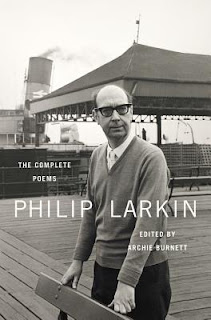
I love to work on several book manuscripts concurrently, moving back and forth between them in order maintain a fresh perspective and to avoid boredom. Right now, I’m writing what I call “meditative close readings” of poems by Philip Larkin. This project tries to make sense of how the writers whose words we love become an intimate part of our daily lives. So, I’ve been reading and rereading Larkin’s The Complete Poems, edited by Archie Burnett. This new edition brings together all sorts of poems and scribbles by Larkin that I’ve never read before, but it also offer useful critical commentary. I don’t intend my essays to function primarily as scholarly analyses of Larkin, but it’s important to study a scholar’s perspective of Larkin nonetheless.
Finally, I’ve been reading a book by my former poetry professor, Stanley Plumly. Posthumous Keats: A Personal Biography serves as one kind of model for what I hope to accomplish with Philip Larkin. Plumly’s study of the life of Keats is not only thoughtful and tremendously well-researched (Plumly spent twenty years working on this project) but it is also, as the title reminds us, a personal engagement with a fellow poet. So much of what poets do involves conversation, argument, debate, and communion with previous generations of poets. A poet doesn’t die, if we carry his words with us—in our pockets, in our mouths, in our memories.
Visit Jehanne Dubrow's website and blog.

Writers Read: Jehanne Dubrow (April 2010).

--Marshal Zeringue

Tuesday, November 6, 2012

Jon Wiener

Jon Wiener is a contributing editor to The Nation magazine and teaches 20th century US history at the University of California – Irvine. He sued the FBI for their files on John Lennon — the story is told in his book Gimme Some Truth: The John Lennon FBI Files and at the website www.LennonFBIfiles.com. The case went all the way to the Supreme Court before most of the outstanding issues were settled in 1997.

Wiener's latest book is How We Forgot the Cold War: A Historical Journey across America.

A few weeks ago I asked the author about what he was reading.  His reply.
I’m still thinking about how we remember the Cold War. The new book by Kristen Iversen, Full Body Burden: Growing Up in the Nuclear Shadow of Rocky Flats, is an unforgettable work that brings together the personal and the political in the story of a little-known disaster at a plutonium factory west of Denver.

One of the highlights of my history grad seminar is Emily Rosenberg’s book A Date Which Will Live. It shows how the memory of Pearl Harbor has changed over the decades: in the seventies, fear of Japanese economic power led to talk about “an economic Pearl Harbor,” and of course 9/11 was “the Pearl Harbor of the 21st century.” Most amazing, on the tenth anniversary of Pearl Harbor, Dec. 7, 1951, there were no public ceremonies of remembrance at all – because we needed Japan’s support in our war in Korea.

I’m also reading Erika Doss’s Memorial Mania: Public Feeling in America, which looks at just how feverish and intense our culture of commemoration has become. Kirk Savage’s Monument Wars uncovers the shift in Washington DC from heroic statues to spaces of experience, especially in Washington, D.C. It's also a gorgeously illustrated and produced book. And I’ve been re-reading Nixonland by Rick Perlstein–vivid, intense, thick description of politics in my youth.
Visit Jon Wiener's website.

--Marshal Zeringue

Sunday, November 4, 2012

Gretchen McNeil

Gretchen McNeil is a former coloratura soprano and was the voice of Mary on G4's Code Monkeys, and she currently sings with the L.A.-based circus troupe Cirque Berzerk. She is a founding member of vlog group the YARebels—where she can be seen as "Monday"—and is an active member of the Enchanted Inkpot, a group blog of YA and middle-grade fantasy writers. Her latest novel is Ten.

Last month I asked her what she was reading. Her reply:
Since it's Halloween, and I'm about to start writing a new horror pitch after the holidays, I'm rereading some of my favorite scary stories for "inspiration." Here are my two favorites...

The Turn of the Screw by Henry James. I love a good ghost story (even though James himself insisted this novella isn't actually about ghosts...whatever), and this turn of the century tale of a governess with possibly supernatural charges is one of the best. Kids can be creepy, and Miles and Flora take that to a whole new level. You've got possession, murder, lust, revenge - all tied up in two very disturbed children. This novella is drippingly gothic, and James spins the setting and tension so tightly, the reader is practically in a frenzy to find out what happens.

Hell House by Richard Matheson. Haunted house books are, by far, my favorite scary read. And Matheson, better known for another horror classic I am Legend, delivers the best, scariest, freakiest, creepiest, down right horrifying haunted house novel ever. Belasco House is the epitome of a haunted house, what all others should aspire to, as much of a character as the four fools who have to spend the night there. It's simultaneously scream-inducing and gory, page-turning and horrid. Like watching a train wreck - you literally cannot put this book down, even though you'll want to.
Visit Gretchen McNeil's website.

--Marshal Zeringue