Thursday, November 29, 2012

Felix Gilman

Felix Gilman is the author of the novels Thunderer, Gears of the City, and The Half Made World, which was one of Amazon's Top Ten SF/F novels for 2010, and was described by Ursula LeGuin as "gripping, imaginative [and] terrifically inventive ... we haven't had a science fiction novel like this for a long time." His most recent book, The Rise Of Ransom City, is out this month.

Recently I asked the author what he was reading.  Gilman's reply:
At the moment -- having just handed in a novel draft to my editor, and started laying down groundwork for a new project -- I'm mostly reading for research. This means a big pile of books on:

-- Manuscript illumination. Books about the lives of medieval scribes and illuminators - their work habits, their society, the economics of the profession. A couple of big glossy coffee-table books of illuminations, good for flipping through for inspiration. Books about technique and details (what kind of pens did they use? where does the ink come from? Etc). I'm reasonably certain that the book begins with an illuminator traveling on business, circa 1325, in England.

-- Medieval travel-writing. E.g. John Mandeville, who wrote a 14th century account of his (possibly apocryphal) travels to and from Jerusalem, in which useful advice about travel is mixed in with rumours of dragons and giants and et cetera; Benjamin of Tudela, a 12th century traveler from Spain, who wrote mostly about visiting Jewish communities between Spain and Africa; Ibn Battuta, who set off for Mecca in 1325 and wandered about for another thirty years; and whatever others I can get my hands on. So far Ibn Battuta is by far the most readable for modern tastes.

-- General historical works that have struck my fancy. I read Huizinga's Decline of the Middle Ages years and years ago at university; it's even better re-reading it than I remembered - a beautiful book. Very old now and probably outdated now but that's OK; I'm reading more for inspiration than for the sake of strict fidelity to facts. A lot of what I want is out of print and I don't have convenient library access at the moment, so I'm dependent on what happens to be available online at a reasonable price. That's OK too; I like the element of randomness/serendipity.

I'll let myself read fiction again when I have at least a few chapters + synopsis of the new thing under my belt.

Also, I have a 14-month old child so I spend quite a lot of time reading the kind of books where you point at a picture of a ball and say "Ball. Ball. Do you see the ball? It's a red ball. The ball is red. William? William? Do you see the red ball? It's a ball. No don't eat the book. No, don't."
Visit Felix Gilman's website and Twitter perch.

--Marshal Zeringue

Wednesday, November 28, 2012

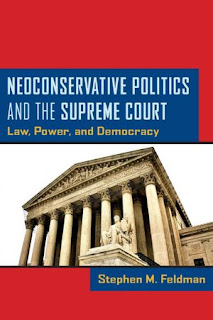
Stephen M. Feldman

Stephen M. Feldman is the Jerry W. Housel/Carl F. Arnold Distinguished Professor of Law and Adjunct Professor of Political Science at the University of Wyoming. Feldman’s new book is Neoconservative Politics and the Supreme Court: Law, Power, and Democracy. His previous books include Free Expression and Democracy in America: A History, and American Legal Thought From Premodernism to Postmodernism: An Intellectual Voyage. Free Expression and Democracy was featured in a joint National Archives and First Amendment Center book forum and chosen as Book of the Month by the American Booksellers Foundation for Free Expression. American Legal Thought has been translated into Japanese and Chinese and was supported by a National Endowment for the Humanities Fellowship.

Earlier this month I asked Feldman what he was reading.  His reply:
I just finished reading Ann Patchett’s The Magician’s Assistant. To say that I loved this book would be an understatement. The protagonist, Sabine, is a devoted resident of Los Angeles. Her gay husband has recently died, and through an evolving series of odd events, she ends up visiting his estranged family (mother, sisters, and nephews) in Alliance, Nebraska. I have never lived in L.A., and I don’t live in Nebraska. But I grew up in New York, lived in San Francisco, and currently reside in Laramie, Wyoming, only a few hours from Alliance. Patchett’s comedic contrast between life on the coast and in the heartland is brilliant. Her depiction of life (and winter) in the heartland is sensitive and subtle, particularly when compared with today’s New York Times (November 19, 2012) article describing Wyoming as if everybody in the state is a white, male, Protestant conservative (I can attest that this gross oversimplification is untrue). The Magician’s Assistant leaves one contemplating family relationships, both nuclear and extended, as well as the meaning of magic in the real world.
Learn more about Neoconservative Politics and the Supreme Court at the New York University Press website.

--Marshal Zeringue

Tuesday, November 27, 2012

Teresa Rhyne

Teresa Rhyne is a lawyer, writer, dog lover and breast cancer survivor (though definitely not in that order). She loves wine, books, coffee and dogs (still not in order) and loathes exercise, Christmas, and chocolate (probably in that order). She has lived in Southern California (it’s like its own state) for her entire life but only recently has she lived in any one house longer than five years. She shares said house with her boyfriend Chris and their irrepressible, diabolically cute beagle, Seamus (the Famous).

Rhyne's new memoir is The Dog Lived (and So Will I).

Recently I asked the author what she was reading. Her reply:
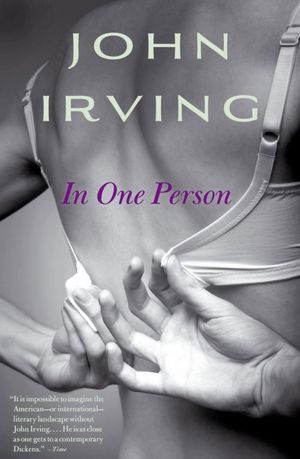
I recently finished A.M. Homes's May We Be Forgiven, which is an astoundingly good book. I was drawn into the characters and the drama immediately and am just in awe of her writing chops. I’d been reading a ton of non-fiction, because that’s what I’ve been writing, and this book brought me right back to my love of fiction. So next I picked up John Irving’s In One Person. John Irving is one of my favorite writers of all time and this recent book did not dampen my enthusiasm. I thought he handled a difficult subject (transgender and bi-sexuality) with great sensitivity. I was lucky enough to hear Mr. Irving’s talk at the American Library Association annual conference in Anaheim, CA this year and he read a bit from this book. It was enjoyable to read/hear the book in his voice as he envisions the characters, but his writing is so vivid and his characters so clearly drawn, the personal reading by the author isn’t necessary (just an added bonus). I tend toward the “dysfunctional family/ people” sorts of fiction because in the end, that’s all of us. It’s a universal experience. These two books were great reminders of that.

On the non-fiction front, I just finished Buddy: How a Rooster Made Me A Family Man by Brian McGrory. Memoirs about animals are my thing right now and after reading Sy Montgomery’s Birdology (which I read because I love her The Good, Good Pig), I was intrigued by a memoir about a rooster (though as these memoirs usually are, it’s really about so much more). I enjoyed the story and thankfully, did not rush out and get a rooster (nor did I get a pig after reading Sy’s book…but I wanted to).
Visit Teresa Rhyne's website and The Dog Lived (and so Will I) blog.

See--Coffee with a Canine: Teresa Rhyne & Seamus.

--Marshal Zeringue

Monday, November 26, 2012

Elana K. Arnold

Elana K. Arnold completed her M.A. in Creative Writing/Fiction at the University of California, Davis. She grew up in Southern California, where she was lucky enough to have her own horse--a gorgeous mare named Rainbow--and a family who let her read as many books as she wanted. She lives in Long Beach, California, with her husband, two children, and a menagerie of animals.

Arnold's debut YA novel is Sacred.

Recently I asked her what I was reading.  Her reply:
I’m pretty thrilled that I’ve been invited to teach a course called Adolescent Literature next quarter at UC Davis. I’ve been compiling a reading list, having a lot of fun revisiting some of my favorites. Two of the books I’m especially enjoying right now are The Golden Compass and Uses for Boys.

The Golden Compass—actually, Pullman’s entire His Dark Materials trilogy (which Pullman doesn’t consider to be a trilogy, but rather one long book) pretty much rocks my world every time. What I admire about Pullman’s philosophy is that he doesn’t hold up innocence as preferable to experience. His books don’t make a cult out of purity, and they put forth the notion that adulthood is a world full of mystery and magic, not just the depressing antithesis to idyllic childhood. As an adult, and as a parent to kids who will become adults, I find this notion reassuring and life affirming.

Uses for Boys by Erica Lorraine Scheidt actually isn’t even published yet, but I got ahold of an advanced reader’s copy last winter and ate it up in one sitting. It’s short, but not petite in any way—it’s a big story of pain and isolation and glimmers of hope without making any promises.

And (I’m a little embarrassed to admit) I’m rereading my own novel Sacred. It just came out this month, and it’s the first book I’ve ever published. It’s such a sensual pleasure to turn its pages.
Visit Elana K. Arnold's website.

--Marshal Zeringue

Saturday, November 24, 2012

Jessica Pierce

Jessica Pierce has taught and written about philosophy for many years. She is the author of a number of books, including Morality Play: Case Studies in Ethics and The Last Walk: Reflections on Our Pets at the End of Their Lives.

Earlier this month I asked Pierce what she was reading.  Her reply:
I was exposed to some of the most marvelous literary works long before I was actually capable of reading them for myself. Every night, from before I can remember to long past when I was too old, my father would read to me as I went to sleep. We read childhood classics like James and the Giant Peach, all the Little House on the Prairie books, and all the Wizard of Oz books. We worked our way into more advanced material: Anna Karenina, War and Peace, Oliver Twist. And we journeyed through The Iliad and The Odyssey. You might think that Homeric poetry would bore a child to tears, but you would be wrong (at least in my case): I was utterly enthralled by the wild adventures of Odysseus and his men.

Although there is something very powerful about hearing Homer’s epic poem, and about participating in some small way in the oral tradition, I set about reading the story (for the third or fourth time) a month or two ago. I had several motivations. First of all, my dog Ody (short for, and named in honor of, Odysseus) died recently, and I felt that reading the poem would be one way to honor his life. Like the human Odysseus, my Ody’s life was full of hardship and misadventure. The other motivation for revisiting The Odyssey is that I’ve been thinking a lot about myth and ritual, and The Odyssey is overflowing with myth that still resonates today. I was particularly attuned, this time through, to the role of animals in the story and about “appropriate” human relations to animals. The Cattle of the Sun story was particularly interesting in this regard.

I always have at least one “lighter” book going, and my latest pick was Tana French’s newest story, Broken Harbor. It is a psychological murder mystery, set in Ireland and featuring Murder squad’s rough-around-the-edges Mick “Scorcher” Kennedy (familiar from French’s earlier book Faithful Place), his rookie partner Richie, and (to complicate things) Scorcher’s mentally ill sister. French’s murder mysteries are complex and eerie, and I love becoming immersed in her descriptions of Ireland. Her heroes always have dark histories that are intertwined in surprising ways with the cases they are trying to solve.
Learn more about The Last Walk: Reflections on Our Pets at the Ends of Their Lives at Jessica Pierce's website and blog.

Read--Coffee with a Canine: Jessica Pierce and Maya.

--Marshal Zeringue

Thursday, November 22, 2012

J.T. Ellison

J.T. Ellison is the bestselling author of eight critically acclaimed novels and multiple short stories. She has been published in over twenty countries. Her novel The Cold Room won the ITW Thriller Award for Best Paperback Original of 2010, and Where All The Dead Lie was a RITA® Award nominee for Best Romantic Suspense in 2012.

Ellison's Dr. Samantha Owens Series includes A Deeper Darkness and the recently released Edge of Black.

Recently I asked her what she was reading. Ellison's reply:
One of the joys of being a writer is the fact that reading is part of the job description. Right now, on the recommendation of two writer buddies, Laura Benedict and Jeff Abbott, I am reading Quiet: The Power of Introverts in a World That Can't Stop Talking. It’s fascinating; a very frank look at how the world perceives introverts. As an introvert who is often mistaken for an extrovert, it’s heartening to see that what I’ve always worried was anti-social behavior is just my way of recharging the batteries. It also strikes me that without introverts nothing would be invented or created, and without extroverts, nothing would get done.

I’ve also just reread the 7th Harry Potter. It’s always nice to remind oneself that good triumphs over evil, and love is the answer.
Learn more about the book and author at J.T. Ellison's website and blog.

The Page 69 Test: A Deeper Darkness.

Writers Read: J.T. Ellison.

My Book, The Movie: A Deeper Darkness.

--Marshal Zeringue

Tuesday, November 20, 2012

Melissa Hardy

Melissa Hardy's first novel was A Cry of Bees, which was published in 1970 when she was just seventeen years old. Since then she has won the Journey Prize for an excerpt from her short story collection Constant Fire and the Canadian Authors Association Jubilee Award for The Uncharted Heart. Her writing has appeared in many literary journals and has been twice anthologized in Best American Short Stories and The Year's Best Fantasy and Horror. Her latest book, The Geomancer's Compass, marks her debut as an YA author. Born and raised in Chapel Hill, North Carolina, Melissa Hardy makes her home in Port Stanley, Ontario.

Earlier this month I asked her what she was reading.  Her reply:
I have a confession to make: these days I mostly listen to audiobooks. Because I have a long commute to work and a dog who needs running, this means I get a lot of reading in. 37 books so far this year, including David Foster Wallace’s mammoth opus Infinite Jest, which I had to read with a study guide (but mostly loved and, when I did not love, admired). I also like to listen to books while knitting and with a glass of wine – no hand to hold the book, you see? Besides, it’s always so nice to be read to. I’m Audible.com’s best customer and I highly recommend a membership.

I have just finished J.K. Rowling’s The Casual Vacancy, which I thoroughly enjoyed. It’s not going to win any great literary acclaim, but it was a well-drawn and well-observed comedy of manners and moved along at a good clip. Her ability to create a complete world – so wonderfully manifested in Hogwarts - served her well in her first adult novel and her characters were well drawn and as complex as they needed to be to move the story along. Her embrace of the grotesque survived the Harry Potter series; I particularly loved her description of Howard’s belly.

I’ve just started Helen Schulman’s This Beautiful Life (so far, good) and have queued up on my ipod The Girl Who Circumnavigated Fairyland in a Ship of Her Own Making, by Catherynne M. Valente, and Jonathan Strange & Mr. Norrell, by Susanna Clarke.
Visit Melissa Hardy's website.

--Marshal Zeringue

Monday, November 19, 2012

Karen Engelmann

Karen Engelmann is a writer and designer. She was born and raised in the American Midwest, then moved to Sweden after completing university studies in drawing and design. The city of Malmö was home base for eight years, but she now lives just north of New York City.

Her new novel is The Stockholm Octavo.

Recently I asked Engelmann about what she was reading.  Her reply:
I’m a sporadic reader, which means that I may go for days or even a week without a book, take forever to finish a complex work, or devour several in a rush. It’s been a dry spell (mostly due to no electricity in the aftermath of Superstrom Sandy) but I am now a quarter into a historical novel, Noon at Tiffany’s. This just came out, and author Echo Heron is a friend whose work I admire. It is the story of Clara Wolcott Driscoll, a gifted artist working in the shadow of Louis Tiffany at the end of the 19th century. Clara’s genius becomes Tiffany’s triumph and financial success — a secret hidden until 2007 with the discovery of a large cache of letters. I worked in design and illustration for many years, so I can relate to the life of the hired pen. And because equal pay for equal work is still an issue, Clara’s story has significance far beyond that of a fascinating narrative. I love seeing how Echo solves the many challenges of historical fiction: blending fact with imagination, transporting us completely to another time, and creating a world with significance to contemporary readers.
Visit Karen Engelmann's website.

--Marshal Zeringue

Saturday, November 17, 2012

Derek Haas

Derek Haas is the co-writer of the films The Double, Wanted, and 3:10 to Yuma, and author of The Assassin Trilogy: The Silver Bear, Columbus and Dark Men. His new novel is The Right Hand.

Recently I asked Haas what he was reading.  His reply:
Currently, I'm reading Reamde by Neal Stephenson. It's a globe-trotting, character jumping espionage thriller focusing on a young woman who gets caught up in a web of intrigue after she discovers her hacker boyfriend has been stealing credit cards and handing them over to a Russian crime syndicate. That is actually way too simple of an explanation… I'm thoroughly enjoying the book but you have to set aside a couple of months to read it because Stephenson leaves no detail underplayed. I am in awe of his ability to write such a complex plot.

Before that, I read Dave Eggers' latest, A Hologram for the King. I'm a huge fan of sad sack stories and this is one of the sad-sackiest. It's a modern day Death of a Salesman meets Waiting For Godot. Hats off to Eggers… he packs a lot of pathos and squirm-inducing empathy in every page.
Visit Derek Haas's website.

My Book, The Movie: Dark Men.

Writers Read: Derek Haas (December 2011).

The Page 69 Test: Dark Men.

--Marshal Zeringue

Thursday, November 15, 2012

M. Todd Bennett

M. Todd Bennett is assistant professor of history at East Carolina University.  His new book is One World, Big Screen: Hollywood, the Allies, and World War II.

Earlier this month I asked Bennett about what he was reading.  His reply:
My wife and I recently travelled to Japan for the first time, and we have been semi-obsessed with all things Japanese ever since. Dining at our neighborhood izakaya. Keeping an eye on the Nippon Professional Baseball league standings. (Go Ham Fighters!) And reading as much as we can about Japanese culture, history, and politics. As you may already have guessed, we are baseball fans – attending five, yes, five, NPB games in Tokyo, Hiroshima and suburban Osaka – and so our reading regimen included Robert Whiting’s You Gotta Have Wa, a journalistic account of the culture clash that has all too often occurred between the American athletes who play in the NPB and their Japanese hosts. Using baseball as a prism, Whiting writes that the game reveals a great deal about broader Japanese as well as American values, and he argues that those values have typically collided because whereas Japanese players, managers, and journalists emphasize collective well-being – wa, or team spirit – American expatriates value individual success. A good illustration of Whiting’s thesis occurred during our trip when Yomiuri Giants hurler Toshiya Sugiuchi, who was one strike away from pitching the first NPB perfect game since 1994, threw a borderline pitch that resulted in a walk because Sugiuchi felt, as he said afterward, that grooving one over the middle of the plate would have jeopardized his team’s chance of winning the close game. While the Japanese media praised Sugiuchi for sacrificing his own glory for the greater good of the team, for the Giants’ wa, such an act would be unthinkable in the United States. (Can you imagine the American media reaction had the San Francisco Giants’ Matt Cain, who two weeks later pitched just the twenty-third perfect game in Major League history, similarly risked his shot at baseball immortality?) My partner and I had an amazing, even life-changing, experience in Japan. We tried to be good guests, and our hosts could not have been more welcoming. But Whiting’s book, though its story of cross-cultural collision may be overdrawn (the work was first published in the 1980s, when Japanese-American relations were at a low point), serves as a useful reminder to those of us who study international cultural affairs. We assume that cross-cultural contact breeds better international understanding, and often that is the case; You Gotta Have Wa clearly demonstrates that the opposite can also be true, however. I reached a similar conclusion in my new book, One World, Big Screen: Hollywood, the Allies, and World War II, which shows that both attraction and repulsion occurred when the cinematic cultures of the war’s great Allied powers met on the world’s stage.
Learn more about One World, Big Screen at the the University of North Carolina Press website.

--Marshal Zeringue