Thursday, December 17, 2015

Paullina Simons

Paullina Simons is the international best-selling author of novels such as Tully, Red Leaves, Eleven Hours, The Bronze Horseman, and Tatiana and Alexander.

Her latest novel is Lone Star.

Recently I asked Simons about what she was reading. Her reply:
“There’s a panther stalks me down. One day I’ll have my death of him.” So writes poetess extraordinaire Sylvia Plath, the day after meeting England’s future poet laureate and her future husband Ted Hughes in February 1956. They fell in love and three months later married. Seven years later, in another frozen February, her premonition came true. She was thirty years old when she kneeled in front of the gaslit oven, while her two small children slept nearby, and put her head inside.

Lately I’ve been consumed by all things Plath/Hughes. Who was this man who drove his passionate heartbroken wife to suicide? And why did tragedy continue to follow him down the road of life? Many years later his only son also committed suicide. I re-read Ariel, the book of poems Plath wrote in the six months before her death. Ted Hughes was the love of her life, but he had fallen for another woman. He left Sylvia Plath, abandoned her and his children to travel joyfully abroad with his new lover, a childless yet married Assia Wevill (rhymes with devil not evil).

While they gamboled, Plath nursed her wounds and her babies and wrote Ariel, arguably one of the best poem collections of the twentieth century. And after she was done writing, she glanced around and Ted wasn’t back. She was still alone, and his new lover was pregnant. Plath may have known this. Or the winter of 1963 may have been too cold and too long for her, the burdens too heavy, the future too bleak. Who knows. Not even Ted Hughes knows. This, according to the books I read.

I read Sylvia Plath: Letters Home, followed by Her Husband by Diane Middlebrook, and Assia Wevill, Lover of Unreason, by Yehuda Koren and Eilat Negev. I read Sylvia Plath: The Unabridged Journals. Not stopping there, I read The Savage God, a study of suicide (mainly hers) by their mutual friend, the critic Al Alvarez.

But it was two books of poetry by Ted Hughes himself that brought me to my proverbial knees. One is Birthday Letters. The other is Crow. He started writing the former just after Plath died—as a series of letter-like poems addressed to her—and continued writing for twenty-five years. Having been mute on the subject of his dead wife, he didn’t publish Birthday Letters until 1998, months before his own death and thirty-five years after hers. Crow, a small volume of raw suffering was written right after Assia, the lover he left his wife for, killed herself in 1969, also by oven, along with their four-year-old daughter. A short while before she died, she wrote to a friend, “There can never be another man for me. Never.”

She might have been able to compete with a live woman but she could not compete with Plath’s ghost. Having read Birthday Letters and Crow, I conclude that Assia was right. Ted Hughes never recovered from the devastation of his wife’s death. “With all her babes in her arms, in ghostly weepings, she died,” he writes, and he has been haunted by her ever since. “What would he do, do, do without me?” Sylvia Plath asked in Ariel. As it turned out, to this last breath he was never without her.

“What can I tell you that you don’t know of the life after death?” he says in one wrenching poem in Birthday Letters. “[I was] dropped from life.” And “two babes who have turned, in their sleep, into orphans.”

To read these two books is to look almost too deeply inside the black heart of anguish. Hughes calls the word “grief” a euphemism.

“Who is stronger than hope?” he asks in Crow, in “Examination at the Womb-door.”
“Death.
“Stronger than love? Death.
“Stronger than life? Death.
“But who is stronger than death?”
And replies: “Me, evidently.”

Maybe, as Sylvia Plath wrote in her last poem, “The Edge,” “the moon has nothing to be sad about,” but the human hearts were permanently broken.
Visit Paullina Simons's website.

The Page 69 Test: Lone Star.

--Marshal Zeringue

Tuesday, December 15, 2015

Emily Ross

Emily Ross received a 2014 Massachusetts Cultural Council finalist award in fiction for her novel Half in Love with Death. Her fiction and nonfiction have been published in Boston Magazine, Menda City Review, and The Smoking Poet. She is an editor and contributor at Dead Darlings, a website dedicated to discussing the craft of novel writing. She attended Sarah Lawrence College and the University of Massachusetts Boston, and is a 2012 graduate of Grub Street’s Novel Incubator program.

Recently I asked Ross about what she was reading. Her reply:
I recently read the science fiction novel, The Man Who Fell to Earth, by Walter Tevis. I was a huge fan of the 1976 movie version. Directed by Nicolas Roeg, it featured David Bowie in his film debut, playing Thomas Jerome Newton, an alien who travels to Earth to save his dying planet. This movie has an unforgettable mythic quality, and I’ve always been curious to see if the book measured up – and it really did!

Newton is not your typical green-skinned, bug-eyed alien. Tall, slender, and frail, he easily disguises himself as a human, and only in the privacy of his own home does he remove the lenses concealing his golden, cat-like eyes.

On a desperate mission to find food and water for his war-ravaged planet, Newton comes to Earth with plans for technical inventions that ultimately turn him into a billionaire and the CEO of a giant corporation. But earthly success brings him no happiness. Lonely for the world he left behind, he meets Betty Jo, an alcoholic who introduces him to gin. An uneasy friendship develops into an unlikely love story as the well-meaning Betty Jo triggers Newton’s destructive descent into alcoholism and despair.

Any science fiction story runs the risk of becoming out-of-date, given the lightning speed of technological change. For example, Newton’s invention of self-developing, high-quality film might have seemed remarkable when the book was first published in 1963, but the rise of digital photography renders it mundane to us in 2015. This hardly matters, however, as the book raises the always timely questions about who we are and how technology changes us. Shy, feral Thomas Jerome Newton, who shares a last name with one of the most influential scientists of all time, is an alien who makes us think about what it means to be human.

Tevis is the author of other novels, including The Hustler and The Color of Money (both became great Paul Newman movies). Now that I have discovered this remarkable writer, I’m primed to read more of his work.
Visit the official Emily Ross website.

The Page 69 Test: Half In Love With Death.

--Marshal Zeringue

Monday, December 14, 2015

David Drake

David Drake (born 1945) sold his first story (a fantasy) at age 20. His undergraduate majors at the University of Iowa were history (with honors) and Latin (BA, 1967). He uses his training in both subjects extensively in his fiction. Drake entered Duke Law School in 1967 and graduated five years later (JD, 1972). The delay was caused by his being drafted into the US Army. He served in 1970 as an enlisted interrogator with the 11th Armored Cavalry Regiment, the Blackhorse, in Viet Nam and Cambodia. He has used his legal and particularly his military experiences extensively in his fiction also. Drake practiced law for eight years; drove a city bus for one year; and has been a full-time freelance writer since 1981, writing such novels as Out of the Waters and Monsters of the Earth.

Drake's new novel is Air and Darkness.

Recently I asked the author about what he was reading. Drake's reply:
I'm reading Our Hearts Were Young and Gay by Cornelia Otis Skinner and Emily Kimbrough, a 1942 memoir (in Skinner's first-person voice) of the European trip the two young ladies took twenty years earlier when they were just out of Bryn Mawr. The decision to read it was a sentimental one for me.

One of my classics teachers at Iowa had done the same thing with a friend at what must have been the same time. I recall with pleasure her stories of being guided through the ruins of Knossos by Sir Arthur Evans, who had discovered the site. For an undergraduate who had never traveled, it was as different a time as Samuel Johnson's London would have been.

In addition to those memories from my youth, my friend Manly Wade Wellman was a great fan of the collections of myths and legends by Charles M Skinner. Skinner was a journalist, not a folklore professor, so his focus was on the story itself. That was also Manly's interest as a working writer.

Manly read one of his later mountain-set stories to me and Karl Wagner before he sent if off--The Dakwa. He'd taken it directly from Skinner.

When I recently opened my copy of Myths and Legends of Our New Possessions (1899), I saw that it was "affectionately dedicated to Cornelia Otis Skinner, our new possession." She was Charles Skinner's granddaughter.

I picked up Cornelia's memoir which I recalled being offered in a scholastic book club when I was 14 and in 9th grade. I'm laughing a great deal, but it's also a way back into a variety of warm memories.
Visit David Drake's website.

--Marshal Zeringue

Saturday, December 12, 2015

Triss Stein

Triss Stein is a small-town girl who has spent most of her adult life living and working in New York City. This gives her the useful double vision of a stranger and a resident which she uses to write mysteries about Brooklyn, her ever-fascinating, ever-changing, ever-challenging adopted home. Brooklyn Graves is the second Erica Donato mystery, following Brooklyn Bones.

Stein's latest novel is Brooklyn Secrets, the third Erica Donato Mystery.

Recently I asked the author about what she was reading. Her reply:
Most writers are readers, and if they are not, what the heck are they doing in this game? And most mystery writers like me are also mystery fans. I think we read a little differently than other fans, though.

There are certainly some mystery authors whose work I have read and loved for years. Even at their weakest moments their books are interesting,
perceptive, clever, funny, surprising. I will always enjoy reading something by them. Those are the people I read like a fan.

The mystery world has expanded so much in the last decades, one could read only mysteries and never run out of new experiences. Reading just the books on my nightstand right now, or recently, I could go back in time and find entertaining fluff about a cash-poor debutante in 1930’s London, or a sobering story about crimes set against the military in World War 11, or a rollicking story about a kind of law enforcement in Elizabethan London. Or I could read about political turmoil that is modern Greece in a book that could have been written yesterday. I could read The Fever. (Because. Megan Abbott. And it’s about time!)

However, after my fan reading, a lot of my mystery reading is because I want to see how an author handles a setting or topic, to see if they have something to show me or teach me, to see what the excitement is about. (That is how I came to read Gone, Girl, which, by the way, I thought was brilliantly plotted.) Sometimes I learn what I need by the first half or less, and if I am not captivated, I stop reading. That is reading like a writer.

There are mystery lovers who sneer at “literary” fiction. I am not one of them. A book of beautiful language and perception, where nothing much happens, can be a way to grow. I recently read Alice McDermott’s Someone, a brief novel which yet seemed to encompass a whole life. I’m still trying to figure out how she did that miracle. A book that takes apart the narrative and splinters it into a funhouse mirror can be a rewarding challenge. I have loved Kate Atkinson’s work since before she wrote mysteries but I did think that Life After Life might be too much experimenting for me. Instead, I could barely keep breathing as I read it.

And I like to do some oddball non-fiction reading. My love of reading about history’s obscure corners is subsumed these days by research for my own books, but I find travel writing and books
about food and cooking to be oddly fascinating…and they won’t keep me up if I read them at bedtime.

But right now, I am deep in When Books Went to War by Molly Gupthill Manning, the story of the Armed Services Editions books that helped the American troops of World War 11 stay sane before, after, and in-between combat. Sounds boring?

How could any book be boring when it tells me that FDR said, “In this war, books are weapons?” That two of the most popular books in the program, ever, were A Tree Grows in Brooklyn and Forever, Amber? That men read until the “pages of each book were so dirty you can’t see the print?” That they wrote “thanks for everything from Zane Grey to Plato?”

A perfect book for any book reader, book writer, book lover.
Visit Triss Stein's website.

The Page 69 Test: Brooklyn Secrets.

My Book, The Movie: Brooklyn Secrets.

--Marshal Zeringue

Thursday, December 10, 2015

Jack McDevitt

Jack McDevitt is a former English teacher, naval officer, Philadelphia taxi driver, customs officer, and motivational trainer.

His new novel is Thunderbird.

Recently I asked the author about what he was reading. His reply:
I’m scheduled to do a presentation on Mark Twain for the St Simons Island Literary Guild in a few weeks, so I’ve been reading every Mark Twain book I can find, other than novels, most of which I’ve already read. Just finished The Library of America edition of his Collected Tales, Sketches, Speeches,& Essays, 1852-1890. I’ve been discovering that, while he deserves his reputation as America’s Great Humorist, he also has a dark side. It’s evident that he believes life is too painful to be worthwhile, not only for humans, but for everything else on the planet. I’m also reading The World As It Is, by Chris Hedges, which examines the issues currently plaguing the effort to create a stable civilization across the globe. I suspect Hedges, though he limits his analysis to culture, politics, and war, would be much in agreement.
Learn more about the book and author at Jack McDevitt's website.

The Page 69 Test: Firebird.

The Page 69 Test: Thunderbird.

--Marshal Zeringue

Tuesday, December 8, 2015

Andrew Pettegree

Andrew Pettegree is a professor of modern history at the University of St. Andrews, where he was the founding director of the St. Andrews Reformation Studies Institute. He currently serves as the vice president of the Royal Historical Society. His books include The Invention of News, The Book in the Renaissance, which was a New York Times Notable Book of 2010, and Emden and the Dutch Revolt.

Pettegree's latest book is Brand Luther: How an Unheralded Monk Turned His Small Town into a Center of Publishing, Made Himself the Most Famous Man in Europe--and Started the Protestant Reformation.

Recently I asked the author about what he was reading. His reply:
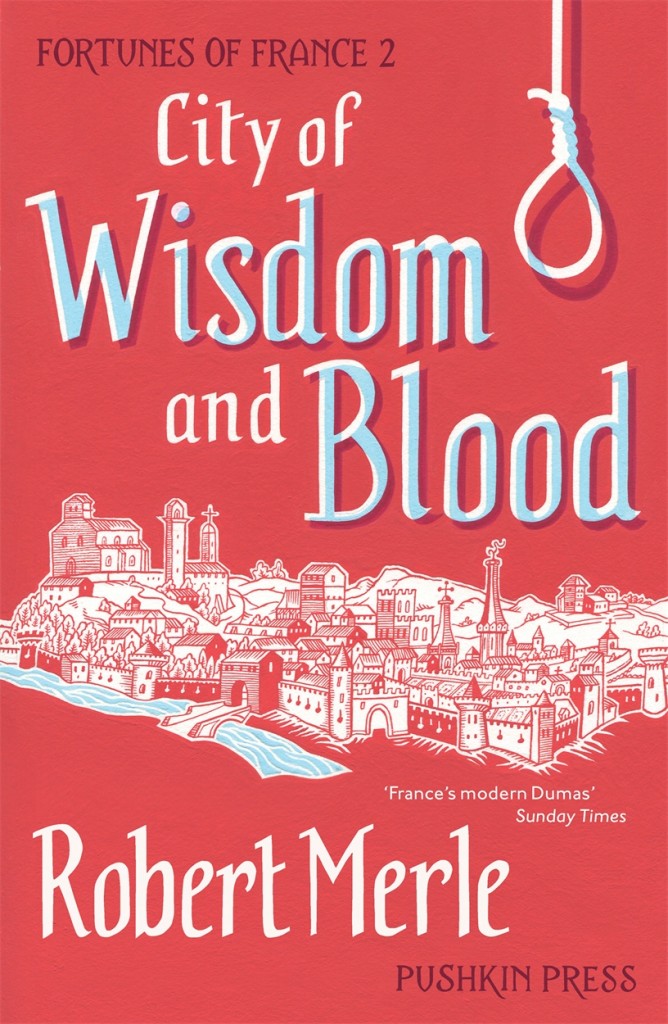
City of Wisdom and Blood by Robert Merle

Even though so many of the world’s people now speak English, it is a happy fact that Anglophone readers have access to an even increasing range of non-English literature. The astonishing success of Hans Fallada’s Alone in Berlin, or the Suite Française of Irène Némirovsky's, has emboldened publishers to seek out other unknown gems: and never more productively than with the decision of the Pushkin Press to take on Robert Merle’s extraordinary sage of the French Wars of Religion, Fortune de France. This project originated as a labour of love of its translator, Jefferson Kline, Professor of French at Boston University. Kline recognised the extraordinary beauty of Merle’s creation, a chronicle of French society in war and peace, seen through the eyes of its swashbuckling young hero, Pierre de Siorac. The son of a minor noble in the south of France, Pierre follows his father into the faith of the French Protestant minority, the Huguenots. He also shares his father’s roving eye; Merle being French, there is plenty of sex, but described with a suggestive delicacy evocative of its sixteenth-century narrator. The first volume, The Brethren, is now followed by City of Wisdom and Blood, which follows Pierre in his medical studies at Montpellier, where he cannot escape the consequences of his impetuous compulsion to stand up to bullies and of his varied amorous conquests. The third of the series, Heretic Dawn, is set in 1572, among the turbulent events of the St Bartholomew’s Day Massacre. This is promised for April 2016, and I for one can’t wait; and there are ten more to come.
Learn more about Brand Luther at the publisher's website.

The Page 99 Test: The Book in the Renaissance.

The Page 99 Test: The Invention of News.

The Page 99 Test: Brand Luther.

--Marshal Zeringue

Monday, December 7, 2015

Stephanie Thornton

Stephanie Thornton is a writer and high school history teacher who has been obsessed with infamous women from ancient history since she was twelve. Her first two novels, The Secret History: A Novel of Empress Theodora and Daughter of the Gods: A Novel of Ancient Egypt, focus on two of history's forgotten women: Theodora of the Byzantine Empire and Pharaoh Hatshepsut. Her third novel, The Tiger Queens: The Women of Genghis Khan, is the story of Genghis' wife and daughters.

Thornton's new novel is The Conqueror's Wife.

Recently I asked the author about what she was reading. Her reply:
I'm currently reading a whole slew of books for research on my next book, but for fun I'm reading three very different books. There's always a historical fiction book on my list so right now I'm thoroughly enjoying Z: A Novel of Zelda Fitzgerald by Therese Anne Fowler which provides a closer look between the notoriously wild couple that was F. Scott Fitzgerald and his wife.

At night I'm reading Into the Wild by Erin Hunter to my daughter, the first in the Warriors series about feral cats. (Side note: My daughter adores these books and has almost the entire series. Highly recommended for third graders!)

I'm also re-reading 1984 by George Orwell for the high school Government class I teach and am attempting to understand A Brief History of Time by Stephen Hawking.
Visit Stephanie Thornton's website.

The Page 69 Test: The Conqueror's Wife.

--Marshal Zeringue

Saturday, December 5, 2015

Jean Flowers

Camille Minichino received her Ph.D. in physics from Fordham University, New York City. She has published over twenty novels and many short stories and nonfiction articles. Her new novel, writing as Jean Flowers, is Death Takes Priority.

Recently I asked the author about what she was reading. Her reply:
I always have several books going at the same time, some paper copies, some on my e-reader.

Here's my current stack and the excuses to read them:

Dead Wake: The Last Crossing of the Lusitania, by Erik Larson, for a nonfiction book group that has been meeting monthly in my home for more than 20 years. Like all his narratives, Larson's detailed presentation of the WWI disaster reads like the best fiction. Here the characters are a luxury ocean liner and a German U-boat. I'm always amazed when a writer can accomplish suspense, even when we all know the outcome.

Life on the Edge: The Coming of Age of Quantum Biology, by Johnjoe McFadden and Jim Al-Kalili. Heavy! This one will take a while to finish. Biology is so much more complex than physics (five simple equations and you're done).

Guilt by Degrees, by attorney Marcia Clark, for the next meeting of the Castro Valley Library Mystery Book Club, another longstanding group. The story, or "case", is interesting, the author's many years reading police reports obvious.

The Water's Edge, by Karin Fossum, my new favorite thriller writer. For me, the darker the better when it comes to reading crime fiction.

Assorted magazines: The New Yorker (of course; makes feel like one); Science & Technology Review (to stay connected); Writers Digest and Publishers Weekly (to feel like a writer); Real Simple (makes me feel organized); the Metropolitan Museum of Art Bulletin (to enter a different world); and miniatures magazines (makes me feel crafty).

And, finally, just for fun:

Grand Central: How a Train Station Transformed America, by Sam Roberts. Probably my favorite place on earth, and probably because I grew up with the radio show long before I ever saw the terminal. What can be more exciting to listen to while ironing than the crossroads of a million private lives?
Visit Jean Flowers/Camille Minichino's website.

--Marshal Zeringue

Thursday, December 3, 2015

Joseph Wallace

Joseph Wallace is the author of three novels: Diamond Ruby, set in 1920s New York City; the global apocalyptic thriller Invasive Species; and its follow-up, the newly released Slavemakers.

Recently I asked the author about what he was reading. Wallace's reply:
Given that my new novel is set in some (indeterminate) post-apocalyptic future, it might seem strange that my recent reading choices have looked backward—specifically to historical fiction.

I just finished reading Gringos, a not-very-well-known 1991 novel by the American writer Charles Portis, most famous for his novel True Grit. (And that fame comes more from the two hit movie versions than from the book itself.) True Grit, bleak, violent, and told in tough vernacular prose by a teenage girl named Mattie Ross, is a strange masterpiece, but I think I might like Gringos—a kind of shaggy-dog novel—even better.

Gringos throws together a multinational bunch of colorful characters—pot hunters, archaeologists, smugglers, cult members—in the Wild West-style cities and jungles of southern Mexico. Then it sits back to see what happens next. American expat Jimmy Burns is the narrator, and his laconic voice as he observes the insanity around him makes him great company. The book is smart and funny and insightful about the way people live together…or don’t quite manage to.

I also read 1975’s The Great Train Robbery, one of Michael Crichton’s earliest novels. (This book will be a surprise to anyone expecting something highly technological and speculative, along the lines of Crichton’s Jurassic Park or The Andromeda Strain.)

The Great Train Robbery is a highly fictionalized retelling of a true-life gold robbery in 1855 England that was notorious worldwide at the time. It is witty, lively, and filled with the kind of “information bonus” that can bring historical novels to life: in this case, fascinating details about the world back in the 19th century.

What struck me the most, though, was the way that Crichton puts these details into context. For example, in describing the preparations for the robbery, he points out that the plotters were attempting to rob a vehicle that could move twice as fast as any human had ever moved before.

Think about that: When the plan involved one of the robbers walking along the top of the train, no one realized that 1) the rush of air would be so strong that it would likely blow him off and 2) that he would likely die from striking the ground at that speed. Today that seems so obvious that it’s as if we’ve always known it…but the truth is that it’s hard to imagine something before you’ve experienced it. Before you know what the rules are.
*
As I wrote this post, I realized that there is a connection between my recent reading choices and Slavemakers. In my novel, I try to create a world completely unlike the one I’m living in today, which certainly defines Portis’s corner of Mexico. And I also focus on human responses to situations that are completely new to them…when survival depends on the ability to figure things out on the fly, just as the robbers in The Great Train Robbery do.

But mostly I read books like these simply just because it’s fun to be transported to different times and places. That’s works, too.
Visit Joseph Wallace's website.

The Page 69 Test: Slavemakers.

--Marshal Zeringue

Tuesday, December 1, 2015

David Silverman

David Silverman is the president of American Atheists and one of the best-known atheists in America. Known as “America's loudest heathen,” a term he embraces proudly, Silverman is passionate about atheism and atheist equality.

His new book is Fighting God: An Atheist Manifesto for a Religious World.

Recently I asked the author about what he was reading. Silverman's reply:
I’m currently just finishing Islam and the Future of Tolerance by Maajid Zawaz and Sam Harris. I had hoped to gain some insight on the Paris murders and how to stop Islamic terrorism from a Muslim point of view.

I was not disappointed, but neither was I thrilled. I was hoping for answers that hit hard, but what I got was the need to push pluralism, the fact that people can see different interpretations in the same book. That’s a start, but it doesn’t go all the way.

The ISIS terrorists are not bloodthirsty evil people out to kill babies. They think they are doing good. They think they are bringing peace and love. They are killing people, but they don’t believe in death – they believe their victims go to Heaven when God allows the worthy ones into heaven. The terrorists are, in a very real way, doing their victims a favor by getting them to heaven early. Where’s the harm in that?

The problem is not the lack of pluralism per se. It’s the concept of objective morality. The concept that they are right, because their preachers say so, and there is no doubt or flex in that. They are definitely doing good. This is how planes get flown into buildings, abortionists get shot, and kids in Norway get slaughtered. Doubt will create hesitation. Yes, the pluralism of which Harris and Nawaz speak is one means to that end, but perhaps a larger goal would be to stop teaching that objective morality is real. That every religion, and every belief, is just a matter of opinion. It’s all up to interpretation.
Learn more about Fighting God at the publisher's website, and follow David Silverman on Facebook and Twitter.

--Marshal Zeringue